


 Manufacturing
 Logistics
 Real Estate
 Retail
 Finance
 Healthcare
 Hospitality
 Automotive


Configuration errors in solution development often arise from manual handoffs, inconsistent environments, and fragmented version control. These misconfigurations lead to delayed releases, compliance risks, and expensive rework.
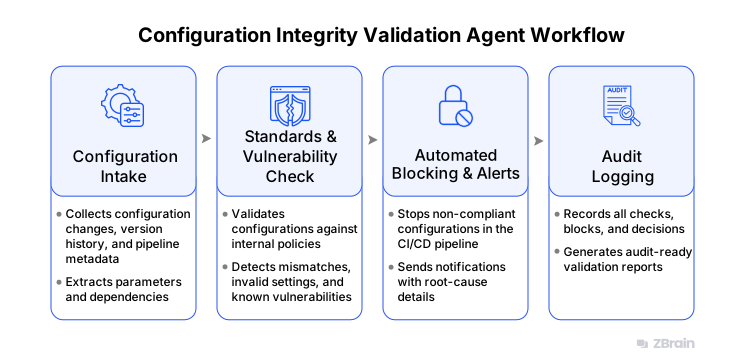
The Configuration Integrity Validation Agent proactively enforces configuration accuracy and compliance throughout the CI/CD lifecycle. It aggregates real-time inputs from configuration change logs, version histories, and build pipelines, as well as unstructured data from repositories and integration scripts. Using AI-driven correlation and pattern analysis, the agent identifies invalid parameters, dependency mismatches, and security vulnerabilities by cross-referencing configuration items against internal standards and known vulnerability databases.
When non-compliant or risky configurations are detected, the agent instantly blocks them from progressing through the CI/CD workflow and notifies stakeholders with root cause insights. Every validation and block event is logged and made available through automated reports, ensuring continuous auditability and compliance visibility.
By embedding intelligent, preventive validation directly into solution delivery, enterprises can eliminate manual QA bottlenecks, enhance release quality, and maintain high configuration integrity across environments.

Accuracy
TBD

Speed
TBD
Sample of data set required for Configuration Integrity Validation Agent:
Configuration file for the QuantumLead Module
Commit by: sarah.dev@innovatecorp.com
Commit ID: b7c4d8a
module_details:
name: QuantumLead
version: "1.2.0"
maintainer: "Sales Engineering Team"
database_settings:
Connection settings for the primary application database
host: "db.innovatecorp.internal"
port: 5432
username: "admin"
password: "[SECRET_VAULT_KEY:DB_PROD_PASSWORD]"
api_integrations:
Configuration for the DataStream Inc. third-party integration
feature_flags: enable_beta_analytics: true use_legacy_reporting: false
dependencies:
lib-authentication: "v4.5.1" lib-logging: "v2.1.0" lib-parser: "v3.0.2"
Sample output delivered by the Configuration Integrity Validation Agent:
Configuration Assurance Scan Report
Summary
| Status | Commit ID | File Scanned | Timestamp |
|---|---|---|---|
| BLOCKED | b7c4d8a | quantumlead-config.yml |
2023-10-27 14:32:11 UTC |
Reason for Block: The CI/CD pipeline was halted due to the detection of 1 CRITICAL and 1 HIGH severity risks in the provided configuration file. The changes must be remediated before the build can proceed.
The following issues were identified during the automated scan:
| ID | Severity | Parameter | Detected Value | Finding | Recommendation |
|---|---|---|---|---|---|
| VULN-001 | CRITICAL |
dependencies.lib-logging |
v2.1.0 |
Dependency version is associated with known vulnerability CVE-2023-45678 (Remote Code Execution). | Upgrade to version v2.3.1 or higher to remediate. |
| SEC-004 | HIGH |
database_settings.username |
admin |
Use of a default administrative username ('admin') violates internal security policy SEC-POL-004. | Use a dedicated, non-privileged service account for database connections. |
| CONF-012 | MEDIUM |
api_integrations.timeout |
500 |
API timeout of 500ms is below the recommended minimum of 3000ms, posing a risk of frequent connection errors under load. | Increase timeout value to at least 3000ms or consult performance baseline documentation. |
Action Required: This commit has been blocked from proceeding to the build and deploy stages. Please resolve the CRITICAL and HIGH severity issues identified above and push a new commit.

Provides instant, contextual guidance to help debug code, resolve errors, and improve your programming workflow.

Automates security questionnaire answers using LLMs and a structured knowledge base for faster, consistent, and reliable responses.

Generates initial implementation and testing plans for change requests by analyzing request details and referencing past changes.

Automatically collects and consolidates contextual information from logs or monitoring tools to enrich incident or request tickets, accelerating root cause analysis and resolution.

The License Audit and Optimization Agent scans software usage data to identify underused licenses and recommends cost-saving actions like downgrades or removals, optimizing license allocation and reducing costs.

Automates the monitoring of Service Level Agreements (SLAs), ensuring that IT services meet agreed-upon performance metrics and alerting teams when SLAs are breached.

Book a Demo
with Our AI Experts!