Manufacturing
 Logistics
 Real Estate
 Retail
 Finance
 Healthcare
 Hospitality
 Automotive
Solution architecture best practices: A guide for enterprise teams
A common root cause of major technology failures is the gap between what an organization intended to build and what it actually built. That gap widens when architecture is treated as a formality rather than a discipline, when teams move from business requirement to implementation without a coherent, validated blueprint to guide them.
The pressure to move fast has never been greater. Cloud platforms, microservices, event-driven systems, and AI-native architectures have expanded what is technically possible. But possibility without structure is exposure. Without proper governance and design discipline, complexity compounds quietly until it becomes the very obstacle that transformation was meant to remove.
Solution architecture is the discipline that closes this gap. It is the practice of translating an organization’s strategic goals into coherent, implementable technology blueprints that account not only for systems and data but also for the people, processes, security requirements, and long-term evolution that determine whether a solution creates lasting value or lasting problems. Done well, solution architecture prevents costly rework, accelerates delivery, and ensures that every system introduced into the enterprise ecosystem earns its place.
This article presents a unified set of solution architecture best practices, organized around six interconnected themes: foundational principles, the design process, technical quality attributes, governance, communication, and organizational culture. It also examines how AI-assisted technical architecture design platforms, such as TechBrain, are changing the operationalization of these practices in enterprise delivery. Whether you are designing a greenfield system, modernizing a legacy platform, or governing a complex integration programme, the principles that follow provide a durable framework for every consequential architectural decision.
Table of content
- Foundational principles of effective solution architecture
- The solution architecture design process
- Technical quality attributes
- Common architecture patterns and their applications
- Governance, reviews, and continuous improvement
- Communication: The underrated dimension of architecture
- Balancing innovation and stability
- Common pitfalls and how to avoid them
- Building an architecture-positive culture
- TechBrain: AI-assisted enterprise architecture design in practice
Foundational principles of effective solution architecture
Anchor every decision in the business purpose
The most prevalent failure mode in solution architecture is the premature leap to technology selection, committing to a platform, pattern, or tool before the underlying problem has been rigorously defined. A solution without a clearly articulated business driver is not a solution; it is a technical exercise. Before any design work begins, the architect must be able to state, in plain terms, the strategic objective, user pain point, or operational gap that the proposed solution is intended to address.
This demands structured engagement with business stakeholders through requirements workshops, capability assessments, and value mapping exercises. Tools such as business capability models, use case diagrams, and requirements traceability matrices provide the scaffolding for a documented, auditable link between business intent and technical response. Prioritizing requirements by business impact and delivery feasibility, rather than by technical novelty or architectural preference, is the discipline that ensures the architecture remains in service of the organization rather than an end in itself.
Design with the end user at the centre
Every system, regardless of its sophistication, ultimately exists to serve people. The users of enterprise systems are not abstract roles on a stakeholder register; they are individuals with defined responsibilities, established workflows, and legitimate expectations of the tools that support their work. An architecture that imposes friction, through poor performance, inconsistent behaviour, or brittle integrations, has failed its primary purpose, irrespective of its technical integrity.
User experience must be elevated from a post-design consideration to a first-order architectural concern. This means engaging end users during requirements refinement, validating proposed designs through working prototypes, and applying the same analytical rigour to usability shortfalls as to security vulnerabilities or reliability gaps. Architecture that genuinely serves its users is architecture that creates lasting organizational value.
Treat simplicity as a strategic discipline
Complexity in architectural design is inherently captivating. A design that incorporates microservices, event sourcing, CQRS (Command Query Responsibility Segregation), and multi-cloud federation can appear thorough and forward-thinking, yet complexity carries a compounding operational cost that accumulates across the entire delivery and maintenance lifecycle. It increases cognitive load, multiplies the integration surface area, introduces additional failure modes, and progressively makes the system harder to evolve.
The principle of just enough architecture deliberately counters over-engineering. It holds that a solution should model and implement precisely what is required to meet current and near- term business needs, no more. The architect’s discipline is to guard against unnecessary abstraction and ask, at every design juncture: Is this the simplest approach that meets the requirement? Simplicity is not a constraint on ambition; it is a mark of architectural maturity. The most resilient enterprise systems are, invariably, those that accomplish their objectives through the fewest necessary components.
Establish requirements before selecting technology
Sound architecture practice dictates that technology selection follows requirements definition, never precedes it. Committing to a specific database engine, cloud platform, or messaging infrastructure before the full scope of functional, non-functional, and compliance requirements is understood produces solutions that are shaped by the tool rather than by the problem. This inversion of priorities consistently leads to re-platforming costs, architectural exceptions, and delivery overruns as misalignments surface during implementation.
A technically credible architect approaches technology evaluation with deliberate neutrality. Shortlisted technology platforms under consideration and patterns should be assessed against documented requirements, performance thresholds, compliance obligations, team capability, total cost of ownership, and strategic vendor alignment, rather than prevailing market trends. What constitutes best practice in one organizational context may be entirely unsuitable in another; the architect’s judgment lies in understanding the distinction.
Build for evolution, not for the ideal state
No architecture, however carefully designed, is immune to the forces of change. Business strategies evolve, user expectations shift, regulatory frameworks are revised, and the technology landscape transforms continuously. An architecture that requires fundamental reconstruction to accommodate such changes is not a robust architecture; it is a brittle one, with a predictable and costly obsolescence cycle. Designing for evolution requires deliberate structural choices. Use modular decomposition to isolate change, define explicit and versioned interface contracts between components, and manage technical debt as a liability rather than an unavoidable artifact.
The solution architecture design process
Define the vision before drafting the blueprint
The architecture process begins not with diagrams but with vision, a clear statement of what the solution must achieve, for whom, and within what constraints. Microsoft’s Dynamics 365 implementation guidance frames this as the ‘vision’ pillar of solution architecture: the big picture that aligns the proposed solution with the organization’s strategic goals. A well-defined vision naturally cascades into identifying affected business processes, the people and stakeholder groups involved, the data domains the solution will touch, and the technology strategy required to realize it. Skipping this step and proceeding directly to system design is one of the primary causes of projects that deliver technically functional systems but fail to create business value.
Gather and refine requirements systematically
Requirements fall into two categories: functional requirements (what the system must do) and non-functional requirements, or NFRs (how well it must do it). Both are architectural inputs. A solution that meets its functional specification but fails on performance, security, availability, or compliance is not a successful solution. Non-functional requirements deserve particular attention in architecture work because they constrain every subsequent design decision. The following table maps common NFR categories to the architectural concerns they drive:
|
NFR category |
Architectural concern |
Example techniques |
|---|---|---|
|
Scalability |
Handling growth in load, data, and users |
Horizontal scaling, sharding, and caching |
|
Security |
Protecting data, access, and integrity |
Zero-trust, encryption, IAM, SAST/DAST |
|
Availability |
Maintaining service continuity |
Redundancy, failover, disaster recovery |
|
Performance |
Responsive and efficient operation |
Async processing, indexing, CDN |
|
Maintainability |
Ease of change and ongoing operations |
Modularity, documentation, observability |
|
Compliance |
Adherence to regulations and standards |
Audit logging, data governance, GDPR/HIPAA |
|
Portability |
Deployment flexibility |
Containerization, Infrastructure as Code (IaC), and abstraction layers |
Requirements should be prioritized by business impact and feasibility. Not every requirement needs to be addressed in the initial release, a phased delivery approach, informed by architectural runway is often more effective than attempting to satisfy all requirements simultaneously.
Select the right architecture pattern
Different problem contexts call for different architectural styles. The architect’s responsibility is to evaluate the trade-offs of each approach relative to the project’s specific constraints, rather than defaulting to whichever pattern is currently trending.
- Monolithic architecture: Appropriate for small-scale applications with simple domains and stable requirements, offering lower operational complexity.
- Layered architecture: Separates concerns (presentation, business logic, data access) into distinct tiers, improving structure and testability.
- Microservices: Suited to large, distributed systems with complex domains and teams operating independently; adds operational overhead that must be justified.
- Event-driven architecture: Supports real-time, loosely coupled integration between systems, particularly in high-volume or asynchronous workflows.
- Serverless / FaaS: Valuable for event-driven or bursty workloads where operational simplicity and cost efficiency outweigh the need for fine-grained control.
- Service-Oriented Architecture (SOA): A strong fit for integrating heterogeneous enterprise systems through standardized, reusable services.
A widely cited failure mode is adopting microservices prematurely. Teams of fewer than ten developers building systems with well-understood, cohesive domains are typically better served by a well-structured monolith than by a distributed system whose operational complexity exceeds the team’s capacity to manage it.
Validate with prototypes and threat models
Architecture assumptions, particularly around performance, integration feasibility, and security boundaries, should be validated before committing to full-scale implementation. Proof-of- concept (PoC) exercises allow architects to test critical hypotheses under realistic conditions, reducing late-stage rework. Threat modelling, using frameworks such as STRIDE (Spoofing, Tampering, Repudiation, Information Disclosure, Denial of Service, Elevation of Privilege) should be conducted early to surface security vulnerabilities at the design level, where they are inexpensive to remediate. Security concerns discovered during implementation or after deployment are exponentially more costly to address.
Produce a structured solution architecture document
The architecture design process culminates in a set of documented artifacts that communicate the solution to development, operations, and business teams. A well-structured Solution Architecture Document (SAD) typically includes:
- Project scope and business context
- Functional and non-functional requirements
- High-level architecture diagrams (context, component, deployment)
- Data flow and integration diagrams
- Design decisions log with rationale and trade-offs
- Security and compliance considerations
- Assumptions, risks, and constraints
- API specifications and interface contracts
The SAD is not a one-time deliverable. It must be maintained as a living document, updated to reflect the evolving state of the architecture as the system is built, deployed, and enhanced.
Streamline your operational workflows with ZBrain AI agents designed to address enterprise challenges.
Technical quality attributes
Security by design
Security must be woven into every layer of the architecture from the outset, rather than applied as a surface-level afterthought post-implementation. Retrofitting security controls into an existing system is far more expensive than integrating security at the design stage. It often requires re-architecting data flows, adding authentication layers to APIs that were not designed for them, or encrypting data stores that were originally built as plaintext. A security-first architecture is guided by several core practices:
- Zero-trust principles – no implicit trust based on network location; every request is authenticated and authorised explicitly.
- Identity and access management – using standards such as OAuth 2.0, OpenID Connect, or SAML, with the principle of least privilege enforced consistently.
- Encryption in transit and at rest – all sensitive data protected regardless of where it is stored or how it flows.
- Input validation and rate limiting – defending against injection attacks and abuse at every API boundary.
- Security testing in CI/CD pipelines – automated static (SAST) and dynamic (DAST) analysis integrated into the deployment process.
Scalability and resilience
A system that works under normal load but degrades or fails under pressure is not production- ready. Scalability, the ability to accommodate growth in users, data volume, and transaction frequency, must be planned from the beginning, not retrofitted when problems emerge. Key scalability techniques include horizontal scaling (adding more instances rather than larger ones), data partitioning and sharding, caching at appropriate layers (server-side, CDN, application), and load balancing. Modularity and loose coupling are structural prerequisites for scalability: components that are tightly coupled cannot be scaled independently.
Resilience, the ability to maintain functionality despite partial failures, requires explicit architectural investment. Patterns such as circuit breakers (preventing cascade failures), bulkheads (isolating resource pools), and graceful degradation (maintaining core functionality when non-critical services are unavailable) should be standard elements of any system operating at enterprise scale.
Observability
A system that cannot be observed cannot be reliably operated. Observability encompasses three pillars: logging (a structured record of events), metrics (quantitative measurements of system behavior over time), and tracing (the ability to follow a request across distributed service boundaries). Together, these capabilities allow engineering and operations teams to understand system health, diagnose issues rapidly, and make informed capacity and optimization decisions.
Observability should be architected in from the start. This means designing logging schemas that are consistent and queryable, instrumenting services to emit meaningful metrics, and adopting distributed tracing frameworks such as OpenTelemetry. Reactive monitoring – responding to incidents only after users report them – is not a viable strategy at scale. Proactive alerting based on defined thresholds and anomaly detection is the standard.
API-first and integration design
Modern solution architectures rarely operate in isolation. Every enterprise system exists within an ecosystem of applications, data stores, external services, and user interfaces. Designing for integration from the outset, rather than treating it as an implementation-phase concern, is essential for avoiding point-to-point complexity and maintaining the agility to connect or replace components over time.
An API-first approach means defining, documenting, and versioning APIs before implementation begins. This gives consuming teams a stable contract to develop against, reduces integration rework, and enables parallel development across teams. API documentation using standards is not optional – it is a professional obligation. Where asynchronous communication is required, message brokers provide the decoupling needed for resilient, scalable integration.
Cloud and infrastructure best practices
For organizations building on cloud platforms, architectural best practices align with the principles of cloud-native design: stateless services, horizontal scalability, managed platform services, and infrastructure expressed as code. Infrastructure as Code (laC) tools ensure that environments are reproducible, version-controlled, and auditable.
Multi-cloud strategies, while appealing for their resilience and negotiating leverage benefits, introduce significant complexity. Architects should resist designing only to the features and services that every cloud provider shares, sacrificing each platform’s unique strengths just to maintain portability, unless portability is a genuine, documented requirement. The operational overhead of multi-cloud is non-trivial and should be justified by a concrete business need.
Common architecture patterns and their applications
Experienced architects do not design from a blank page. They draw on a catalogue of proven design patterns, each representing a distilled solution to a recurring architectural problem. The following are among the most frequently applied in enterprise contexts:
|
Pattern |
Problem it solves |
When to apply |
|---|---|---|
|
CQRS (Command Query Responsibility Segregation |
Separates read and write operations for independent scaling; prevents cascade failures in distributed calls |
High-traffic systems with asymmetric read/write loads |
|
Circuit breaker |
Prevents cascade failures in distributed calls |
Microservices and any remote service dependency |
|
Strangler fig |
Incrementally replaces a legacy system |
Legacy modernization without big-bang replacement |
|
Event sourcing |
Stores state as a sequence of events |
Audit trails, complex event replay, and financial syste |
|
Bulkhead |
Isolates failures within resource pools |
Systems requiring fault containment at the component level |
|
Anti-corruption layer |
Protects a clean domain from legacy interfaces |
Integration with legacy or third-party systems |
|
Saga pattern |
Manages distributed transactions |
Multi-service business transactions without Two-Phase Commit (2PC) |
|
Feature toggle
|
Controls feature exposure dynamically |
Controlled rollouts, A/B testing, canary deployments |
A critical discipline is selecting patterns based on genuine need rather than theoretical completeness. The combination of CQRS, event sourcing, microservices, and a multi-cloud deployment is appropriate in very few real-world scenarios, yet it appears with alarming frequency in architecture proposals. Each pattern carries an operational cost; that cost must be justified by a concrete requirement.
Governance, reviews, and continuous improvement
Establish architectural governance structures
Without governance, architectural standards erode under delivery pressure. An Architecture Review Board (ARB) provides a forum for reviewing significant design decisions, enforcing standards, and maintaining reusable reference architectures. Effective governance enables teams to move quickly within well-understood boundaries rather than centralizing every technical decision as an approval bottleneck.
Conduct regular architecture reviews
Point-in-time architecture reviews conducted at major project milestones ensure the evolving implementation remains consistent with the intended design. The ISO/IEC 25010 quality model provides a useful framework covering functional suitability, performance efficiency, reliability, security, and maintainability. Reviews should be collaborative rather than adversarial, with shared learning as the primary objective.
Integrate architecture with enterprise architecture (EA) repositories
When solution designs are maintained within an EA repository, they benefit from real-time traceability to business capabilities, shared component libraries, and automated impact analysis when changes are proposed. A centralized platform provides a single source of truth, enabling intelligent reuse of existing components and better governance of technology standards across the enterprise portfolio.|
Manage technical debt proactively
Technical debt should be treated as a managed backlog item: documented with a cost estimate, assigned a severity, and allocated a portion of each development cycle for systematic reduction. A common model reserves 20% of engineering capacity for debt remediation. Gartner estimates that organizations already spend up to 40% of their IT budgets maintaining existing technical debt rather than investing in innovation, a figure that compounds annually without proactive management.
Communication: The underrated dimension of architecture
Visualize to communicate
Architecture diagrams are communication tools, not documentation artifacts. Architects must maintain multiple views at different levels of abstraction: context diagrams for business stakeholders, component diagrams for development leads, and deployment diagrams for operations. Standard notations provide shared vocabulary that reduces ambiguity. The discipline of keeping diagrams current and audience-appropriate is as important as technical rigor.
Tell the story behind the design
Effective architectural communication means explaining not just what was decided, but why, what alternatives were considered, what trade-offs were made, and what assumptions underpin the design. Architecture Decision Records (ADRs) capture this context in a format that remains useful as the system evolves and team membership changes. If you cannot explain your solution clearly, you do not yet understand it well enough.
Engage stakeholders continuously
Architecture is a continuous discipline, not a phase. Solution designs should be reviewed by representatives of all affected groups, with feedback genuinely incorporated. Visual workshops and interactive design sessions are far more effective for building stakeholder alignment than distributing written documents for asynchronous review.
Balancing innovation and stability
The innovation-stability dilemma
Technology leaders face a persistent tension: innovate to remain competitive, but maintain stability to protect customer trust and operational continuity. The instinct to chase every emerging capability must be balanced against the discipline of protecting what already works. A practical way to resolve this tension is to treat engineering investment as a portfolio, deliberately segmenting capacity across three horizons: sustaining core systems, optimizing existing capabilities, and exploring new technologies. The proportions vary by industry context, but the principle of intentional, bounded innovation investment applies universally.
Controlled experimentation
Structured experimentation through feature flags, canary deployments, A/B testing, sandbox environments, and chaos engineering allows organizations to validate new approaches while protecting production systems. Progressive rollout – 1% to 10% to 50% to 100% – provides confidence in new capabilities before full deployment, with rollback capability at every stage.
Evolve, do not revolutionize
Large-scale ‘big bang’ replacements of enterprise systems carry a well-documented and consistently underestimated failure rate. The Strangler Fig pattern allows organizations to modernize complex legacy platforms incrementally, with continuous value delivery. Versioned APIs, backward-compatible database migrations, and deliberate deprecation cycles are the mechanisms that allow architecture to advance without leaving broken integrations in its wake.
Common pitfalls and how to avoid them
Over-engineering
The temptation to design the theoretically perfect system consistently produces architectures that are too complex to build, too expensive to operate, and too opaque to maintain. Start with the simplest architecture that meets current requirements and add complexity only when a concrete, observed requirement demands it. ‘We might need this later’ is not sufficient justification for architectural complexity.
Security as an afterthought
Treating security as a final-phase quality gate rather than an architectural input is one of the most persistent and costly failures in enterprise technology delivery. Threat modelling and secure design review must be integrated into the standard design process, not relegated to a separate team review late in the project lifecycle.
Neglecting non-functional requirements
Projects that focus exclusively on functional requirements consistently produce systems that work in demonstrations but fail under real-world operational demands. NFRs must be explicitly documented, measurable, and incorporated into acceptance criteria. For example: The system shall be fast is not an architectural requirement. ‘P95 API response time under 200ms at 5,000 concurrent users is.
Ignoring the people dimension
A solution that is architecturally sound but practically unusable, due to poor change management, inadequate training, or designs that ignore actual user workflows, will fail to realize its intended value. The most successful architects balance deep technical capability with genuine curiosity about how people work, strong communication skills, and the humility to recognize that the best design is one that serves its users.
Streamline your operational workflows with ZBrain AI agents designed to address enterprise challenges.
Building an architecture-positive culture
Psychological safety for raising technical risks
Architects must be empowered to raise risks, surface trade-offs, and push back on unrealistic constraints without fear of political consequences. Cultures in which bad news is suppressed consistently produce projects that encounter predictable but undisclosed problems late in delivery.
Continuous learning and adaptation
Technology evolves continuously. Architectural standards that were current three years ago may be outdated today. Organizations should invest in structured learning programmes, communities of practice, and dedicated time for architects to evaluate emerging technologies and update reference architectures accordingly.
Learning-focused incident reviews
When systems fail, they will be learning-focused incident reviews focused on understanding systemic causes rather than assigning individual accountability produce architectural improvements that reduce the likelihood of recurrence.
Architecture as a shared responsibility
In high-performing engineering organizations, architectural thinking is distributed across engineering teams, with architects providing enabling guidance, standards, and oversight. This model scales architectural capability as organizations grow rather than creating a centralised bottleneck.
TechBrain: Al-assisted enterprise architecture design in practice
The principles and practices outlined in this article, requirements traceability, and design validation, structured documentation, governance, and cross-stakeholder alignment – represent the gold standard of solution architecture. Yet in practice, the translation from validated solution requirements to execution-ready technical designs remains one of the most consistently challenging phases of enterprise delivery. Requirements are scattered across fragmented sources, system dependencies are manually reconciled, and key assumptions go unvalidated until development is underway, and documentation is produced retrospectively rather than as an integral part of the design process.
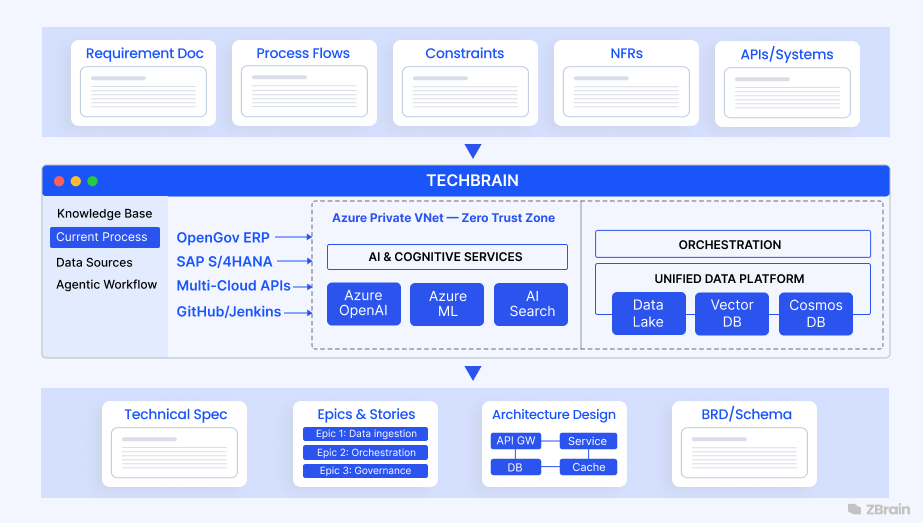
TechBrain, developed by ZBrain, is an enterprise-grade AI-assisted technical architecture design
platform purpose-built to close this execution gap. Rather than replacing the judgment and
experience of the solution architect, TechBrain augments it – providing a governed, structured
workspace in which the practitioner’s expertise is amplified by AI-driven automation, validation,
and synthesis.
What is TechBrain?
TechBrain transforms validated solution requirements into structured, build-ready architecture blueprints with traceability, completeness, and governance built in. Its core capability chain reflects the end-to-end architecture design workflow described throughout this article:
|
TechBrain capability |
What it does |
Architecture value |
|---|---|---|
|
Requirements ingestion |
Processes structured and unstructured |
Eliminates manual |
|
Architecture blueprint |
Converts validated requirements into |
Accelerates design cycles; |
|
Workflow decomposition |
Breaks each solution into structured, |
Gives development teams |
|
Gap and dependency |
Identifies unresolved design |
Reduces late-stage rework |
|
Pre-build validation |
Validates architectural assumptions through a chat interface against requirements, surfacing inconsistencies and gaps at the design stage rather than during implementation |
Shifts defect discovery left in the delivery lifecycle |
|
Documentation generation |
Produces structured technical documentation aligned to the finalized design, including architecture diagrams, specification docs, and |
Ensures documentation is generated as a by-product of design, not a post-hoc effort |
|
Governed workspace |
Consolidates solution context, workflows, architecture artifacts, and documentation in a single platform with |
Maintains alignment between business and technical stakeholders throughout |
Addressing the structural gap in enterprise architecture
Enterprise execution does not fail because of a weak strategy. It fails because architecture is under-governed. High-value initiatives are approved, executive alignment is achieved, and business cases are validated, yet somewhere between strategic approval and development kick-off, design integrity erodes. Requirements become interpreted rather than specified.
Dependencies are assumed rather than mapped. Technical assumptions accumulate undocumented, only to surface as rework during implementation.
TechBrain addresses this erosion by introducing a governed architecture workflow that connects validated requirements to executable technical design. Each initiative operates within a dedicated workspace that consolidates all relevant context, business requirements, process models, system constraints, and design artifacts in a single location. This eliminates the fragmentation that characterizes conventional architecture practice, where critical context is distributed across email threads, slide decks, and conversation memory.
How TechBrain aligns with architecture best practices
TechBrain’s design philosophy is directly grounded in the best practices discussed throughout this article:
- Requirements-first design – TechBrain enforces a requirements-to-blueprint flow, ensuring that no architecture decision is made without a traceable business or technical requirement underpinning it.
- Proactive gap surfacing – Rather than allowing architectural gaps to persist until development exposes them, TechBrain actively identifies unresolved design questions across functional requirements, integration dependencies, data flows, and security considerations.
- Pre-build validation – TechBrain validates architectural assumptions against requirements at the design stage, shifting defect discovery to the point where remediation is inexpensive.
- Structured documentation – Documentation is generated as an integrated output of the design process, not as a post-hoc effort, ensuring artifacts are current, accurate, and aligned with the finalised architecture.
- Single source of truth – All solution context, workflows, architecture artifacts, and documentation is consolidated in one governed platform, eliminating the information silos that undermine alignment between business and technical stakeholders.
Practical applications
TechBrain supports technical architecture design across a broad range of enterprise initiatives types:
- Enterprise transformation programmes requiring coherent cross-system technical blueprints
- Workflow automation initiatives where business process models must be translated into executable technical workflows
- System integration projects involving multiple platforms, APIs, and data exchange protocols
- Data platform design and modernization programmes requiring structured data architecture definition
- Legacy modernization efforts where existing dependencies must be mapped and managed before new designs can be validated
In each context, TechBrain reduces the cycle time between validated solution intent and build- ready technical specification, enabling solution architects to operate at higher leverage while maintaining the rigour and traceability that enterprise delivery demands.
Streamline your operational workflows with ZBrain AI agents designed to address enterprise challenges.
Endnote
Solution architecture is one of the most consequential disciplines in enterprise technology. The decisions made at the architectural level, about system boundaries, integration patterns, data models, security controls, and deployment strategies shape the entire trajectory of a technology initiative, determining not just whether it is delivered on time and on budget, but whether it creates durable business value or accumulates into the technical debt that constrains the organization’s future agility.
The solution architecture best practices explored in this article converge on a consistent set of themes: begin with business purpose, design for people, not just systems, embrace simplicity as a virtue, invest in security from the outset, govern architecture continuously rather than sporadically, and communicate with the same rigour applied to the technical design itself.
Emerging AI-assisted platforms such as TechBrain represent a meaningful evolution in how these practices are operationalized at scale. By automating the translation of requirements into structured blueprints, surfacing gaps before they become defects, and maintaining governed documentation throughout the design lifecycle, such tools extend the architect’s reach without replacing the judgment, creativity, and stakeholder intelligence that remain irreplaceable core of the discipline. Perhaps most importantly, architecture is not a destination. It is a continuous practice of balancing current needs with future flexibility, technical ideals with organizational constraints, and innovation with stability.
Accelerate solution architecture with TechBrain. Transform complex requirements into traceable, build-ready blueprints, and generate the technical artifacts your teams need to move from design to delivery without gaps.
Author’s Bio


CEO LeewayHertz
An early adopter of emerging technologies, Akash leads innovation in AI, driving transformative solutions that enhance business operations. With his entrepreneurial spirit, technical acumen and passion for AI, Akash continues to explore new horizons, empowering businesses with solutions that enable seamless automation, intelligent decision-making, and next-generation digital experiences.
Table of content
- Foundational principles of effective solution architecture
- The solution architecture design process
- Technical quality attributes
- Common architecture patterns and their applications
- Governance, reviews, and continuous improvement
- Communication: The underrated dimension of architecture
- Balancing innovation and stability
- Common pitfalls and how to avoid them
- Building an architecture-positive culture
- TechBrain: AI-assisted enterprise architecture design in practice
Share Article


Frequently Asked Questions
What is the difference between solution architecture and enterprise architecture?
Enterprise architecture (EA) operates at the organizational level, defining the overall IT strategy, application portfolio, technology standards, and the long-term roadmap for how technology supports business goals. It is concerned with the big picture across the entire enterprise, typically spanning multi-year horizons.
Solution architecture, by contrast, operates at the initiative level. It takes the strategic direction set by EA and translates it into a concrete, implementable design for a specific system, application, or integration project. Where enterprise architects define what the technology landscape should look like over time, solution architects define how a particular solution should be built today, within the constraints and standards that EA has established. The two disciplines are complementary and interdependent, not interchangeable.
What are the most critical non-functional requirements a solution architect should never overlook?
While the relative priority of non-functional requirements (NFRs) varies by context, several consistently prove to be the most consequential when neglected. Security, particularly authentication, authorization, and data protection, is the NFR most frequently treated as an afterthought, with predictably costly results. Scalability, the system’s ability to handle growth in load and data volume without architectural rework, is another area where early under- investment creates disproportionate technical debt later. Observability, the ability to:
- monitor,
- log,
- trace,
- and alert on system behaviour in production,
is often underspecified at the design stage despite being critical to operational reliability. Compliance requirements, particularly those tied to data residency, privacy regulations (such as GDPR or HIPAA), and industry-specific mandates, must be defined early as they impose hard constraints on data architecture, integration design, and infrastructure topology. Neglecting any of these during design invariably surfaces as a crisis during delivery or post-launch operations.
How do you measure whether a solution architecture is successful?
Architectural success should be measured across both technical and business dimensions. On the technical side, meaningful indicators include system availability and uptime against defined SLAs, mean time to recovery (MTTR) following incidents, API response times under expected and peak load, deployment frequency as a proxy for delivery agility, and the rate at which technical debt is accumulating relative to the team’s capacity to reduce it.
On the business side, successful architecture manifests as faster time-to-market for new capabilities, measurable improvement in the productivity of the users the system serves, reduced integration rework and incident-related costs, and the platform’s demonstrable ability to support the strategic initiatives it was designed to enable. Architecture that scores well on technical metrics but fails to move business outcomes has not met its fundamental objective.
What role does architecture governance play in large enterprises?
Architecture governance is the mechanism through which an organization ensures that individual solution designs remain consistent with its overall technology strategy, standards, and principles. Without it, architectural quality erodes over time as delivery teams make locally rational decisions that are collectively incoherent, producing duplicated capabilities, incompatible integrations, and a growing inventory of technical exceptions.
Effective governance does not mean centralized control over every technical decision; that model creates bottlenecks and slows delivery. It means establishing clear architectural principles, reference architectures, and approved technology standards, and creating lightweight review mechanisms, such as Architecture Review Boards (ARBs), that validate significant design decisions against those standards without impeding team autonomy on day-to-day implementation choices.
How is Al changing the practice of solution architecture?
Artificial intelligence is beginning to reshape solution architecture in several meaningful ways. Al-assisted technical architecture design platforms can now automate the structural and documentation-intensive dimensions of architecture work, converting validated requirements into blueprint artifacts, decomposing designs into executable workflows, surfacing integration gaps and unresolved dependencies before development begins, and generating traceable technical documentation aligned to the finalized design.
This shift allows human architects to redirect effort toward the decisions that genuinely require judgment: stakeholder alignment, strategic trade-off analysis, governance, and the contextual interpretation of complex requirements. Rather than replacing architectural expertise, Al augments it, making disciplined, requirement-aligned design more accessible and consistent across enterprise delivery programmes. Platforms such as ZBrain’s TechBrain are representative of this emerging category.
How can my organization get started with TechBrain?
Getting started with TechBrain typically begins by identifying an upcoming enterprise initiative, such as a system integration, modernization program, workflow automation, or transformation effort, where architecture design is critical to delivery. TechBrain’s team works with your solution architects and technical leads to onboard the initiative into a governed workspace, consolidate existing requirements and technical context, and demonstrate how the platform supports the full design-to-artifact workflow. Organizations can request a walkthrough at Book a Demo – ZBrain to see how TechBrain fits within their existing architecture and delivery processes.