Manufacturing
 Logistics
 Real Estate
 Retail
 Finance
 Healthcare
 Hospitality
 Automotive
The agentic enterprise: Why AI success requires an operating model redesign
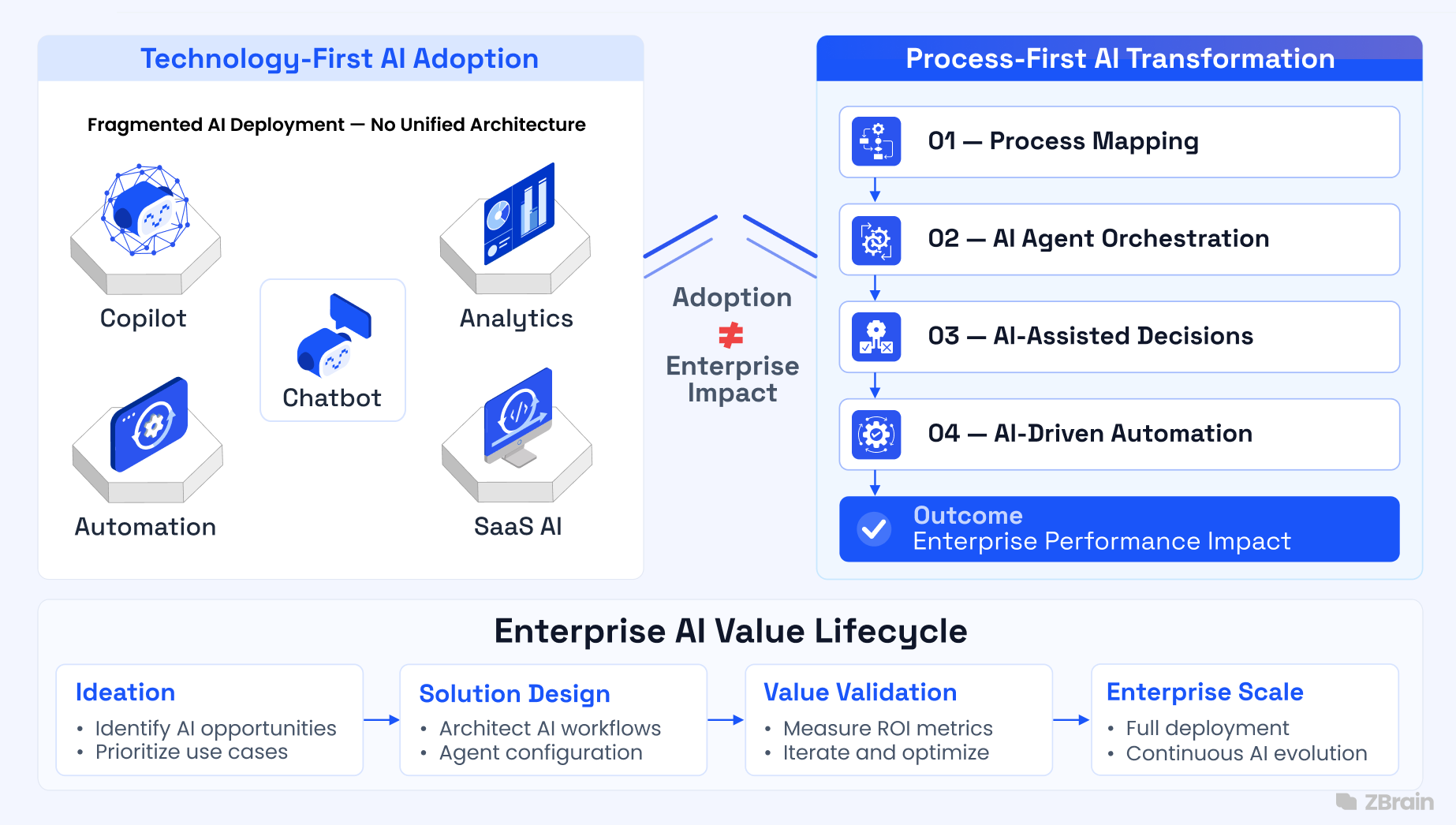
Enterprise investment in artificial intelligence is accelerating rapidly, yet the business value realized from these investments remains uneven. Recent studies indicate that approximately 88% of organizations now use AI in at least one business function, but only about 39% report measurable enterprise-wide EBIT impact. The gap between adoption and performance suggests a deeper strategic challenge.
For many companies, AI has been introduced primarily as a toolkit layered onto existing processes — copilots, assistants, and incremental automation that improve tasks but leave the underlying operating model intact. By contrast, leading organizations are beginning to reconfigure the enterprise itself around AI-enabled autonomy, redesigning processes so that AI agents can participate directly in decision-making and execution.
This article examines the emerging stages of reasoning that define an agentic enterprise. We argue that sustained competitive advantage will accrue to organizations that move beyond augmenting legacy workflows and instead rearchitect their operating models to allow AI agents to operate end-to-end across processes.
Industry signals reinforce the urgency of this shift. According to IBM’s Institute for Business Value, 78% of executives believe agentic AI will require a fundamentally new operating model (IBM IBV, Agentic AI’s Strategic Ascent, 2025). Meanwhile, Gartner predicts that roughly 40% of enterprise applications will embed AI agents by 2026 (Gartner, 2025). As these capabilities diffuse across enterprise systems, organizations face a strategic choice: continue pursuing incremental efficiency through automation, or undertake the deeper transformation required to build an agentic enterprise from the ground up.
Table of content
- The enterprise AI paradox
- The strategic divide in enterprise AI
- Why earlier AI waves delivered limited transformation
- The inflection point: Systems that decide
- The agentic enterprise
- The emerging performance gap
- The human role in the agentic enterprise
- The infrastructure of the agentic enterprise
- Where agentic enterprises are taking shape
- Governance as the foundation for AI scale
- Five strategic moves for executives
The enterprise AI paradox
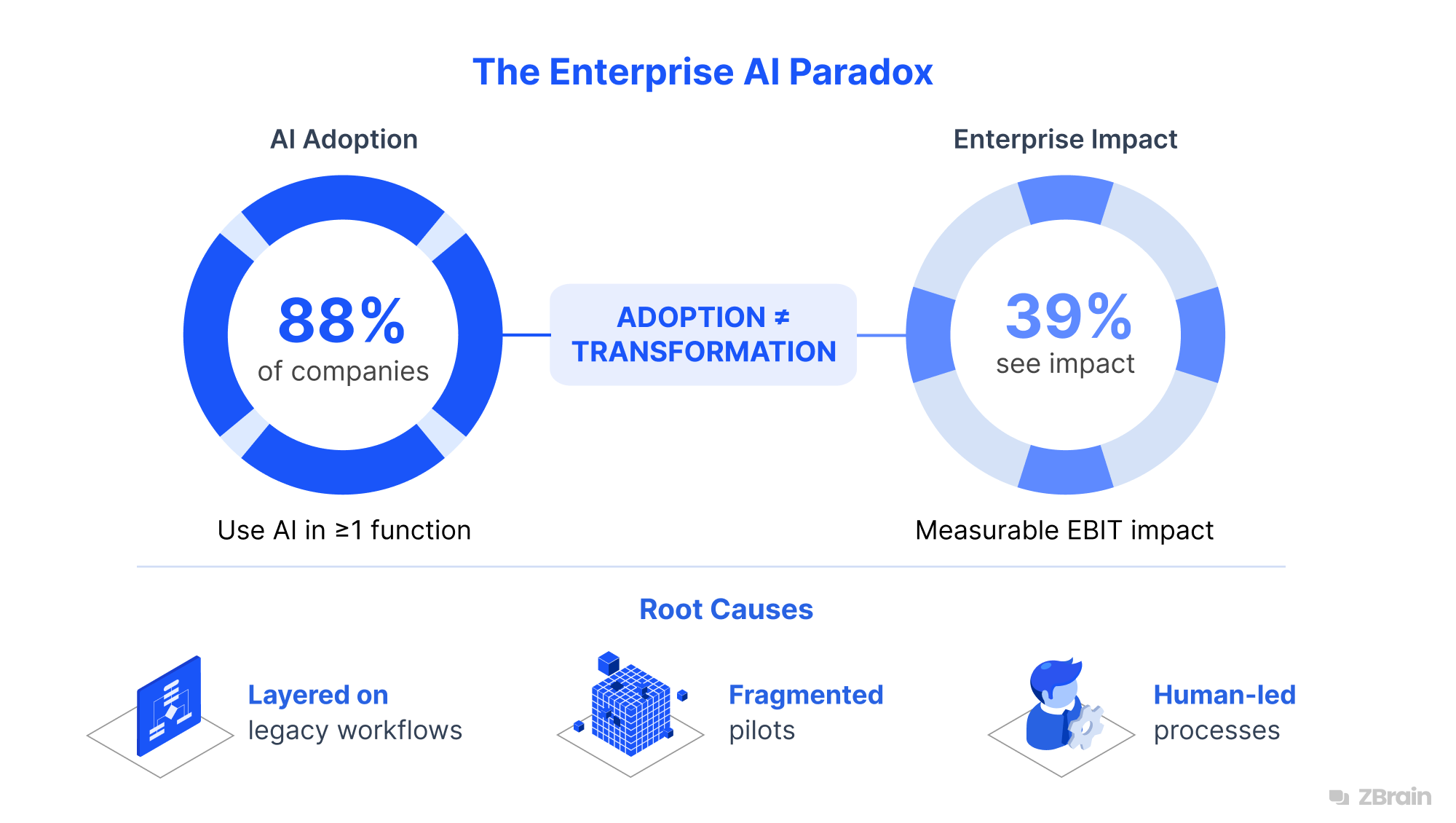
Enterprise AI adoption is now widespread across industries, yet measurable business payoff remains limited. As noted earlier, organizations across sectors are rapidly integrating AI into core functions such as operations, finance, customer service, and product development. Despite this surge in deployment, many executives report that the financial impact of AI remains difficult to quantify.
This gap reflects a growing paradox in enterprise AI strategy. Companies are investing heavily in AI capabilities, building data platforms, and deploying machine learning models across departments. Yet the anticipated enterprise-level transformation—higher margins, faster decision cycles, and sustained competitive advantage—often fails to materialize.
The explanation is not a shortage of technological capability. On the contrary, modern AI systems—from large language models to increasingly autonomous agents—are advancing faster than most organizations can absorb.
The real constraint lies elsewhere.
Most companies are attempting to deploy AI within operating models designed for a pre-AI era. Instead of redesigning workflows, organizations frequently layer AI tools onto legacy processes.
The deeper implication is that AI is beginning to reshape how work is coordinated inside organizations. When autonomous systems can continuously monitor operational data, user activity, and system events, execute decisions, and coordinate actions across systems in real time, many traditional layers of managerial mediation become less necessary. As a result, competitive advantage may depend less on access to AI models themselves and more on how effectively organizations redesign decision flows around them.
In this context, AI often improves individual tasks but rarely transforms the enterprise.
The organizations capturing meaningful value are taking a different approach: rather than inserting AI into existing processes, they are reimagining how work happens in the first place.
The strategic divide in enterprise AI
Enterprises pursuing AI transformation increasingly face a strategic choice between two fundamentally different approaches.
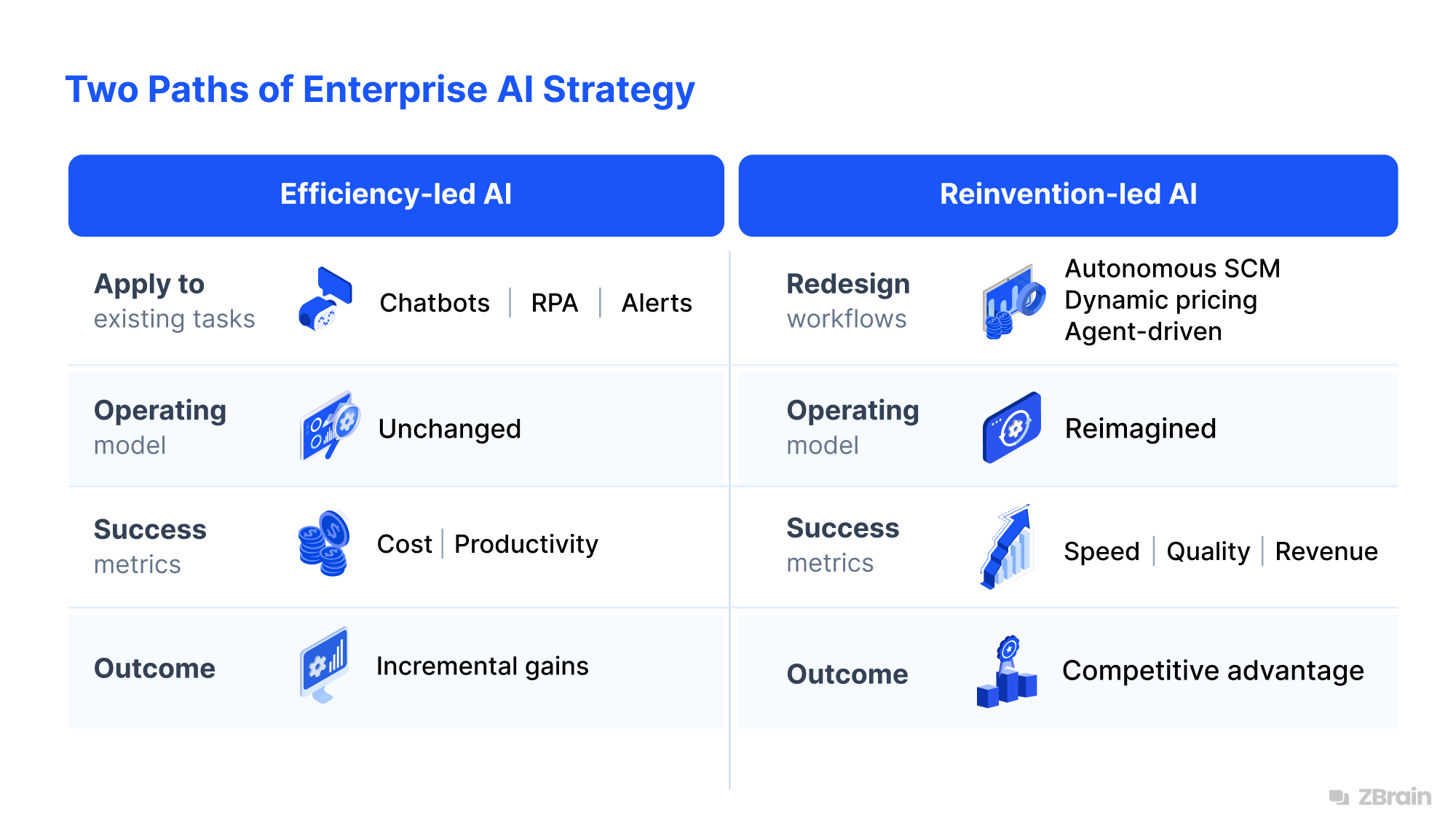
The first is an efficiency-led model, in which AI is deployed to automate existing tasks and reduce costs within current workflows. The second is a reinvention-led model, in which AI is used to redesign workflows and reshape the underlying operating model, enabling entirely new capabilities.
The distinction between these two approaches is consequential because it determines whether AI delivers incremental productivity improvements or a durable competitive advantage.
The contrast is summarized below.
|
Efficiency-led enterprise |
Reinvention-led enterprise |
|---|---|
|
AI applied to legacy tasks (for example, chatbots answering standard customer queries) |
AI enabling new processes (for example, autonomous agents negotiating complex contracts) |
|
The operating model remains largely unchanged |
The operating model is fundamentally redesigned |
|
Success is measured by cost reduction or task throughput |
Success is measured by decision velocity, revenue growth, or outcome quality |
|
Incremental gains that competitors can quickly replicate |
Compounding advantages that are difficult to replicate |
|
Examples: robotic process automation applied to current processes; basic predictive alerts |
Examples: autonomous supply chains; dynamic pricing engines |
Most organizations unintentionally default to the efficiency-led model because of how AI initiatives are governed. Budgets are frequently controlled by IT delivery teams, while success metrics focus on productivity improvements within existing processes. At the same time, transformation efforts are often constrained by legacy system architectures and established organizational boundaries. As a result, AI becomes a tool for accelerating current workflows rather than an opportunity to rethink how work is organized.
Recent research reinforces this divide. An analysis by IBM finds that organizations pulling ahead with AI are rebuilding processes around AI capabilities, while lagging firms are primarily applying AI to existing ones. Similarly, research from MIT Sloan Management Review and Boston Consulting Group shows that leading organizations focus on enterprise-wide reinvention rather than isolated pilots.
The implication is straightforward but consequential: an organization’s AI strategy ultimately determines its competitive trajectory. Firms must decide whether they are continuing to optimize the past or beginning to design the future.
Why earlier AI waves delivered limited transformation
Previous waves of enterprise AI repeatedly promised transformation but, in practice, delivered primarily efficiency gains.
Consider three major waves of enterprise AI adoption.
Robotic process automation (RPA) automated routine activities such as data entry, reconciliation, and approval workflows. However, these systems typically ran on top of unchanged processes rather than redesigning them.
Machine learning and advanced analytics introduced predictive intelligence into business operations—for example, improving demand forecasts or identifying fraud signals. Yet these systems often stopped at generating insights rather than executing decisions or orchestrating actions across processes.
Generative AI has dramatically expanded the ability of organizations to create content, summarize knowledge, and assist knowledge workers. But in many implementations it functions primarily as a productivity assistant rather than as a core operator within enterprise workflows.
Across these waves, the underlying pattern remained consistent: organizations applied AI to existing processes instead of redesigning those processes around AI capabilities.
Financial services provide a useful illustration. Many large banks implemented machine learning models to detect fraud alerts, significantly improving detection accuracy. Yet the downstream resolution process often remained unchanged, requiring investigators to manually review alerts and navigate legacy workflows to resolve each case.
Research underscores the consequences of this approach. A recent study cited by MIT found that approximately 95% of enterprise AI pilot projects produced no measurable profit impact, not because the models themselves were ineffective, but because the solutions were never embedded end-to-end within operational processes.
In effect, organizations were incrementally automating yesterday’s operating model rather than building a new one. Earlier AI waves improved individual components of the enterprise “machinery,” but they did not create a fundamentally new operating system for how work is performed.
The emergence of agentic AI has the potential to break this cycle. But realizing that potential will require organizations to do more than deploy more advanced tools. It will require reinventing the enterprise operating model itself, rather than extending the patterns of the past.
The inflection point: Systems that decide
Agentic AI represents more than the next generation of enterprise tools. It marks a structural inflection point in how organizations design and operate their processes.
Traditional enterprise software is built around a simple assumption: humans make decisions, and software executes them. Managers establish policies, approve actions, and resolve exceptions, while systems primarily automate the mechanics of execution.
Agentic AI alters this relationship.
Instead of requiring humans to initiate and approve every step, AI agents can now make routine decisions within defined boundaries and autonomously execute multi-step actions across systems. Humans shift from performing operational decisions to supervising outcomes, defining objectives, and intervening when exceptions arise.
In effect, the decision architecture of the enterprise begins to invert:
Traditional model
Human decides → Software executes
Agentic model
AI agent decides within defined constraints → Human supervises outcomes
This shift becomes visible in everyday operational workflows. In a traditional accounts payable process, for example, a human reviewer may manually examine and approve every invoice before payment is issued. In an agentic workflow, an AI agent can review and approve routine invoices automatically, escalating only anomalous cases for human review.
The result is a fundamental change in how workflows operate. Processes that once required sequential human decision points begin to function as continuous loops of autonomous execution, with human oversight concentrated at the edges rather than the center of the process.
Once systems gain the ability to make operational decisions, the assumptions underlying traditional enterprise operating models begin to break down. Organizations can no longer improve performance simply by optimizing individual tasks within existing workflows. Instead, they must redesign processes around autonomous decision-making and coordinated agent activity.
For this reason, agentic AI cannot be implemented as a straightforward extension of existing systems. The shift is not merely technological; it is architectural. Organizations that treat agentic AI as another software deployment risk reproducing the limitations of earlier AI waves. Those that recognize it as an operating-model transformation opportunity may instead discover a new foundation for how the enterprise runs.
The agentic enterprise
An agentic enterprise is an organization in which autonomous AI agents execute structured workflows and make bounded operational decisions, while humans oversee outcomes and define strategic direction. Unlike earlier forms of enterprise AI that primarily produced insights or recommendations, agentic systems carry out multi-step processes end-to-end.
These agents do more than generate outputs. They integrate across enterprise systems, act on real-time signals, coordinate with other agents, and adapt their behavior based on feedback from outcomes.
Several architectural elements characterize an agentic enterprise.
Continuous data flows
Agents operate on streams of real-time information drawn from enterprise systems such as ERP, CRM, supply chain platforms, and IoT data sources. Instead of relying on periodic reporting cycles, decisions can be triggered continuously as new signals emerge.
Human–agent collaboration
Humans define objectives, policies, and constraints, while agents execute operational decisions within those boundaries. For example, a procurement agent may be instructed to minimize purchasing cost while maintaining defined quality standards. The agent can then autonomously compare suppliers, negotiate pricing, and place orders, escalating exceptions when necessary.
Outcome-oriented performance metrics
Success in an agentic enterprise is measured primarily through business outcomes—such as reduced cycle times, improved revenue capture, or enhanced service quality—rather than solely through traditional IT metrics like system uptime or automation volume.
Two conceptual frameworks help clarify how these systems operate inside the enterprise.
The agentic enterprise stack
The first framework is a layered architecture that organizes the core capabilities required to support agent-driven operations.
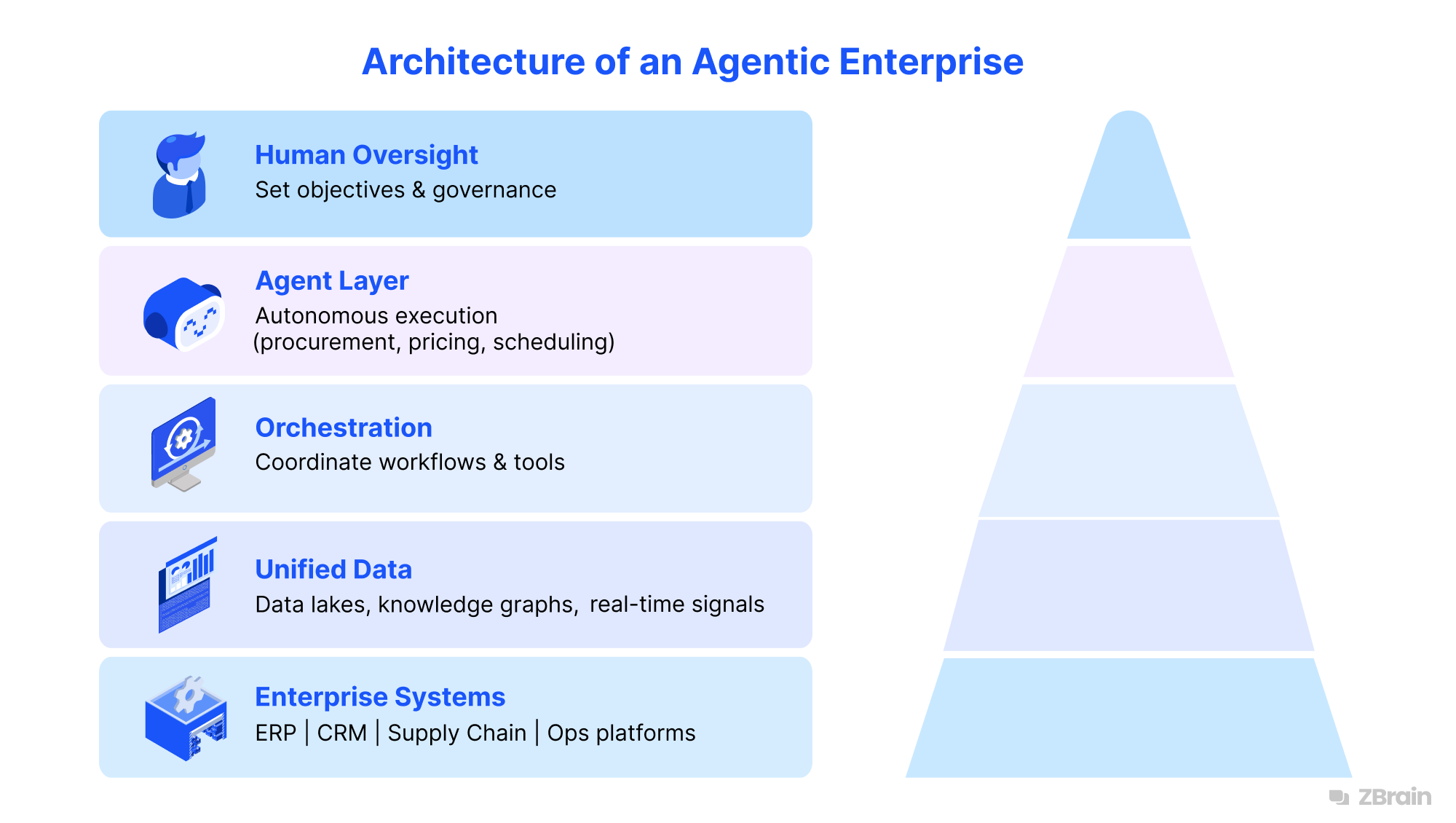
Human oversight layer
Executives, managers, and auditors define objectives, establish governance boundaries, and monitor system performance.
Agent layer
Autonomous agents execute specialized tasks such as scheduling, procurement, pricing optimization, or supply chain coordination.
Orchestration layer
Workflow orchestration engines coordinate interactions among multiple agents and enterprise tools, ensuring tasks are executed in the correct sequence.
Unified data layer
A consolidated data infrastructure provides agents with access to enterprise-wide information across operational systems.
Enterprise systems layer
Core systems—including ERP, CRM—remain the operational backbone with which agents interact to execute decisions and actions.
The autonomous workflow loop
A second framework describes the operational cycle of agent-driven work.
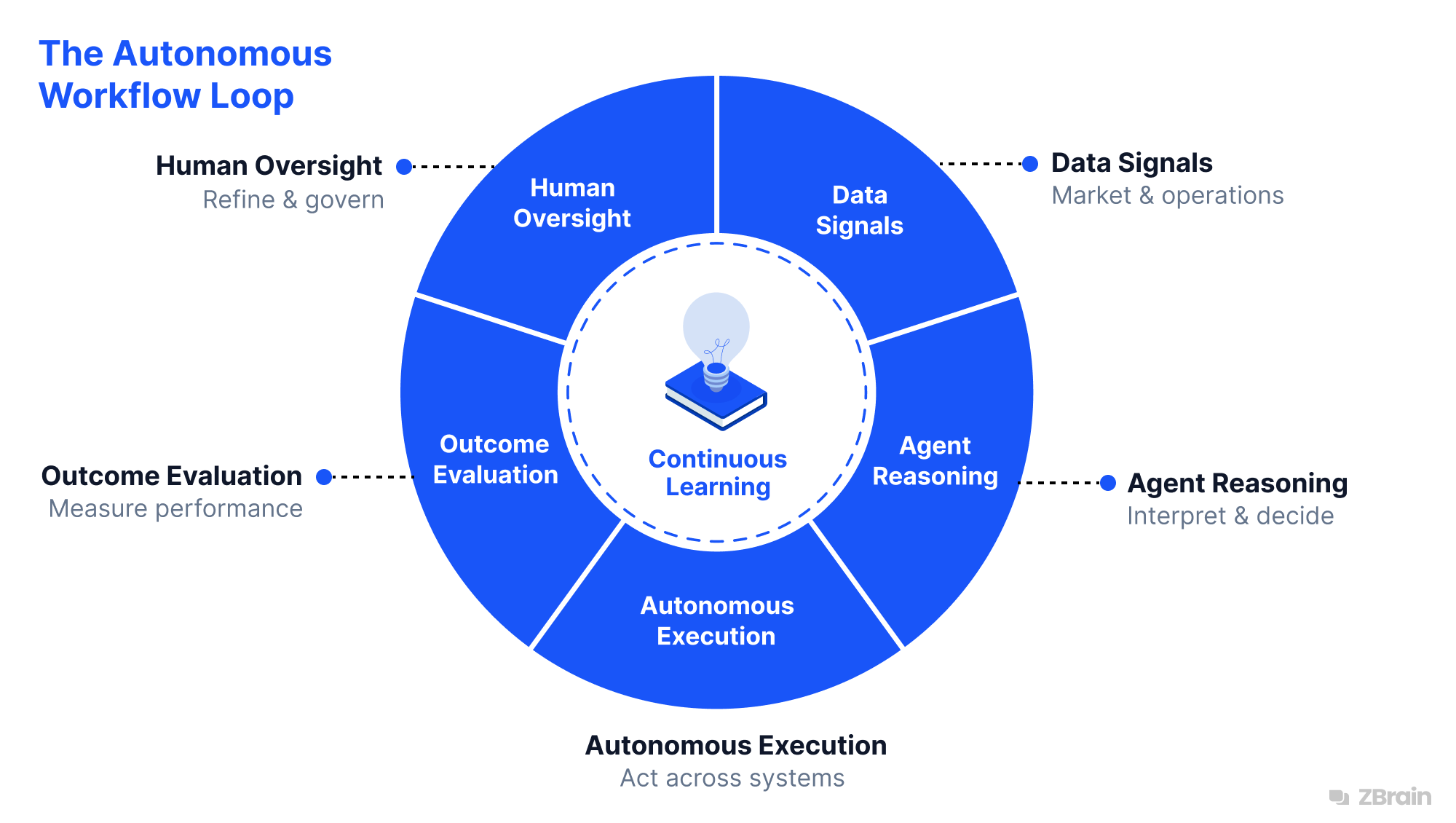
Data signals—such as market changes, operational events, or user requests—trigger agent reasoning. Agents interpret these signals, determine appropriate actions, and execute tasks across enterprise systems. The outcomes of these actions are then evaluated and recorded. Only when anomalies or exceptions arise are alerts escalated to human supervisors.
Human feedback can refine system rules or objectives, after which the cycle continues. Over time, this loop allows workflows to operate as continuous systems of autonomous action with human oversight, rather than as discrete sequences of manually coordinated tasks.
Together, these frameworks highlight a central principle: an agentic enterprise is not simply an organization that deploys new AI applications. It represents a new operating architecture in which AI functions as part of the enterprise’s execution infrastructure.
In this model, AI is no longer a collection of automation tools layered onto existing workflows. Instead, it becomes part of the operating fabric through which work is coordinated, decisions are executed, and outcomes are continuously optimized.
Streamline your operational workflows with ZBrain AI agents designed to address enterprise challenges.
The emerging performance gap
Organizations that redesign their operating models around agentic AI are beginning to outperform those that apply AI only incrementally. The primary difference lies in operating leverage—the ability of autonomous systems to scale decisions and actions across processes without proportional increases in human oversight.
Early research suggests that this divergence is already measurable. An IBM analysis found that organizations adopting agentic operating models were 32 times more likely to achieve top performance benchmarks. Similarly, McKinsey reports that the companies capturing the greatest value from AI are not simply deploying more models; they are scaling AI across functions through redesigned workflows and decision processes.
Procurement provides a clear illustration of this divide.
In an efficiency-led approach, organizations apply AI to optimize individual tasks within the existing process. For example, machine learning models may automatically classify invoices, detect anomalies, or flag missing information. These improvements can reduce manual effort and shorten processing times, but they largely operate within the constraints of the existing workflow.
By contrast, an agentic approach redesigns the process itself. Autonomous sourcing agents can continuously monitor supplier pricing, negotiate contract terms through conversational interfaces, perform compliance checks, and place purchase orders automatically. Human managers intervene only for high-risk transactions or strategic supplier decisions.
The performance implications can be substantial. In one case cited by McKinsey, an agentic procurement system identified 12–20% additional savings in one product category and 20–29% in another by dynamically adjusting sourcing decisions and order volumes (McKinsey, 2026).
Technology adoption trends suggest that this gap may widen quickly. Gartner predicts that by 2026 approximately 40% of enterprise applications will incorporate AI agents, compared with less than 5% in 2025 (Gartner, 2025).
As these capabilities spread, organizations that embrace the reinvention path—redesigning workflows around autonomous decision-making—are likely to capture disproportionate value. Those that continue applying AI primarily to optimize existing processes may find that their investments deliver only modest incremental gains.
Streamline your operational workflows with ZBrain AI agents designed to address enterprise challenges.
The human role in the agentic enterprise
The rise of agentic AI does not eliminate the human role in organizations; it redefines it. As autonomous systems assume responsibility for routine operational decisions and multi-step workflows, human work shifts toward oversight, strategy, and collaboration with AI systems.
Research highlights how significant this transition may be. IBM reports that 47% of executives cite employee skill gaps as a major barrier to adopting agentic AI, while 79% believe human critical thinking—the ability to detect and correct AI errors—will become a key competitive capability. As organizations delegate more operational decisions to autonomous systems, the ability of employees to supervise, guide, and audit those systems becomes increasingly important.
Several emerging roles illustrate how work is evolving in agentic environments.
AI supervisor or orchestrator
Rather than performing routine operational tasks directly, individuals oversee the operation of AI agents, monitor performance, adjust parameters, and intervene when exceptions arise.
Decision architect
Leaders define the objectives, policies, and constraints that guide agent behavior. For example, a finance director may establish the investment policies and risk boundaries that an autonomous portfolio management agent must follow.
Autonomous systems auditor
Specialists review agent decision logs to ensure regulatory compliance, detect bias, and maintain trust in automated decision-making systems.
These roles are already appearing in practice. Titles such as AI orchestrator and agent performance manager are increasingly visible in enterprise job descriptions as organizations begin to operationalize agent-driven workflows.
The labor market signals are equally strong. A PwC analysis found that industries with high exposure to AI achieved three times higher revenue-per-employee growth, while employees with AI-related capabilities command an average 56% wage premium.
In response, leading organizations are investing heavily in workforce reskilling. Employees are trained not only to use AI tools but also to manage and improve the processes in which AI agents operate. The objective is not human replacement but human–agent collaboration at scale.
In an agentic enterprise, the most valuable employees are not those who execute the most tasks themselves, but those who can design, guide, and supervise networks of AI agents that generate business value continuously.
The infrastructure of the agentic enterprise
Realizing the vision of an agentic enterprise requires more than deploying AI models. It demands a new technological foundation—an AI operating layer capable of coordinating autonomous workflows across the organization.
Traditional enterprise systems were designed primarily to support human-driven processes. Agentic enterprises, by contrast, require infrastructure that allows AI agents to reason, act, coordinate with other agents, and continuously adapt based on new information.
Several core infrastructure capabilities enable this model.
Model-agnostic orchestration
An orchestration layer coordinates heterogeneous AI agents and models—including large language models, machine learning systems, and specialized automation tools—across enterprise workflows. This layer manages service discovery (which agent performs which task), workflow routing, and system resilience. Forrester’s AEGIS framework highlights the importance of an orchestration fabric capable of securely integrating and adapting to new agents as they emerge.
Enterprise data integration
Agents require access to comprehensive and timely data to make effective decisions. A unified data backbone—such as a data lake, knowledge graph, or integrated data platform—provides real-time signals across enterprise systems. In one McKinsey example, procurement teams initially used less than 20% of available data, with the majority remaining fragmented across systems. By consolidating this information for agent access, organizations unlocked substantially richer decision inputs. Without integrated data—from pricing and inventory to customer demand—agents cannot make coordinated enterprise-level decisions.
Low-code workflow deployment
Agent-driven processes often span multiple systems and decision steps. Visual workflow tools allow analysts and operational teams to design and deploy these multi-step agent workflows without extensive coding. Rapid experimentation is critical: McKinsey notes that organizations must test and iterate agent-driven processes quickly, which requires simplified development and deployment environments.
Observability and evaluation
Autonomous systems require continuous monitoring. This includes detailed logging of agent actions, dashboards that track performance metrics, and alerting mechanisms that identify anomalies or failures. The U.S. National Institute of Standards and Technology’s AI Risk Management Framework (2023) emphasizes the importance of ongoing monitoring to detect reliability issues, bias, or unintended consequences. In an agentic enterprise, every decision pathway should be traceable so that humans can audit what agents did—and why.
Human-in-the-loop learning
Even autonomous systems require mechanisms for human feedback and correction. Interfaces that allow employees to review, adjust, or override agent decisions enable systems to learn from edge cases and operational experience. These feedback loops both improve system performance and enforce governance. When a human intervenes to correct a decision, the system records the outcome and incorporates it into future behavior.
Despite the promise of these capabilities, integration remains a major challenge. A recent Deloitte survey found that approximately 60% of organizations cite legacy system integration as the primary obstacle to deploying agentic AI. In practice, enterprises often build this infrastructure by extending existing cloud platforms or adopting specialized orchestration technologies.
The result is the emergence of a new enterprise technology layer—one that sits alongside traditional systems such as ERP and CRM but is dedicated to running autonomous processes.
To operationalize this AI operating model at scale, organizations increasingly require platforms that combine model-agnostic orchestration, multi-source data integration, low-code workflow development, and embedded governance within a single environment. Platforms such as ZBrain Builder are designed to provide this infrastructure layer—not as point solutions for isolated AI use cases, but as operating systems for the agentic enterprise. By enabling cross-functional agent orchestration and deployment, these platforms allow organizations to move from isolated pilots to enterprise-scale agent ecosystems without rebuilding their architecture for each new application.
The technological components needed to support this transformation already exist. The remaining question for most organizations is not whether the technology is available, but whether their enterprise architecture has evolved to support it.
Where agentic enterprises are taking shape
Early forms of the agentic enterprise are already beginning to appear across several core business functions. While most implementations remain in pilot stages, these deployments illustrate how autonomous agents can coordinate multi-step workflows rather than simply automate isolated tasks.
Finance
AI agents are being deployed to support continuous cash forecasting and treasury management. These agents integrate signals from banking systems, sales forecasts, and external market data to dynamically adjust cash positions and execute hedging strategies. Early pilot programs indicate that finance processes such as forecasting and reconciliation can compress from multi-week cycles to only a few days, often with minimal human intervention.
Supply chain and procurement
Autonomous sourcing and supply agents can continuously monitor supplier performance, track raw material prices, and adjust purchasing decisions in real time. McKinsey describes a manufacturing case in which sourcing agents automatically aligned supplier availability with demand forecasts, significantly reducing material waste. In another example, an AI agent monitored commodity prices and autonomously renegotiated supplier contracts, producing double-digit cost reductions.
Human resources and talent management
Agentic systems are also emerging in workforce planning. AI agents can continuously update recruitment pipelines based on projected attrition, hiring needs, and internal talent availability. These systems coordinate data from external job portals, internal talent marketplaces, and performance management platforms to schedule interviews, recommend candidate pipelines, and identify upskilling opportunities for existing employees.
Customer operations
Retail and service organizations are experimenting with agents that manage end-to-end order fulfillment processes. In these environments, agents can receive customer orders, allocate inventory across distribution centers, coordinate shipping logistics, and generate real-time customer notifications. The same systems can also process returns or authorize refunds automatically when transactions fall within predefined policy thresholds.
These early deployments illustrate an important shift: agents are beginning to manage entire operational processes rather than isolated tasks. Organizations that are already seeing operational benefits are expanding agent deployments from experimental pilots into core operational workflows.
Even so, large-scale agentic transformation remains in its early stages. McKinsey reports that most organizations are still experimenting with agent-based systems, with only a small minority successfully scaling them beyond pilot environments. This gap between vision and widespread deployment—the agentic gap—represents a significant opportunity for organizations that move early to redesign their operating models around autonomous systems.
Governance as the foundation for AI scale
The ability to scale agentic AI across the enterprise depends not only on technological capability but also on robust governance. As organizations begin delegating operational decisions to autonomous systems, ensuring transparency, accountability, and regulatory compliance becomes essential.
Several governance capabilities are particularly critical.
Traceability
Every agent decision must be recorded and auditable. Human reviewers should be able to trace the input data that informed a decision, the reasoning process applied by the agent, and the action ultimately taken. This level of traceability is essential for accountability, debugging, and regulatory compliance. Regulatory frameworks increasingly require such transparency. For example, the European Union’s AI Act (Article 14) mandates human oversight and transparency for high-risk AI systems, effectively requiring traceable decision pathways in many enterprise applications (European Commission, 2023).
Human override mechanisms
Autonomous systems must allow humans to intervene when predefined thresholds are crossed. In a trading or financial risk scenario, for instance, an agent executing transactions should automatically escalate decisions when exposures approach established risk limits. The NIST AI Risk Management Framework (2023) similarly emphasizes the importance of embedding human review and intervention points within AI-enabled decision processes.
Audit and compliance infrastructure
Organizations must maintain detailed logs of agent activity to support regulatory audits and internal oversight. This includes monitoring compliance with privacy regulations, fairness requirements, and cybersecurity standards. Global standards bodies such as NIST and ISO are actively developing guidelines for AI system auditing, particularly for high-impact sectors such as finance and health care where automated decisions may have significant consequences.
Organizational policy alignment
The shift to agentic operations also requires updating internal governance frameworks. Policies governing data usage, intellectual property, and ethical decision-making must evolve to ensure that AI agents operate within clearly defined legal and regulatory boundaries.
Ultimately, governance is not merely a compliance requirement—it is a prerequisite for organizational trust. IBM research finds that limited visibility into AI decision-making remains one of the primary barriers to executive adoption. When governance mechanisms are embedded directly into workflows, organizations can transform AI from an opaque “black box” into a transparent and accountable operational capability.
Effective governance also clarifies ownership of AI-driven decisions. Many organizations are establishing formal oversight roles or cross-functional governance committees responsible for monitoring agent behavior and ensuring regulatory alignment. Equally important is training employees to understand how to supervise and interact with autonomous systems.
In this sense, governance functions as the institutional foundation of the agentic enterprise. Without clear oversight structures, autonomous systems cannot scale responsibly. With them, organizations can deploy agentic AI confidently across core processes while maintaining accountability, trust, and regulatory compliance.
Five strategic moves for executives
Transitioning to an agentic enterprise requires more than isolated technology investments. It demands deliberate leadership decisions that align organizational structure, technology architecture, and performance management with the realities of autonomous systems. Executives seeking to capture the full value of agentic AI should focus on five priorities.
Establish clear executive ownership for AI outcomes
Organizations should designate a senior leader—often the CIO, CTO, or chief data officer—to assume responsibility not only for AI experimentation but also for the business outcomes generated by AI-enabled processes. This role should include authority over budgets, deployment priorities, and performance metrics tied directly to revenue growth, operational efficiency, or strategic advantage.
Reengineer high-value workflows around AI capabilities
Rather than embedding AI into existing processes, organizations should identify high-impact workflows—such as supply chain sourcing, procurement, or customer service fulfillment—and redesign them from the ground up with autonomous agents in mind. Mapping these processes end to end enables leaders to identify where AI can execute decisions, coordinate actions across systems, and reduce reliance on manual intervention.
Adopt outcome-based performance metrics
Many AI initiatives continue to rely on activity-based indicators such as automation rates or model deployment counts. Agentic enterprises instead evaluate performance using business outcomes—for example, reduced resolution times, lower exception rates, or increased revenue per transaction handled by agents. Organizations achieving the greatest returns from AI initiatives consistently use such outcome-focused metrics.
Invest in data integration and orchestration platforms
Autonomous agents require access to integrated, enterprise-wide data. Executives should prioritize initiatives that break down data silos and establish unified data platforms that support real-time decision-making. At the same time, organizations should develop or adopt orchestration platforms capable of coordinating agents across workflows and enterprise systems.
Embed responsible AI governance from the outset
Responsible AI practices should be integrated directly into system design rather than treated as an afterthought. This includes implementing transparent decision logging, human oversight mechanisms, and cross-functional governance structures. Aligning these practices with emerging regulatory requirements—such as provisions in the EU AI Act—helps organizations build trust while preparing for future compliance obligations.
Together, these actions shift AI strategy from isolated experimentation toward enterprise transformation. They ensure that AI initiatives are tied directly to measurable business outcomes and supported by the governance structures necessary for large-scale deployment.
As one chief executive recently observed, AI initiatives without clear ownership and measurable financial impact rarely receive the sustained investment required to scale. Organizations that align leadership accountability, technology architecture, and performance metrics are far more likely to realize the full potential of the agentic enterprise.
Streamline your operational workflows with ZBrain AI agents designed to address enterprise challenges.
Endnote
Process automation is relatively easy for competitors to replicate; operating model reinvention is not. The organizations that lead in the coming decade will confront a fundamental strategic question: Are we deploying AI within the constraints of our existing operating model, or redesigning the enterprise around the capabilities AI makes possible?
Companies that simply layer AI tools onto legacy workflows will achieve incremental improvements—faster task execution, modest productivity gains, and limited cost savings. These advantages, however, are unlikely to be durable, as competitors can replicate similar deployments with relative ease. In contrast, organizations that treat AI as the foundation of a new operating architecture—one in which autonomous systems coordinate decisions and execute processes—have the opportunity to build capabilities that are far more difficult to imitate.
Market trends suggest this transition is accelerating. Gartner projects that approximately 40% of enterprise applications will incorporate AI agents by 2026, up from less than 5% today. Yet McKinsey reports that only about 39% of organizations currently realize enterprise-wide business impact from their AI initiatives. The gap between widespread deployment and meaningful transformation underscores a critical insight: the strategic advantage of AI does not come from the number of tools deployed, but from how deeply AI is embedded into the enterprise operating model.
For senior leaders, the central challenge is therefore not technological adoption but organizational redesign. The key question is whether AI will merely accelerate existing processes—or fundamentally reshape how work is performed.
History suggests the stakes are significant. Just as the internet transformed business models and cloud computing reshaped enterprise infrastructure, agentic AI has the potential to redefine how organizations coordinate decisions and execute work. Companies that treat AI primarily as a productivity layer will capture incremental gains. Those that redesign their operating models around autonomous workflows and agent-driven coordination may instead redefine how the enterprise itself functions.
The organizations that move decisively to build this new architecture will not simply deploy AI more effectively—they will establish the foundations of the agentic enterprise.
The future enterprise will be built around autonomous workflows—not isolated AI tools.
Discover how ZBrain Builder enables teams to architect and scale agentic systems across business functions.
Author’s Bio


CEO LeewayHertz
An early adopter of emerging technologies, Akash leads innovation in AI, driving transformative solutions that enhance business operations. With his entrepreneurial spirit, technical acumen and passion for AI, Akash continues to explore new horizons, empowering businesses with solutions that enable seamless automation, intelligent decision-making, and next-generation digital experiences.
Table of content
- The enterprise AI paradox
- The strategic divide in enterprise AI
- Why earlier AI waves delivered limited transformation
- The inflection point: Systems that decide
- The agentic enterprise
- The emerging performance gap
- The human role in the agentic enterprise
- The infrastructure of the agentic enterprise
- Where agentic enterprises are taking shape
- Governance as the foundation for AI scale
- Five strategic moves for executives
Frequently Asked Questions
What is an agentic enterprise?
An agentic enterprise is an organization in which autonomous AI agents execute multi-step workflows, make bounded decisions, and interact with enterprise systems, while humans supervise outcomes and strategy. Instead of simply assisting employees, AI agents actively manage processes such as procurement, customer operations, financial forecasting, or supply chain coordination.
In this model, work shifts from human-driven execution to human-supervised autonomy. AI agents analyze data, trigger actions, coordinate across systems, and continuously learn from feedback. Humans remain responsible for governance, strategy, and exception handling.
Agentic enterprises therefore operate through continuous decision loops, where AI systems process signals, take action, evaluate outcomes, and improve performance over time. This fundamentally differs from traditional automation, where AI only assists with isolated tasks.
Why is integrating AI into legacy operations often ineffective?
Most organizations initially deploy AI to optimize existing processes rather than redesign them. This approach often produces incremental efficiency gains but rarely delivers enterprise transformation.
Legacy workflows were designed around human decision-making and manual coordination. When AI tools are simply added to these processes, they can accelerate tasks but cannot fundamentally change how work happens.
For example, using AI to summarize customer emails may save time, but the broader service workflow—ticket routing, resolution logic, escalation rules—remains unchanged. The organization still operates under the same structural constraints.
True enterprise impact occurs when companies rebuild workflows around autonomous decision systems, allowing AI agents to manage entire processes rather than individual tasks.
Platforms like ZBrain Builder help organizations move beyond task automation by enabling teams to design and orchestrate agent-driven workflows across multiple enterprise systems, turning AI into a core operating capability rather than a productivity add-on.
What are AI agents, and how do they differ from traditional AI tools?
AI agents are autonomous systems capable of planning, reasoning, and executing multi-step tasks to achieve defined objectives.
Unlike traditional AI tools, which typically produce outputs (for example, predictions, summaries, or classifications), agents can take actions and interact with systems. They may query databases, trigger APIs, communicate with other agents, or execute workflows.
For instance:
Traditional AI workflow
Human asks for a demand forecast → AI generates a prediction → human decides what to do next.
Agentic workflow
AI agent monitors demand signals → generates forecast → adjusts supply orders → alerts humans only when anomalies occur.
This shift transforms AI from a decision-support tool into an operational actor.
With platforms such as ZBrain Builder, organizations can create and deploy specialized agents that manage complex workflows—such as procurement negotiations, customer issue resolution, or financial reconciliation—while maintaining governance and oversight.
What capabilities are required to build an agentic enterprise?
Building an agentic enterprise requires a technology and governance foundation that supports autonomous workflows. Key capabilities include:
Agent orchestration
Systems must coordinate multiple AI agents and define how they interact within workflows.
Enterprise data integration
Agents require unified access to structured and unstructured enterprise data to make informed decisions.
Workflow design tools
Organizations need mechanisms to define and deploy agent-driven processes across functions.
Observability and governance
Every agent decision should be traceable and auditable.
Human-in-the-loop supervision
Humans must be able to intervene in decision-making, refine objectives, and provide feedback to improve performance.
Platforms such as ZBrain Builder provide many of these capabilities by allowing enterprises to design, deploy, and orchestrate agentic workflows while maintaining oversight and control across enterprise systems.
How does ZBrain Builder support the transition to an agentic enterprise?
ZBrain Builder is designed to help organizations build and scale agentic AI systems across enterprise workflows.
The platform enables teams to:
-
Design agent-driven workflows that automate multi-step processes across departments
-
Orchestrate multiple AI agents that collaborate to execute tasks and decisions
-
Integrate enterprise data sources and applications such as CRM, ERP, and knowledge systems
-
Monitor and evaluate agent performance through built-in observability and feedback mechanisms
-
Implement governance and compliance controls to ensure responsible AI deployment
Instead of deploying isolated AI tools, organizations using ZBrain Builder can create end-to-end autonomous processes, enabling AI agents to manage workflows such as customer service operations, procurement decisions, or financial forecasting.
This approach helps enterprises treat AI as an operating infrastructure rather than a collection of disconnected tools.
What business functions can benefit most from agentic AI?
Agentic AI can transform a wide range of enterprise functions, particularly those involving complex, multi-step workflows and continuous decision-making.
Examples include:
Supply chain management
Agents can monitor supplier risk, adjust inventory levels, and coordinate logistics in real time.
Customer operations
AI agents can manage ticket resolution, automate order processing, and coordinate service delivery across channels.
Finance and accounting
Agents can reconcile transactions, generate forecasts, and flag anomalies for human review.
Human resources
AI agents can optimize workforce planning, coordinate hiring pipelines, and personalize employee development programs.
Using platforms like ZBrain Builder, organizations can build specialized agents tailored to these functions while ensuring they operate within enterprise governance frameworks.
What governance measures are necessary for agentic AI systems?
Governance becomes increasingly important as AI systems begin making operational decisions.
Key governance practices include:
Decision traceability
Organizations must maintain records of how agents reached decisions and what data influenced them.
Human oversight
Critical workflows should include checkpoints that allow humans to intervene or override decisions.
Auditability and compliance
Agent actions should comply with regulatory frameworks such as the EU AI Act and NIST AI Risk Management Framework.
Continuous monitoring
Enterprises must track performance, accuracy, and potential bias in agent behavior.
Platforms like ZBrain Builder help enforce governance by enabling organizations to monitor agent activity, log decision paths, and apply compliance rules across AI-driven workflows.
How should executives begin building an agentic enterprise?
Executives should approach agentic transformation as an operating model initiative rather than an IT project.
Key steps include:
-
Identify high-value workflows suitable for agentic automation.
-
Redesign these workflows around AI-driven decision loops.
-
Establish governance frameworks to ensure responsible use of AI.
-
Invest in platforms that can orchestrate autonomous agents across enterprise systems.
-
Train teams to supervise, evaluate, and collaborate with AI agents.
Platforms like ZBrain Builder allow organizations to prototype and scale agent-driven workflows quickly, helping leaders move from isolated AI pilots to enterprise-wide transformation.
How can enterprises get started with ZBrain Builder?
Getting started with ZBrain Builder is both straightforward and enterprise-ready. Organizations typically begin by engaging with the ZBrain team to evaluate their existing workflows, data infrastructure, enterprise applications, and AI readiness.
The ZBrain team collaborates with business and technology stakeholders to demonstrate how ZBrain Builder can design, deploy, and orchestrate AI agents across enterprise workflows.
It enables seamless and secure integration with existing systems, including CRM platforms, ERP systems, knowledge repositories, collaboration tools, and internal databases.
This ensures that AI agents operate without disrupting current operations.
During onboarding, the focus is on configuring enterprise context, data integrations, governance policies, and workflow orchestration so organizations can build and scale agent-driven processes with transparency, control, and compliance from day one.
To explore how ZBrain Builder can help your organization transition from isolated AI pilots to fully orchestrated agentic enterprise workflows, book a demo or submit an inquiry through the ZBrain website.