Manufacturing
 Logistics
 Real Estate
 Retail
 Finance
 Healthcare
 Hospitality
 Automotive
How agentic AI and intelligent ITSM are redefining IT operations management
Listen to the article
IT service management is a core function in most modern, digitally enabled enterprises—driving reliability, efficiency, and digital agility. But as organizations scale across SaaS platforms, microservices, and cloud ecosystems, that nervous system is under increasing strain. Every new dependency improves agility, but also introduces more alerts, tighter interconnections, and more opportunities for small failures to cascade into major incidents.
The cost of this complexity is no longer theoretical. In Uptime Institute’s annual survey, 54% of respondents reported that their most recent significant outage cost more than $100,000, with one in five exceeding $1 million. The challenge is not a lack of tools or data—it’s the growing gap between how fast systems evolve and how operations can respond.
This is where a more fundamental shift is emerging. As NVIDIA CEO Jensen Huang puts it, “The IT department of every company is going to be the HR department of AI agents in the future.” What he’s describing is not just another wave of automation, but a transition toward a digital workforce—one capable of continuously interpreting signals, making decisions, and executing work across systems within defined boundaries.
We’ve already seen two major waves of AI in IT. Traditional AI handled narrow, rules-based tasks but struggled with variability. Generative AI expanded what machines can understand and produce, improving interactions and access to knowledge. Now, a third wave is taking shape: agentic AI, in which systems move beyond responding to inputs to actively reason, plan, and act toward outcomes.
Agentic AI adoption is accelerating rapidly. In PwC’s May 2025 survey, 88% of organizations plan to increase AI investment due to agentic AI, while 79% report active adoption of AI agents. Gartner projects that by 2028, 33% of enterprise software applications will include agentic AI, and one-third of enterprise software will incorporate agentic capabilities—up from less than 1% in 2024. This shift is already reshaping core ITSM domains, particularly incident and knowledge management.
In this context, IT operations are beginning to move beyond reactive, ticket-driven workflows toward more autonomous, outcome-driven systems. In this article, we’ll explore how agentic AI and intelligent ITSM are reshaping IT operations – from faster incident resolution and proactive prevention to better service experiences – and how ZBrain Builder helps enterprises put these capabilities into practice across ITOM and ITSM.
- The evolving landscape of IT operations management
- Exploring the current challenges in ITOM
- Understanding agentic AI and autonomous AI agents for IT operations
- Assessing readiness for agentic AI integration in IT operations management
- Agentic failure modes in IT operations — and how to design against them
- The trust architecture: Governance, accountability, and explainability in autonomous IT operations
- Multi-agent architecture patterns for IT operations
- Benefits of agentic AI and intelligent ITSM in IT operations management
- Trends shaping agentic AI in ITSM and ITOM
- What is ZBrain™?
- Applications of agentic AI in ITOM and ITSM
- Measuring the ROI of agentic AI in IT operations management
The evolving landscape of IT operations management
IT operations management (ITOM) has moved far beyond maintaining infrastructure uptime and closing tickets. Today’s IT environments are hybrid by default – spanning cloud platforms, SaaS applications, microservices, endpoints and security controls. That growing surface area has widened the scope of ITOM: Operations teams are expected to keep services reliable, secure and always available while supporting faster releases and better employee and customer experiences.
Over the last decade, service management has progressed in waves. Standardized ITSM processes brought structure and consistency. Automation reduced manual effort for repeatable tasks such as routing tickets, running runbooks, and provisioning common services. More recently, generative and conversational AI improved how teams capture knowledge, summarize incidents and interact with users. Yet in most organizations, the core operating model hasn’t changed – people still do the reasoning and decision-making, while tools assist with execution.
That model is now hitting its ceiling. Modern incidents often span multiple tools and domains, and “alert-to-action” speed matters more than ever. This is where agentic AI signals a shift: Instead of only recommending steps or drafting responses, autonomous agents can observe live context, plan actions, execute workflows across systems, validate results and document outcomes – within defined governance and escalation boundaries. In short, ITOM is transitioning from a ticket-centric, reactive function to a more proactive, outcome-driven discipline – where autonomy is introduced carefully to improve resilience, reduce operational load and keep pace with business demands.
Streamline your operational workflows with ZBrain AI agents designed to address enterprise challenges.
Exploring the current challenges in ITOM
Modern IT operations teams have a mature tool stack – observability, event correlation and automated ticketing – yet many still operate in a reactive loop. Monitoring has evolved to support distributed environments, but the “last mile” of resolution often follows a linear pattern: Alerts generate tickets, tickets move through queues, and humans stitch together the context needed to act. The friction isn’t a lack of data. It’s a mismatch between static operational processes and dynamic, fast-changing environments.
Let’s look at a few of the challenges in ITOM:
Static execution models in dynamic environments
Many operational processes still assume stable systems and repeatable failure modes. In reality, environments change continuously – configurations drift, dependencies shift, and “normal” behavior evolves. This makes rigid SOPs, fixed thresholds and predefined workflows harder to sustain at scale.
Rule-based automation fails in dynamic scenarios
Runbooks and script-based automation remain essential, but they require ongoing maintenance and still tend to fail outside predictable scenarios. When automation only handles ideal scenarios, teams end up managing both incidents and constant automation fixes.
Siloed systems cause fragmented visibility
Most enterprises run separate stacks for observability, ITSM and configuration/service mapping. Alerts may create tickets, but key context – recent changes, dependency relationships and business impact – often doesn’t travel with them. Teams compensate by switching between dashboards to reconstruct what’s happening, turning minutes of diagnosis into hours of coordination.
Siloed ownership and slow cross-team coordination
Incidents rarely stay within a single domain – app, infrastructure, identity, network or security. When ownership boundaries are unclear or collaboration occurs through disconnected tools rather than end-to-end workflows, resolution time is driven more by handoffs and queue hops than by actual troubleshooting.
Change velocity outpacing operational governance
The speed of releases and infrastructure changes can outpace traditional governance models. By the time configuration data is updated – often tracked in a CMDB (configuration management database) – an inventory of key components and their relationships, or thresholds are tuned – the environment may have shifted again. Operations teams end up managing a moving baseline where “normal” changes frequently.
Third-party and “black box” dependencies
Critical services increasingly depend on third-party platforms and APIs. Performance degradation can originate outside the enterprise boundary, where instrumentation is limited and root cause visibility is constrained. Without strong dependency intelligence, teams can waste cycles investigating internal systems for issues driven by the external factors.
Business impact is often unclear
Many IT operations flows still prioritize work by technical severity (CPU, error rates and node health) instead of business impact (critical journeys, revenue paths and regulatory exposure). As a result, teams can spend time on noisy but low-impact issues while truly business-critical incidents go unrecognized and unescalated, hurting SLAs and stakeholder confidence.
Weak feedback loops
Postmortems happen, but learning often stays trapped in tickets, docs, or tribal knowledge. Without a systematic loop that converts resolutions into prevention (automation hardening, detection tuning and architectural fixes), organizations repeatedly solve the same classes of incidents instead of driving them down over time.
Understanding agentic AI and autonomous AI agents for IT operations
Agentic AI marks the next major evolution in enterprise automation, moving beyond systems that merely respond to commands toward AI that can perceive, reason, act and improve autonomously. Unlike traditional or generative AI – which focus on analysis, prediction or content generation – agentic AI is designed to execute complex workflows end to end. It brings intelligence, adaptability, and goal orientation to IT operations, where repetitive tasks and fragmented processes often slow response times and innovation.
What is agentic AI?
At its core, agentic AI refers to an advanced, autonomous AI system capable of planning, executing and adapting actions to achieve specific goals with minimal human oversight. It combines large language models (LLMs), tool-use capabilities and policy-based control mechanisms to interpret context, make informed decisions and perform actions through connected systems or APIs. Unlike static automation that follows pre-set scripts, agentic AI can learn from outcomes and adjust its strategies dynamically in response to real-world conditions.
Understanding autonomous AI agents
An AI agent is the operational building block of an agentic system – a digital entity that performs tasks autonomously within defined boundaries. Each agent is equipped with four essential capabilities:
-
Perception: Collecting data from systems, applications, logs and observability tools to establish real-time situational awareness.
-
Reasoning: Assessing that data to determine intent, diagnose issues and plan appropriate actions.
-
Action: Executing instructions, remediating issues or initiating workflows through authorized systems.
-
Learning: Evaluating the results of its actions and refining future behavior to improve efficiency and accuracy.
These agents can function individually or collaborate as part of a multi-agent architecture (crews) – where specialized agents handle diagnostics, remediation, governance and oversight, coordinated by a supervisory control layer. This structure allows IT teams to scale intelligence safely across operations while maintaining full visibility and compliance.
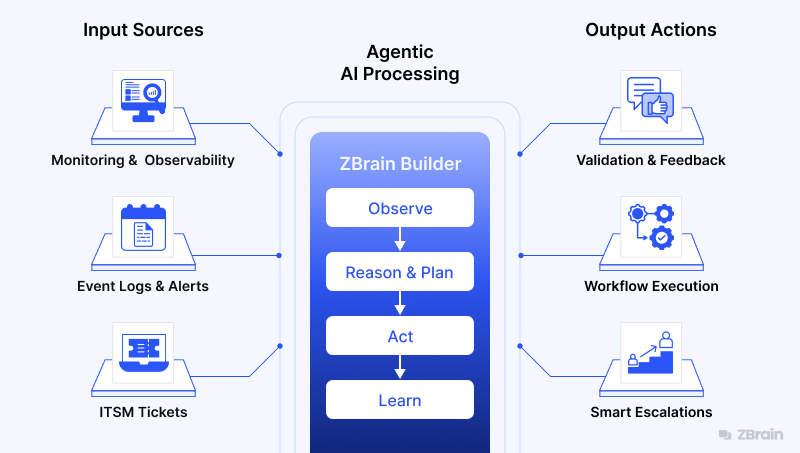
The agentic AI workflow
Agentic AI operates through a self-sustaining feedback loop:
-
Observe: Gather inputs from logs, monitoring tools, service desks and configuration databases.
-
Reason: Analyze patterns and infer what’s happening and why.
-
Plan: Formulate an action plan with checkpoints and fallback strategies.
-
Act: Execute steps through connected IT tools – triggering jobs, modifying configurations or initiating remediations.
-
Learn: Assess the outcome, capture feedback and update internal models to refine future responses.
Together, these steps enable automation that can handle more complex, real-world IT scenarios with greater consistency and control.
Why agentic AI matters for IT operations
In traditional IT operations, automation covers predictable, rule-based tasks, while engineers handle complex, variable problems. However, as IT ecosystems grow more distributed and interconnected, these boundaries blur. Systems now demand adaptive automation – capable of contextual reasoning and safe autonomy.
Agentic AI fulfills that need. It can correlate alerts, diagnose issues, run pre-approved remediations, validate recovery and record actions – all without human intervention for low-risk tasks. For higher-risk scenarios, it operates under graduated autonomy, escalating decisions to human operators when confidence levels or policy thresholds are not met. Low-risk tasks run automatically, while high-risk actions (like modifying firewall rules) are routed to a human-in-the-loop for approval, ensuring that speed never compromises security. This hybrid governance model ensures reliability, transparency and control.
Assessing readiness for agentic AI integration in IT operations management
Agentic AI represents the next frontier of intelligent automation – one that moves enterprises from simply responding to incidents toward systems that can anticipate, act and adapt autonomously. But reaching this level of operational maturity requires more than adopting new tools. It demands a structured assessment of an organization’s data, processes, skills and governance readiness to ensure AI agents can function safely and effectively within IT operations.
1. The ITOM maturity curve: From automation to autonomy
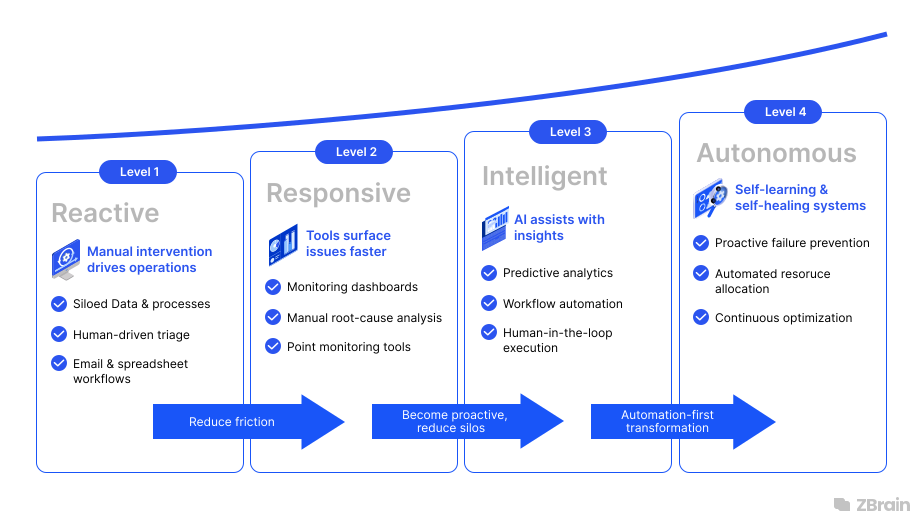
Organizations typically progress through four stages of IT operations maturity. Understanding where you stand helps define realistic agentic goals.
Level 1 – reactive: Manual processes, siloed data and human-driven triage dominate. Teams rely on emails, calls and spreadsheets to resolve incidents.
Level 2 – responsive: Monitoring tools and dashboards surface issues faster, but root-cause analysis and remediation remain largely manual.
Level 3 – intelligent: Predictive analytics and workflow automation reduce noise. AI assists with correlation and diagnosis, though execution actions often still require human approval (human-in-the-loop).
Level 4 – autonomous: Systems become self-learning and self-healing. Agents proactively analyze failures, allocate resources and verify outcomes within defined governance boundaries.
Agentic AI drives this final transition – turning ITOM from a reactive support function into a continuously optimizing, self-regulating ecosystem.
2. Aligning workflow automation and agentic AI
Agentic AI is not a replacement for strong operational automation. It should sit on top of it as a decision and exception-handling layer. For many ITOM scenarios, deterministic automation – standardized workflows, runbooks and policy-based remediation – remains the fastest and most cost-effective path to value. When steps are stable and failure modes are predictable, traditional automation is usually cheaper to build, faster to run and easier to validate.
Choosing between workflows and agents

To keep adoption disciplined, apply a simple “workflow-first” test.
Use deterministic automation (scripts/runbooks) when:
-
The task is stable and repeatable.
-
Inputs are structured and predictable.
-
Success criteria are clear and testable.
Why: lower build and run cost, low latency and straightforward auditability.
Use agentic AI when:
-
Inputs are incomplete, noisy or unstructured (for example, free-text tickets, ambiguous alerts, partial logs).
-
Context is spread across multiple systems (observability, ITSM, change, CMDB, asset data).
-
The resolution path changes based on live conditions, risk or history.
Why: Agents can reason across fragmented contexts and handle variability that breaks rigid workflows.
Using agents as orchestration layers
In mature environments, agentic AI is most effective as a decision and orchestration layer over existing automation. The agent interprets context, selects and parameterizes the right workflows or scripts, executes them through existing tools, and verifies outcomes – escalating to humans when confidence or risk thresholds are not met. This pattern lets organizations keep the reliability of proven automation while using agents to make smarter, context-aware choices about when and how that automation runs.
When designing agentic use cases, define clear success metrics – such as faster resolution, fewer escalations and improved coverage of long-tail scenarios – so agent-driven orchestration delivers measurable value alongside existing workflows.
3. Data readiness: The foundation of agentic intelligence
High-quality, accessible and contextual data is the fuel for effective AI agents. Organizations must ensure:
-
Unified observability: Comprehensive monitoring signals from infrastructure, applications and networks must be captured and correlated in real time.
-
Configuration and topology: A flat list of servers isn’t enough. The configuration management database must be accurate and mapped to dynamic service topologies (dependency graphs) so agents can understand downstream impacts.
-
Event log integrity: Normalized, noise-reduced event streams allow agents to detect true anomalies without being confused by false positives.
-
Feedback loops: Mechanisms must exist for the monitoring and ITSM systems to report success/failure back to the agent, enabling it to update its context.
4. Process readiness: Standardization before autonomy
Agents thrive in structured environments. Before introducing them, IT teams should ensure:
-
LLM-optimized knowledge: Runbooks and standard operating procedures (SOPs) must be digitized and easily accessible for parsing by retrieval-augmented generation (RAG) systems.
-
Automation hygiene: Existing scripts and playbooks should be modular, version-controlled and well-tested – forming the “tools” that agents can safely call upon.
-
Cross-system interoperability: APIs must connect monitoring, ticketing and automation tools, allowing agents to execute actions seamlessly across domains.
5. Skills readiness: The human enablers
Agentic systems elevate human expertise. Key competencies required include:
-
Site reliability engineering (SRE) and platform engineering: Teams responsible for designing safe execution pipelines, ensuring system reliability and embedding observability into every service.
-
Knowledge engineering: Specialists who translate unstructured troubleshooting notes into clear, structured formats that AI agents can use.
-
AI literacy: Operations staff who understand confidence thresholds and model behavior to effectively supervise and audit AI actions.
6. Governance readiness: Trust, security and accountability
The greatest barrier to AI autonomy is not technology – it’s trust. Governance frameworks must evolve to balance speed with control:
-
Non-human identity management: Agents should operate via dedicated service accounts with least-privilege access, rather than sharing admin credentials.
-
Auditability and traceability: Every agent action, reasoning step and data source used must be logged for compliance and post-incident review.
-
Security guardrails: Establish fail-safe controls, rate limits and deterministic rules (e.g., “Never delete a production table”) that the AI cannot override.
7. Risk considerations and mitigation
Adopting agentic AI introduces new operational risks that must be managed:
-
Data integrity issues: Bias or incompleteness in training data can lead to incorrect remediation logic.
-
Hallucination and overreach: The risk of agents generating inaccurate interpretations or acting beyond defined parameters, such as misidentifying issues or performing unintended actions.
-
Integration fragility: Breakages occur when legacy APIs change unexpectedly, causing agent actions to fail.
Mitigation strategy: Use a “graduated autonomy” model – starting with recommendations only, moving to supervised execution, and finally allowing full autonomy for low-risk tasks.
Organizations that meet these prerequisites are positioned to move confidently from automated to autonomous operations, unlocking measurable gains in resilience, agility and efficiency.
Agentic failure modes in IT operations — and how to design against them
Agentic AI introduces a powerful new capability into IT operations: systems that can interpret context, make decisions, and take action with minimal human intervention. But with that capability comes a new class of failure modes—ones that differ fundamentally from traditional automation errors.
In conventional automation, failures are deterministic: a script breaks, a dependency fails, or a condition isn’t met. In agentic systems, failures are contextual and probabilistic—arising from how systems perceive, interpret, and act under uncertainty. This makes them harder to predict and more dependent on data quality, reasoning accuracy, and execution boundaries.
Automation bias: Over-reliance on agent decisions
As agents become more capable, operators tend to trust their outputs—sometimes excessively. This “automation bias” becomes particularly pronounced during high-severity incidents, where time pressure reduces the ability to evaluate recommendations critically.
Unlike traditional automation, where outputs are rule-bound and predictable, agentic systems generate context-dependent decisions that may appear correct but require validation.
Design implication: Maintain human-in-the-loop checkpoints for medium- and high-risk actions, and surface confidence levels and reasoning summaries to support informed oversight.
Action cascade failures: When fixes trigger new incidents
In interconnected environments, a seemingly valid remediation—such as restarting a service—can trigger unintended downstream effects. In agentic systems, where actions may be executed rapidly and in sequence, these cascades can amplify quickly.
Because agents operate across systems and dependencies, their actions can propagate impact beyond the initially identified issue.
Design implication: Enforce bounded action scopes, dependency-aware execution, and staged rollouts (e.g., canary actions) before system-wide changes.
Context integrity failures: Acting on incomplete or outdated data
Agentic systems rely heavily on contextual inputs—such as logs, metrics, CMDB data, and topology maps. When this data is stale, inconsistent, or misaligned, agents can build an incorrect understanding of system state.
Unlike traditional automation, which operates on predefined inputs, agents dynamically assemble context—making them more sensitive to data quality issues.
Design implication: Implement validation layers and prioritize real-time, trusted data sources. Where context confidence is low, agents should defer to escalation.
Reasoning errors: Plausible but incorrect actions
Even with correct data, agents may generate actions that are syntactically or operationally plausible but incorrect—such as referencing deprecated services or constructing invalid commands.
These errors arise from inference under uncertainty rather than broken logic, making them harder to detect through traditional testing.
Design implication: Ground agent actions in verified knowledge sources, enforce schema validation for tool use, and constrain execution to known-safe interfaces.
Misaligned optimization: Solving for speed, not correctness
Agents that learn from outcomes may optimize for the wrong objective—for example, closing tickets quickly rather than resolving underlying issues.
This creates short-term efficiency at the cost of long-term reliability.
Design implication: Align success metrics with durable outcomes such as incident recurrence, system stability, and service health.
Scope errors and blast radius expansion
An agent may correctly identify an action—such as restarting a service—but apply it to the entire cluster rather than a single node, unnecessarily increasing the blast radius of the operation.
Because agentic systems can execute actions at scale, incorrect scoping can significantly magnify impact.
Design implication: Define strict execution boundaries, enforce blast radius controls, and require scoped validation before high-impact actions.
Failure interaction: When risks compound
These failure modes rarely occur in isolation. For example, incomplete context can lead to incorrect reasoning, which, when combined with automation bias, results in the unchallenged execution of flawed actions.
Design implication: Treat the agentic lifecycle—perception, reasoning, and action—as a series of controlled checkpoints rather than a single execution path. Each stage should validate inputs from the previous one, ensuring that errors are detected early instead of compounding across the system.
Understanding how these risks interact is critical, as compounded failures tend to be more severe than individual errors.
Designing for safe autonomy
These patterns highlight a broader principle: autonomy must be bounded by design.
Effective agentic systems are not those that attempt to resolve every scenario independently, but those that:
-
recognize uncertainty and act accordingly,
-
operate within clearly defined execution boundaries,
-
and make their decision processes transparent and auditable.
In practice, this means:
-
graduated autonomy models (recommend → assist → act),
-
context-aware guardrails tied to risk levels,
-
traceable reasoning, where decisions and supporting context are logged for review,
-
and built-in rollback and recovery mechanisms.
Agentic AI does not eliminate operational risk—it redistributes it. The advantage is that, when designed correctly, agentic systems can be more consistent, more observable, and more governable than purely human-driven operations.
The trust architecture: Governance, accountability, and explainability in autonomous IT operations
As agentic AI introduces autonomy into IT operations, the core challenge shifts from capability to trust. Enterprises are not constrained by whether agents can act—they are constrained by whether those actions can be trusted to be safe, predictable, and accountable. In environments where even routine changes can cascade into broader failures, governance cannot remain a checklist layered on top of systems. It must be embedded in the design and operation of those systems.
This is where the idea of a trust architecture becomes critical.
The accountability gap: Redefining responsibility in agentic systems
One of the most immediate challenges in this model is the emergence of an accountability gap. In traditional IT operations, actions can be traced back to a human decision. When something goes wrong, responsibility is clear. In agentic systems, that clarity dissolves.
A decision may be shaped by the model’s reasoning, the knowledge it retrieves, the policies governing its behavior, and the autonomy thresholds defined by operators. The practical question is no longer abstract—it is operational: when an agent causes an outage, who is held accountable?
Is it the platform team that defined the policy, the knowledge engineer who maintained the runbook, or the operator who allowed the agent to act autonomously?
What changes is not whether accountability exists, but where it resides. Organizations must move from assigning responsibility to individual actions toward distributing it across system design, policy ownership, and oversight models. Without this shift, governance frameworks remain incomplete.
Graduated autonomy: From feature to governed capability
Autonomy in IT operations is often framed as a binary choice—either the agent acts, or it does not. In practice, autonomy behaves more like a capability that must be earned and governed over time.
Early deployments rely on recommendations and assisted execution. As systems demonstrate reliability, they are trusted with greater independence. But this progression cannot be implicit. Trust must be built on evidence—on observed outcomes, repeatability, and controlled expansion of scope.
In this sense, autonomy becomes a managed capability rather than a configuration setting.
Explainability aligned with operational risk
Explainability in agentic systems is often treated as a universal requirement. In practice, it is inherently tied to risk. Low-impact actions, such as retrieving logs or classifying tickets, require minimal justification. As the impact increases, so does the need for structured reasoning. Actions such as restarting services or modifying configurations require contextual explanations, while high-risk operations require clear, human-readable justification before execution.
What matters is not that every action is explainable in the same way, but that explanation is proportionate to its potential impact. Systems that fail to differentiate here either introduce unnecessary friction or expose themselves to avoidable risk.
From action logs to decision traceability
Traditional systems answer what happened. Agentic systems must also explain why it happened.
This requires a shift from basic logging to decision traceability—capturing not just actions, but the reasoning behind them. For example, when an agent restarts a service, it should record:
-
the signals that indicated degradation,
-
the context or runbook it referenced,
-
the confidence level of its diagnosis,
-
and the outcome of the action.
This transforms auditability into a reconstructable chain of decisions, enabling teams to evaluate not just outcomes, but the quality of reasoning that produced them.
Non-human identity: Governing autonomous access
Agentic systems introduce a new operational reality: non-human actors with system access.
These agents often operate across multiple tools and environments, requiring permissions that, if not carefully governed, can introduce significant risk. Treating them as extensions of existing systems is insufficient.
They must be treated as first-class identities—provisioned with scoped access, governed by least-privilege principles, and continuously audited based on their behavior. This ensures that autonomy is constrained not by assumption, but by infrastructure.
Designing for trust, not just control
Trust in agentic systems is not achieved by limiting what agents can do, but by ensuring that what they do is bounded, observable, and accountable by design.
Organizations that succeed will move from:
-
static controls to dynamic, policy-driven governance,
-
human-only oversight to system-level supervision,
-
reactive audits to continuous visibility into decision-making.
In doing so, they will find that well-designed agentic systems can be more governable than human-driven operations—because every decision, unlike human intuition, can be traced, evaluated, and improved systematically.
Multi-agent architecture patterns for IT operations
The right question to ask about agentic AI in IT operations is not “what can this agent do?” It is: “How do multiple agents coordinate safely, consistently, and correctly across systems that no single agent can fully understand?”
This distinction matters because IT environments are inherently distributed and cross-domain, making them poorly suited to single-agent design. An incident rarely originates in a single domain—it may involve application behavior, infrastructure changes, network dependencies, third-party services, and identity systems simultaneously. No individual agent has complete visibility across all of these layers.
As a result, effective agentic systems are not built as isolated agents, but as systems of agents, where specialized agents collaborate to observe, diagnose, and act. How these agents are structured—and how they exchange context—determines whether the system converges on the correct outcome or amplifies incorrect assumptions.
Orchestrator–worker: Structured coordination
In this model, a central orchestrator decomposes work and delegates tasks to specialized agents—such as triage, diagnostics, and remediation agents. The orchestrator maintains task state and aggregates results.
This pattern aligns closely with existing ITSM workflows, where a central function coordinates domain specialists. It is well-suited for structured incidents with defined resolution paths and strong audit requirements.
Trade-off:
The orchestrator becomes a coordination dependency. If it loses context or fails to produce a valid plan, the entire workflow can stall—making resilience and fallback handling essential.
Peer-to-peer (mesh): Distributed reasoning
In mesh architectures, agents operate more independently, sharing hypotheses and refining each other’s outputs through a shared context layer.
This approach is effective for complex, cross-domain incidents where the source of failure is unclear and context evolves dynamically.
Trade-off:
Without strong convergence controls, agents can reinforce incorrect assumptions. Correlated signals across systems may be interpreted as independent confirmation, leading to high-confidence but incorrect conclusions.
Hierarchical supervisor: Controlled autonomy
This pattern introduces a supervisory agent that evaluates proposed actions, enforces policy constraints, and approves high-impact decisions.
It mirrors how senior engineers oversee operations—maintaining control over actions with broader impact.
Trade-off:
Improved safety and governance come at the cost of latency, making this pattern better suited for high-risk or policy-sensitive actions rather than real-time remediation.
Failure propagation across agents
Multi-agent systems introduce a unique risk: errors propagate across agent boundaries.
A misdiagnosis by one agent becomes input for another, reinforcing incorrect assumptions as they move through the system. By the time an action is executed, the error may appear well-supported simply because multiple agents have built on the same flawed premise.
Effective systems treat inter-agent handoffs as validation points, not just data transfers—requiring agents to verify upstream conclusions against independent signals before acting.
Coordination and memory considerations
Multi-agent systems rely on shared context and memory—combining real-time signals, historical patterns, and retrieved knowledge. In practice, this includes:
-
working context for active incidents,
-
historical patterns from past resolutions,
-
and knowledge retrieved from runbooks and documentation.
Failures in any of these layers—such as stale data or outdated knowledge—can propagate across agents, affecting downstream decisions.
Pattern selection in practice
In real-world deployments, no single pattern dominates. Most systems combine multiple approaches:
-
orchestrator–worker for structured workflows,
-
supervisory control for high-risk actions,
-
and distributed reasoning for complex diagnostics.
The goal is not to choose one pattern, but to compose them effectively—aligning each with the risk profile, latency requirements, and complexity of the task.
Ultimately, agentic IT operations are not defined by individual agents, but by how systems of agents coordinate under uncertainty. The organizations that succeed will not be those that deploy the most agents, but those that design how those agents work together—safely, predictably, and with clear boundaries.
Benefits of agentic AI and intelligent ITSM in IT operations management
Agentic AI extends traditional automation with reasoning and orchestration, enabling IT to move from reactive scripts to adaptive, reliable operations. Let’s explore the key business and operational benefits of adopting agentic AI across ITOM and ITSM.
-
Faster resolution and lower Mean Time to Resolve (MTTR)
Most ticket resolution is not diagnosis – it’s waiting: waiting for triage, assignment, context gathering, approvals and handoffs. Agentic AI compresses this latency by automating the early lifecycle steps and running parallel investigations.
-
Instant triage and routing: Classify issues, identify impacted services and route to the right resolver group immediately.
-
Context enrichment by default: Attach logs, metrics, change history and configuration item (CI) context before a team member is assigned for the ticket.
-
Parallel execution: Investigate multiple hypotheses simultaneously (instead of a single engineer doing sequential checks).
Value: L1/L2 issues resolve faster, escalations reduce, and specialists spend more time on novel problems rather than repetitive troubleshooting.
-
From reactive firefighting to proactive resilience
Legacy ITOM often detects failure after users feel the impact. Agentic AI improves the system’s ability to analyze and prevent common incidents by continuously evaluating telemetry and operational patterns.
-
Early warning and preventative maintenance: Identify leading indicators (capacity saturation, latency drift, certificate expiry, recurring error patterns).
-
Self-healing for known failure modes: Identify common failure scenarios and automatically initiate pre-approved recovery workflows.
-
Outcome-aware observability: Monitor not only failures but also early signs of drift from reliability targets.
Value: fewer major incidents, less downtime, and fewer “surprise” outages that derail business operations.
-
Reduced toil, alert fatigue and operational burnout
Toil refers to repetitive, low-value work – like noise triage, log scraping and manual documentation – that adds little lasting value. Agentic AI helps reduce this burden while keeping humans in control for high-impact or sensitive tasks.
-
Noise suppression: Groups repetitive alerts into a single incident to reduce alert fatigue and highlight what matters.
-
Routine task offloading: Password/access requests, ticket enrichment, status updates and common remediation steps.
-
Consistency under pressure: Agents don’t skip steps, forget checks or omit documentation during high-severity incidents.
Value: higher engineering focus, better on-call experience, and improved retention in ops/service teams.
-
Standardizing knowledge to minimize team dependency
A recurring IT risk is that critical troubleshooting know-how resides in the heads of a few senior engineers. Agentic AI shifts knowledge from informal memory to reusable operational assets.
-
Dynamic knowledge retrieval: Pull relevant guidance from tickets, runbooks and knowledge bases at the moment of need.
-
Standardized execution: Apply best-known SOPs consistently across teams and shifts.
-
Living documentation: Convert successful resolutions into reusable knowledge content and post-incident summaries.
Value: faster onboarding, fewer expert-dependent resolutions, reduced variance in support quality, and a more resilient ops model.
-
Stronger governance, auditability and safer execution
Autonomy does not have to reduce control. Well-designed agentic systems can be more governable than manual operations because they operate within explicit policies and produce traceable logs.
-
Complete audit trails: Every action, tool call and decision rationale can be logged and reviewed.
-
Policy-based guardrails: Enforce read-only by default approval gates for medium- and high-risk actions, and hard constraints on prohibited operations.
-
Reliable compliance behaviors: Consistent adherence to security and change processes, even during outages.
Value: better compliance posture, reduced human error, and improved trust in operational execution.
-
Cost optimization and resource efficiency
In cloud and SaaS-heavy environments, operational inefficiency directly impacts cost. Agentic AI helps continuously identify and address such inefficiencies through intelligent analysis and automation.
-
Resource efficiency: Detect idle or oversized resources and recommend or initiate right-sizing actions in accordance with policy.
-
License hygiene: Identify underused licenses, prompt reclamation workflows, and reduce unused spend.
-
Better utilization of human time: Shift effort from repetitive ticket work to reliability engineering and improvement initiatives.
Value: measurable reduction in avoidable spend, improved service economics, and higher ROI from existing tooling and teams.
Benefits by stakeholder
For employees and end users: faster, simpler service
-
Higher self-service success: Conversational, context-aware support reduces form-filling and back-and-forth.
-
Faster outcomes: Common issues resolve in minutes instead of hours/days.
-
Consistent experience: Support quality doesn’t depend on shift, channel or individual agent expertise.
-
Always-on availability: 24/7 coverage for global teams without adding support shifts.
For service desk teams: less repetitive work, more meaningful problem-solving
-
Lower handle time: Enriched tickets and recommended resolutions reduce manual investigation.
-
Fewer reassignments: Better categorization and routing reduce unnecessary handoffs between teams.
-
More focus on complex issues: Humans can spend time where judgment is required.
-
Improved documentation quality: Summaries and reports are generated consistently as part of the workflow.
For service owners and administrators: tighter control with less overhead
-
Operational visibility: Real-time insights into SLA risk, bottlenecks and recurring failure modes.
-
Automation that adapts: Workflows can be orchestrated based on context rather than rigid rules.
-
Governance at runtime: Approvals, audit logging and policy enforcement become embedded controls.
-
Continuous improvement loop: Identify what automations worked, where agents hesitated, and where runbooks need refinement.
For CIOs and decision-makers: scalable reliability and measurable ROI
-
Scale without proportional headcount: Handle growth in tickets, services and complexity more efficiently.
-
Reliability as a business enabler: Fewer outages and faster recovery protect revenue and productivity.
-
Better investment decisions: Clearer operational data supports prioritizing tooling, training, and modernization.
-
Strategic capacity unlocked: Teams spend more time on transformation, resilience and service improvement.
Agentic AI turns ITOM and ITSM from queue-driven, manual coordination into a faster, policy-governed execution model – reducing MTTR, toil and risk while improving reliability at scale. The result is measurable operational ROI today, and a foundation for autonomy as data, workflows and governance mature.
Trends shaping agentic AI in ITSM and ITOM
Enterprise IT has already moved through multiple disruption waves – from manual help desks to ITIL (Information Technology Infrastructure Library)-based service management, from workflow automation to AI chatbots. The next shift is more structural: agentic AI, where systems can plan and execute work within defined guardrails, not just generate answers. Over the next few years, this moves from selective pilots to mainstream operating models as platforms, governance and integration maturity catch up.
Below are the most important trends to expect:
The Configuration Management Database (CMDB) evolves into a real-time context layer
The CMDB has long served as an authoritative inventory of systems and dependencies, but its biggest limitation—staleness—becomes critical in agentic environments.
Agents require real-time, relational context at the moment of action, not periodically updated snapshots. This is driving a shift from static records to graph-derived context, where relationships between systems, services, and dependencies are continuously updated and traversable.
As a result, the CMDB moves from a primary source of truth to one input among many, reconciled against live telemetry before decisions are made.
The ticketing system becomes a coordination layer
In traditional ITSM, tickets are units of work for humans. In agentic systems, they become a shared state across agents.
Multiple agents enrich, update, and act on the same ticket—turning it into a coordination surface rather than a queue item. This shifts ITSM platforms toward functioning as real-time orchestration layers rather than just workflow tools.
Observability becomes the foundation for reasoning
Observability data is no longer just for human analysis—it becomes the perceptual layer for agents.
Instead of dashboards, agents require structured, contextualized signals they can interpret directly. As agents continuously analyze telemetry and act on it, the boundary between monitoring and operations blurs.
Knowledge shifts from curation to continuous generation
Knowledge management moves from periodic documentation to continuous creation.
Agents generate knowledge from every incident and resolution, keeping documentation current. However, this introduces a new challenge: ensuring quality and provenance, as machine-generated knowledge becomes part of the decision loop.
Governance moves to the infrastructure layer
Governance is shifting from application-level controls to infrastructure-level enforcement.
This includes:
-
non-human identity management,
-
policy enforcement at execution layers,
-
and blast radius controls applied before actions are executed.
The focus shifts from controlling agents to designing systems that structurally constrain unsafe actions.
What is ZBrain™?
ZBrain™ is an enterprise-grade AI enablement platform that empowers organizations to assess, build, and scale intelligent agents and applications—without requiring deep AI expertise.
What is ZBrain Builder?
ZBrain Builder is the core low-code agentic AI orchestration platform of ZBrain. It enables organizations to build, design and deploy AI agents, workflows, and apps by combining proprietary knowledge, business logic, and model orchestration—all through an intuitive visual interface, Flows.
Key capabilities of ZBrain Builder
-
Low-code AI workflow design: Allows users to visually create Flows to define multi-step logic, invoke tools, and integrate LLMs, APIs, and data sources.
-
Agentic AI orchestration: Enables building and managing intelligent agents that can plan, reason, retrieve knowledge, and act using LLMs and tools.
-
Model-agnostic integration: Allows users to choose from leading LLMs (GPT-5, Gemini, Claude, etc.) and orchestrates them with contextual enterprise data.
-
Knowledge Base management: Enables populating structured KBs with internal documents, databases, or Flows for precise retrieval and contextual understanding.
-
Tool and API integration: Connects seamlessly with external APIs, databases, CRMs, or cloud apps to enable agents to take real-world actions.
-
Enterprise system compatibility: Integrates with Slack, Teams, Salesforce, and other platforms to embed AI into day-to-day operations.
-
Agent Crew collaboration: Enables building multiple specialized agents to collaborate in a modular, orchestrated fashion for complex tasks.
-
Prebuilt agents and customization: Enables deploying ready-to-use agents or creates tailored ones for specific enterprise needs.
-
Monitoring and governance: Allows users to track performance, ensure reliability, and maintain compliance with enterprise-grade observability and security.
-
Security and compliance: Being SOC 2 Type II, ISO 27001, HIPAA, and GDPR-compliant—ensuring secure AI operations with granular control.
ZBrain Builder combines orchestration, retrieval, and reasoning to help enterprises transition from AI opportunity discovery to full-scale, intelligent automation—at speed and with confidence.
Applications of agentic AI in ITOM and ITSM
Agentic AI delivers the most value in IT operations when it reduces manual coordination across tools and teams. Below are high-impact agentic AI applications across ITOM and ITSM—paired with how ZBrain Builder can implement them.
Incident management
Agentic AI shortens the time from issue detection to resolution by enriching tickets, routing them accurately, and standardizing response workflows. The result is lower Mean Time to Resolve (MTTR), fewer escalations, and less back-and-forth.
| Agentic AI use cases | Description | How ZBrain helps |
|---|---|---|
| Contextual incident triage | Consolidating relevant telemetry and diagnostic context to accelerate root cause analysis and resolution. | ZBrain’s Contextual Triage Agent can collect and consolidate contextual information from logs and monitoring tools and enrich incident or request tickets. |
| Ticket categorization | Classifying tickets by issue type, severity, and skills needed to route correctly. | ZBrain’s Ticket Categorization Agent can categorize support tickets and direct them to the appropriate response team. |
| Ticket escalation recommendations | Identifying tickets severity and urgency and recommending the right escalation path early. | ZBrain’s Ticket Escalation Recommendation Agent can analyze severity and urgency and recommend escalation paths for faster handling of critical issues. |
| Automated remediation | Executing authorized fixes for low-risk, repetitive issues (e.g., service restarts, disk cleanup) without human intervention. | ZBrain agents can trigger and validate pre-approved runbooks to resolve known issues instantly, updating the ticket with the outcome. |
| Resolution suggestions | Generating targeted resolution guidance for common issues to reduce clarification cycles. | ZBrain’s Automated Resolution Suggestion Agent can analyze help desk tickets and deliver relevant resolution suggestions for faster issue resolution. |
| Incident documentation generation | Producing consistent incident reports for audits, handoffs, and post-incident review. | ZBrain’s Incident Documentation Generator Agent can automate detailed incident reporting, capturing issues, resolutions, and impact. |
| Auto-triage and prioritization | Applying business context (service criticality, user role, SLAs) to prioritize consistently. | ZBrain agents can support priority recommendations by combining ticket context, historical patterns, and SLA inputs to reduce mis-prioritization. |
Monitoring, performance, and SLA reliability
Agentic AI strengthens reliability by continuously watching service health, detecting degradation early, and triggering the right response workflow. This helps teams protect SLAs with fewer manual checks.
| Agentic AI use cases | Description | How ZBrain helps |
|---|---|---|
| Network downtime alerts | Detecting downtime or degradation and notifying responders to minimize impact. | ZBrain’s Network Downtime Alert Agent can monitor network performance and automatically send alerts on downtime or performance degradation. |
| Server performance alerting | Tracking server resource health and raising alerts when performance degrades. | ZBrain’s Server Performance Alert Agent can monitor server resources in real time and generate alerts when resources are strained. |
| SLA compliance monitoring | Monitoring SLA adherence and alerting on breaches to protect service quality. | ZBrain’s SLA Compliance Monitoring Agent can automate SLA monitoring and alert teams when SLAs are breached. |
| Performance and SLA reporting | Producing periodic and exception-based reports for operational reviews. | ZBrain AI agents can support reporting by summarizing SLA status and performance trends into stakeholder-ready updates. |
Change and release management
Agentic AI reduces change friction by standardizing change planning and surfacing risk and impact signals earlier. When done right, it increases the change success rate without slowing delivery.
| Agentic AI use cases | Description | How ZBrain helps |
|---|---|---|
| Change plan drafting | Generating first-draft implementation and testing plans to standardize change execution. | ZBrain’s Change Plan Drafting Agent can generate initial implementation and testing plans for change requests by analyzing request details and referencing past changes. |
| Impact analysis | Proactively identifying services and dependencies likely to be affected before actions are taken. | ZBrain AI agents can compile context from service inventories and historical operational data to infer potential impact across systems. |
| Approval support and change summaries | Generating concise, approval-ready justifications with rollback and test evidence. | ZBrain AI agents can support change governance by producing reviewer-focused summaries that capture risk, validation steps, and rollout readiness. |
Problem management
Agentic AI supports problem management by detecting recurring issues, analyzing correlations, and generating actionable root-cause insights to prevent repeat incidents.
| Agentic AI use cases | Description | How ZBrain helps |
|---|---|---|
| Recurring-incident pattern detection | Detecting repeated incident indicators/patterns across tickets to identify underlying problems faster. | ZBrain AI agents can cluster historical tickets and surface recurring signatures to propose problem candidates. |
| Root-cause hypothesis generation | Summarizing evidence and proposing likely root causes based on signals and history. | ZBrain AI agents can support RCA by correlating logs, incidents, and change context into a structured hypothesis. |
Request fulfillment and employee self-service
Agentic AI improves service experience by handling common requests end-to-end and guiding users through self-service. This increases deflection while keeping complex cases routed to humans.
| Agentic AI use cases | Description | How ZBrain helps |
|---|---|---|
| Self-service portal management | Improving self-service experiences so users can resolve common issues without team help. | ZBrain’s IT Self-Service Portal Agent can automate the management and optimization of self-service IT portals, enabling users to resolve common issues without direct support. |
| Guided incident and request intake | Standardizing issue capture to reduce clarification cycles and accelerate resolution. | ZBrain AI agents can guide users through structured intake flows—asking the right contextual questions to auto-generate complete, actionable ticket details. |
| Access and provisioning workflows | Automating standard access requests with built-in policy enforcement and full audit traceability. | ZBrain AI agents can handle multi-step provisioning flows—enforcing approvals, managing exceptions, and logging actions for compliance. |
Knowledge management and operational insights
Agentic AI converts operational activity into reusable knowledge and decision-ready summaries. This reduces repeat work and improves consistency across service teams.
| Agentic AI use cases | Description | How ZBrain helps |
|---|---|---|
| Knowledge base article generation | Converting resolved tickets into reusable knowledge to prevent repeat effort. | ZBrain’s Knowledge Base Article Generator Agent can generate knowledge base articles based on resolved tickets, keeping documentation current. |
| User feedback analysis | Identifying dissatisfaction signals and recurring improvement themes from service desk feedback. | ZBrain’s User Feedback Analysis Agent can analyze help desk feedback and surface actionable service improvement insights. |
| Operational summaries and executive reporting | Identifying key patterns, root causes, and emerging operational risks. | ZBrain AI agents can support executive updates by synthesizing incident documentation, ticket patterns, and feedback into concise operational intelligence. |
IT asset, lifecycle, and license governance
Agentic AI strengthens IT governance by keeping asset and license records current and actionable. This improves compliance posture while reducing cost leakage from underused or expired entitlements.
| Agentic AI use cases | Description | How ZBrain helps |
|---|---|---|
| Hardware asset tracking | Maintaining accurate inventory records to reduce loss and misallocation. | ZBrain’s Hardware Asset Tracking Agent can automatically track and manage hardware assets and keep inventory up to date. |
| Asset lifecycle management | Tracking asset depreciation, maintenance, and lifecycle actions to reduce cost and downtime. | ZBrain’s Asset Lifecycle Management Agent can streamline lifecycle tracking, depreciation, and maintenance planning. |
| License expiration and usage alerts | Reducing compliance risk by flagging expirations and usage violations early. | ZBrain’s Software License Alert Agent can automate alerts for license expiration and usage violations to prevent penalties. |
| License optimization | Identifying underutilized licenses and recommending reallocation to cut waste. | ZBrain AI agents can support optimization by consolidating usage signals and highlighting opportunities to reassign or retire licenses. Its License Audit and Optimization Agent can analyze usage data and recommend cost-saving actions. |
Identity and access management (IAM)
Agentic AI strengthens identity and access management by automating privilege oversight, detecting access drift, and streamlining review workflows for continuous compliance.
| Agentic AI use cases | Description | How ZBrain helps |
|---|---|---|
| Privilege drift detection and access governance | Detecting redundant or misaligned access and reducing drift from least-privilege posture. | ZBrain’s Access Governance AI Agent can monitor access drift and misalignments, explain redundant privileges, and support continuous access governance. |
| Access review workflow support | Streamlining periodic access reviews with evidence and exceptions highlighted. | ZBrain AI agents can support access review operations by compiling entitlements, highlighting anomalies, and generating reviewer-ready summaries. |
Streamline your operational workflows with ZBrain AI agents designed to address enterprise challenges.
Measuring the ROI of agentic AI in IT operations management
As enterprises introduce agentic AI into ITOM and ITSM, ROI needs to be viewed beyond direct cost savings. Value typically shows up as improvements in speed, resilience, accuracy, governance and service experience. Because agentic systems reduce manual coordination, automate high-volume decision loops and shift work from reactive to proactive, ROI emerges through both operational efficiencies and qualitative gains in service quality.
Below are the core ROI dimensions IT leaders can track – along with how ZBrain™ can support each.
Reduced operational toil and handling cost
Agentic AI can reduce the manual effort required for repetitive, low-complexity tasks such as classification, routing and standard resolutions. Over time, this may contribute to lower cost per ticket and more capacity for teams to focus on higher-value work.
Example metrics
-
Cost per ticket.
-
Reduction in manual remediation cycles.
-
Fewer repetitive human tasks (“toil hours”).
-
Time spent processing alert noise.
How ZBrain Builder supports this
ZBrain AI agents can help automate routine actions – such as ticket categorization, escalation suggestions, and resolution recommendations for common issues – which may reduce manual effort and streamline service desk operations.
Faster detection, triage and resolution (MTTD/MTTR)
Shrinkage in the time between “something is wrong” and “service is restored” is a key ROI driver. Agentic AI can help compress MTTD and MTTR by enriching incidents with context, guiding responses and supporting more consistent execution.
Example metrics
-
Mean Time to Detect (MTTD).
-
Mean Time to Resolve (MTTR).
-
First-contact resolution rate.
-
Percentage of incidents assisted or auto-resolved.
How ZBrain Builder supports this
ZBrain AI agents can assist in faster detection and triage by consolidating relevant signals and surfacing context for analysts. Its various agents can help surface anomalies quickly, enrich incidents with telemetry and support more efficient diagnosis and response across infrastructure and applications.
Improved service availability and stability
Agentic AI can support a shift from reactive firefighting to more proactive management by highlighting patterns, emerging risks and preventative actions before users are affected.
Example metrics
-
Uptime and SLA adherence.
-
Number of repeat incidents per service.
-
Incidents linked to known recurring problems.
-
Frequency of performance degradations.
How ZBrain Builder supports this
ZBrain agents can help monitor service health and bring potential issues to the attention of IT teams earlier. These can support continuous monitoring, early surfacing of performance or security concerns and more informed preventative actions.
Stronger governance, compliance and auditability
As automation grows, governance becomes a core ROI dimension: fewer compliance gaps, less manual audit work and clearer traceability of operations.
Example metrics
-
Number of compliance or policy deviations.
-
Effort required for audit preparation.
-
Completeness and consistency of incident and change documentation.
-
Findings from access and privilege reviews.
How ZBrain Builder supports this
ZBrain AI agents can support ongoing oversight and documentation across IT operations. Its various agents can help monitor compliance, generate structured documentation and assist teams in reviewing access patterns and preparing for audits.
Improved user experience and service quality
Agentic AI can enhance the experience for both end users and IT staff by providing faster, more consistent support and reducing repetitive workloads.
Example metrics
-
CSAT/ESAT for IT services.
-
Time to resolution from the user perspective.
-
Number of follow-ups per ticket.
-
Self-service adoption and deflection rates.
How ZBrain Builder supports this
ZBrain agents can help improve self-service and assisted support journeys. By automating low-friction tasks, improving accuracy and providing contextual responses, ZBrain AI agents reduce wait times and improve the overall end-user journey. These can help keep documentation current, and the User Feedback Analysis Agent can surface experience insights so teams can refine services and reduce friction over time.
Endnote
Agentic AI is set to become a foundational layer of modern IT operations—not as a silver bullet, but as a disciplined extension of the automation, observability, and service management foundations organizations already have in place. The real shift is not just from manual to automated, but from reactive queues to continuously operating digital teammates that can observe, reason, act, and learn within clear constraints. That only works when data is reliable, workflows are well-defined, and governance is treated as a first-class requirement rather than an afterthought.
ZBrain Builder is built to support this kind of grounded transformation. By offering domain-specific ITOM and ITSM agents, orchestration capabilities, and integrations that sit alongside existing tools and processes, it can help teams introduce agentic AI in a phased, measurable way—starting with clearly scoped use cases and expanding as trust and maturity grow. Used thoughtfully, platforms like ZBrain™ enable IT leaders to turn agentic AI from a set of isolated experiments into a managed operational capability that enhances resilience, improves service experience, and creates room for people to focus on the higher-value work only they can do.
Ready to turn agentic AI from concept into practice? Explore ZBrain Builder’s Agent Store for prebuilt ITOM and ITSM agents you can adapt quickly—or use ZBrain Builder to design custom agents tailored to your environment.
Listen to the article
Author’s Bio


CEO LeewayHertz
An early adopter of emerging technologies, Akash leads innovation in AI, driving transformative solutions that enhance business operations. With his entrepreneurial spirit, technical acumen and passion for AI, Akash continues to explore new horizons, empowering businesses with solutions that enable seamless automation, intelligent decision-making, and next-generation digital experiences.
Table of content
- The evolving landscape of IT operations management
- Exploring the current challenges in ITOM
- Understanding agentic AI and autonomous AI agents for IT operations
- Assessing readiness for agentic AI integration in IT operations management
- Agentic failure modes in IT operations — and how to design against them
- The trust architecture: Governance, accountability, and explainability in autonomous IT operations
- Multi-agent architecture patterns for IT operations
- Benefits of agentic AI and intelligent ITSM in IT operations management
- Trends shaping agentic AI in ITSM and ITOM
- What is ZBrain™?
- Applications of agentic AI in ITOM and ITSM
- Measuring the ROI of agentic AI in IT operations management
Share Article


Frequently Asked Questions
What is the difference between agentic AI and traditional automation in IT operations?
Traditional automation in IT operations relies on predefined rules and scripts to execute specific tasks under known conditions. It works well for repeatable scenarios but struggles when inputs are incomplete or environments change.
Agentic AI, in contrast, can interpret context, reason across multiple data sources, and dynamically decide which actions to take. Instead of following fixed instructions, it adapts to real-time conditions—making it more effective for complex, cross-system incidents where static workflows fall short.
What is agentic AI in IT operations, and how does ZBrain Builder support it?
Agentic AI refers to AI systems that can interpret goals, reason about context, choose actions, and interact with tools to drive outcomes – rather than just generate responses. In ITOM and ITSM, this can include agents that triage incidents, enrich tickets, draft change plans, monitor SLAs or coordinate workflows across tools. ZBrain Builder provides an enterprise platform to design, orchestrate and govern such agents, so they operate within defined guardrails and existing IT processes.
What risks should organizations consider when adopting agentic AI in IT operations?
Key risks include:
-
Incomplete or inaccurate context – agents acting on stale CMDB data, partial logs, or missing dependencies
-
Reasoning errors under uncertainty – incorrect diagnosis when data is noisy, ambiguous, or inconsistent
-
Over-reliance (automation bias) – teams trusting agent decisions without sufficient validation, especially during incidents
-
Unintended impact from poorly scoped actions – actions applied at the wrong level, increasing operational risk
Unlike traditional automation, these risks are often contextual rather than deterministic. Organizations can mitigate them through strong governance, clearly defined guardrails, validation mechanisms, and a gradual, controlled expansion of autonomy.
What kinds of ITOM and ITSM agents can be built or used with ZBrain Builder?
ZBrain Builder can be used to orchestrate a range of ITOM and ITSM-focused agents across service desk, operations, security and governance. Examples include:
-
Service desk and self-service: Ticket Categorization Agent, Ticket Escalation Recommendation Agent, Automated Resolution Suggestion Agent, Contextual Triage Agent, Knowledge Base Article Generator Agent, IT Self-Service Portal Agent, and User Feedback Analysis Agent.
-
SLA, monitoring and infrastructure health: SLA Compliance Monitoring Agent, Network Downtime Alert Agent, Server Performance Alert Agent.
-
Assets, licenses and resource management: Hardware Asset Tracking Agent, Asset Lifecycle Management Agent, License Audit and Optimization Agent, Software License Alert Agent, Project Timeline Generation Agent, Resource Assignment Agent.
-
Security, risk and compliance: Incident Response Agent, Incident Documentation Generator Agent, Compliance Monitoring Agent, Security Questionnaire Automation Agent, Access Privilege Review Agent, Access Governance Agent, Access Log Analysis Agent, Threat Intelligence Aggregation Agent.
-
Change, development and engineering support: Change Plan Drafting Agent, Code Documentation Generator Agent, Unit Test Generator Agent, Code Quality Analysis Agent, Code Assistance Agent, Bug Tracking and Resolution Agent.
Teams can also combine these to create multi-agent workflows that support diverse ITOM and ITSM processes.
What deployment models does ZBrain Builder support for IT operations?
ZBrain agents can be deployed in the cloud, on-premises, or in hybrid environments, depending on enterprise requirements. It supports integration with major cloud providers such as AWS, Azure and GCP, and can connect to distributed, multi-cloud or legacy infrastructure so that agentic workflows run close to existing IT systems and data.
Where should we start with agentic AI – what are good first use cases?
Most organizations begin with focused, low-risk areas where workflows are well understood and data sources are already available. Common starting points include ticket triage and categorization, SLA and service health monitoring, incident context enrichment, automated documentation and knowledge base updates. These use cases have clear success metrics and benefit immediately from AI-driven consistency.
ZBrain Builder supports these early steps with agents that help teams reduce manual effort and improve response quality. Once these foundational areas demonstrate value, organizations often expand into adjacent use cases – like proactive alerting or streamlined service request fulfillment – using the same orchestration approach.
What benefits can organizations expect from adopting agentic AI in ITOM and ITSM?
Key benefits include faster incident detection and resolution, reduced manual toil, improved service availability, proactive issue prevention, more consistent operational execution, and a better user experience. Agentic AI also supports stronger governance and auditability due to detailed logging and policy-driven guardrails.
How can we measure the ROI of agentic AI initiatives?
Organizations typically measure the ROI of agentic AI by tracking operational, reliability and experience-focused metrics over time. Common indicators include:
-
Reduction in manual handling effort and “toil hours.”
-
Change in cost per ticket or incident.
-
Improvements in Mean Time to Detect (MTTD) and Mean Time to Resolve (MTTR).
-
Fewer repeated incidents for the same services.
-
Better SLA adherence and fewer breaches.
-
Higher end-user and stakeholder satisfaction (CSAT/ESAT).
By establishing a pre-implementation baseline and comparing these metrics after agentic AI is deployed, IT leaders can assess whether agents meaningfully improve speed, stability, and service quality relative to the investment.
How does ZBrain Builder address security, privacy and compliance for AI agents?
ZBrain Builder emphasizes enterprise-grade security and governance. The platform supports private cloud deployments, encryption, granular role-based access control and network-level protections. It is built to align with standards ISO 27001:2022, SOC 2 Type II, GDPR, and HIPAA, and includes mechanisms such as detailed audit logs, access reviews, and compliance-monitoring agents to help organizations maintain control over how data and actions are used by AI agents.
What are some best practices for safely deploying agentic AI into production IT operations?
A common approach is to start in “copilot” mode – agents propose actions while humans approve them – and gradually expand the scope of autonomous operations for well-understood, low-risk tasks. Organizations usually define clear guardrails (permissions, confidence thresholds, escalation rules), enable detailed logging, and regularly review agent behavior. ZBrain Builder supports this pattern by allowing teams to configure human-in-the-loop checkpoints, approval steps and policy-aligned workflows before scaling up autonomy.
How can I get started with ZBrain™ to enhance my IT operations?
To begin leveraging ZBrain™ for your IT needs, contact us at hello@zbrain.ai or fill out the inquiry form on our website. Our team will engage with you to discuss how our solution can integrate with and enhance your existing IT systems, helping you to streamline IT operations efficiently.
Insights
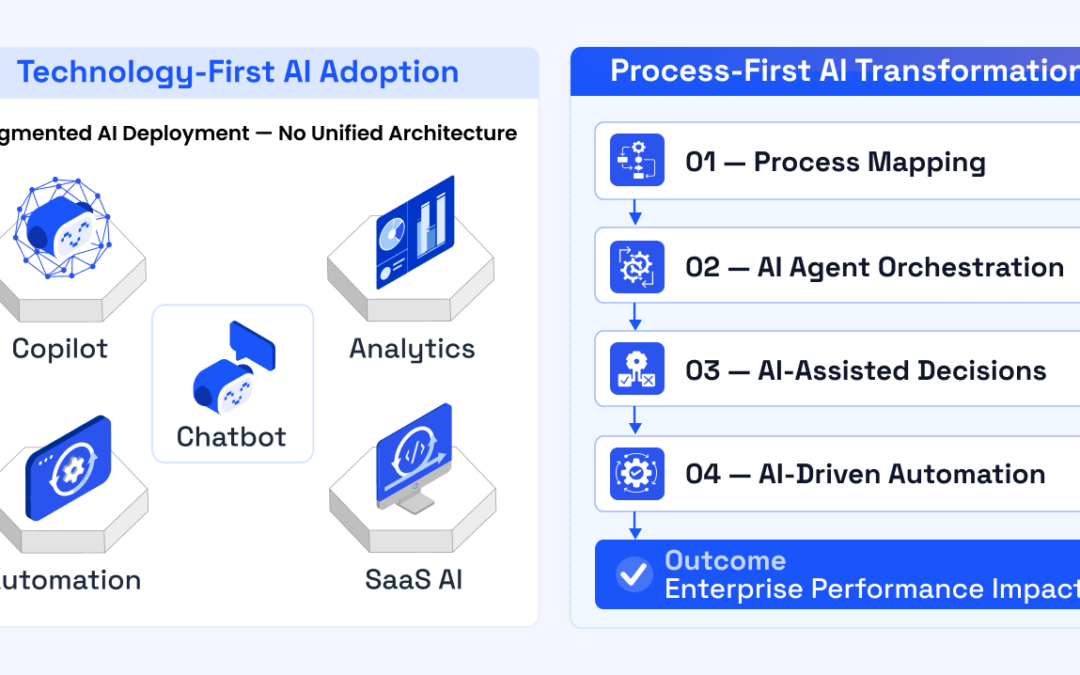
The agentic enterprise: Why AI success requires an operating model redesign
Organizations that redesign their operating models around agentic AI are beginning to outperform those that apply AI only incrementally.
Enterprise AI pilot-to-production gap: Root causes & how to address them
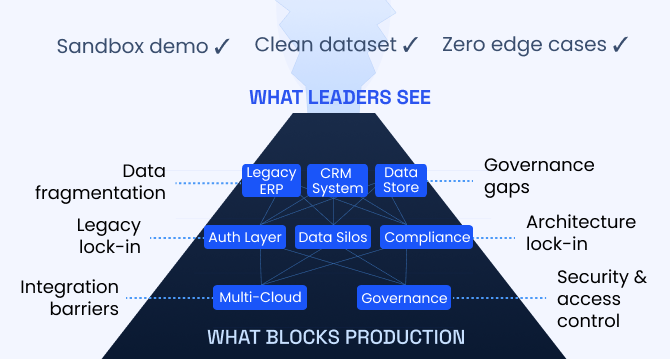
The underlying cause is structural. In many enterprises, AI pilots are developed on infrastructure that was not designed to support production deployment.
Solution architecture best practices: A guide for enterprise teams
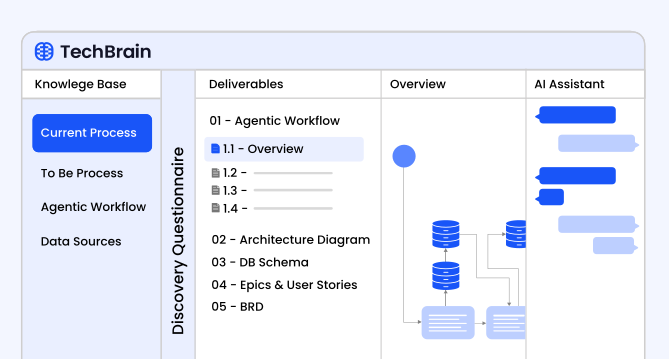
The architecture design process culminates in a set of documented artifacts that communicate the solution to development, operations, and business teams.
Common solution architecture design challenges — and how to overcome them
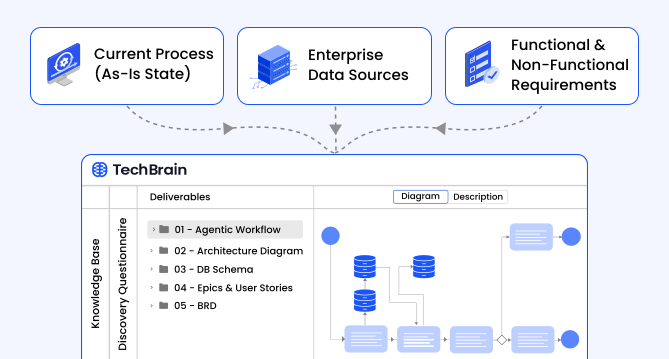
Solution architecture must evolve from fragmented documentation practices to a structured, collaborative, and continuously validated design capability.
Why structured architecture design is the foundation of scalable enterprise systems
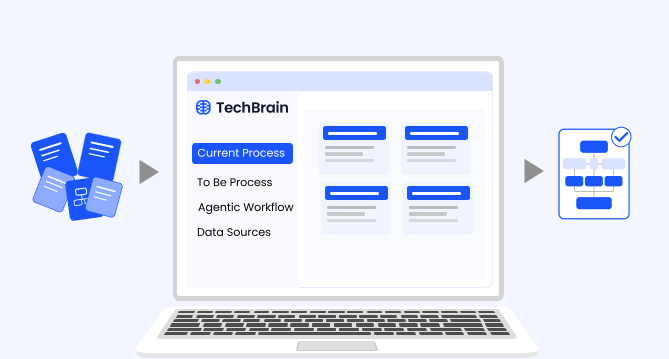
Structured architecture design guides enterprises from requirements to build-ready blueprints. Learn key principles, scalability gains, and TechBrain’s approach.
A guide to intranet search engine
Effective intranet search is a cornerstone of the modern digital workplace, enabling employees to find trusted information quickly and work with greater confidence.
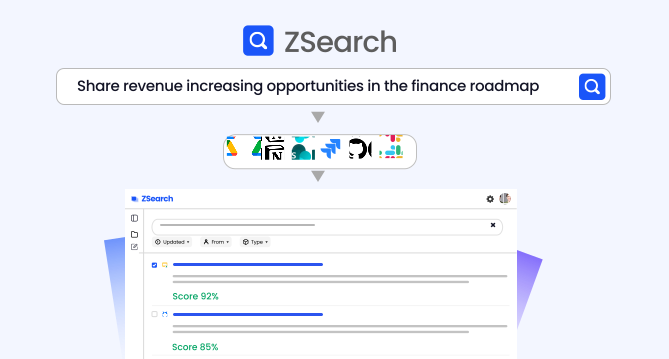
Enterprise knowledge management guide
Enterprise knowledge management enables organizations to capture, organize, and activate knowledge across systems, teams, and workflows—ensuring the right information reaches the right people at the right time.
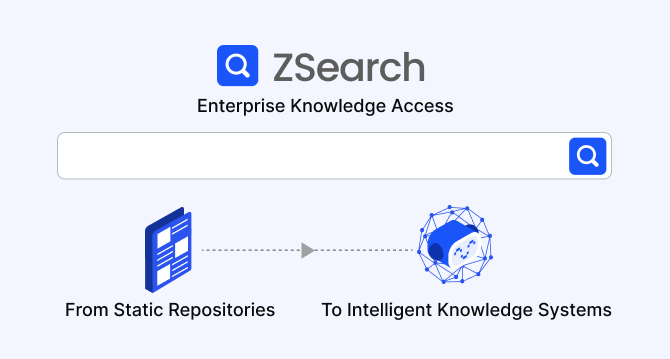
Company knowledge base: Why it matters and how it is evolving
A centralized company knowledge base is no longer a “nice-to-have” – it’s essential infrastructure. A knowledge base serves as a single source of truth: a unified repository where documentation, FAQs, manuals, project notes, institutional knowledge, and expert insights can reside and be easily accessed.
What is an enterprise search engine? A guide to AI-powered information access
An enterprise search engine is a specialized software that enables users to securely search and retrieve information from across an organization’s internal data sources and systems.