


 Manufacturing
 Logistics
 Real Estate
 Retail
 Finance
 Healthcare
 Hospitality
 Automotive
Enterprise knowledge management guide: Strategy, scope, challenges, best practices, and AI integration
Listen to the article
Enterprise knowledge management (EKM) plays a critical role in helping organizations capture, organize, and apply their knowledge assets effectively. From documents, data, and workflows to institutional expertise and team-level context, knowledge shapes how decisions are made, how work moves forward, and how quickly organizations respond to change. Yet in many enterprises, this knowledge remains fragmented across systems, teams, and formats, making it difficult for teams to find and use it when it matters most.
What begins as a knowledge access problem often becomes a broader operational challenge. When employees cannot quickly locate accurate information, they spend more time searching, waiting for responses, recreating work, or relying on incomplete context. Over time, this affects productivity, collaboration, customer responsiveness, and the consistency of decision-making across the organization.
Recent workplace research highlights the scale of this issue. One study [1] found that 34% of employees spend 30–60 minutes every day simply waiting for responses to “quick questions,” in addition to the time already spent searching for information. Such poor knowledge discovery leads to productivity loss, employee frustration, duplicate work, customer delays, and missed deadlines. These findings suggest that fragmented enterprise knowledge is not just a search or tooling issue; it is a business-wide constraint on speed, efficiency, and execution.
Market activity reflects this growing urgency. Grand View Research’s knowledge management software market report [2] estimates that the global KM software market was valued at USD 20.15 billion in 2024 and is projected to reach USD 62.15 billion by 2033, growing at a CAGR of 13.6% from 2025 to 2033. The report attributes this growth to the rising need for agile, cloud-native platforms that support dynamic information discovery, seamless collaboration, and intelligent decision-making across complex enterprise environments.
Effective enterprise knowledge management addresses these challenges by making organizational knowledge discoverable, contextual, governed, and accessible across systems and teams. Rather than treating knowledge as static content to be stored, modern EKM focuses on activating knowledge where work happens. It brings together people, processes, and technology to reduce friction, improve collaboration, accelerate decisions, and enable organizations to better use the knowledge they already possess.
This article explores the foundations of enterprise knowledge management, the common challenges organizations face, and best practices for implementing EKM to support long-term operational efficiency and informed decision-making.
- What is Enterprise Knowledge Management (EKM)?
- Core capabilities of effective enterprise knowledge management
- Key challenges in enterprise knowledge management
- People, roles, and governance in enterprise knowledge management
- The enterprise knowledge management technology ecosystem
- The role of AI in enterprise knowledge management
- How to build an enterprise knowledge management strategy
- Strategic benefits of implementing enterprise knowledge management
- Best practices for modern enterprise knowledge management
- Enterprise knowledge management across industries
- Future trends in enterprise knowledge management
What is Enterprise Knowledge Management (EKM)?
Enterprise Knowledge Management (EKM) refers to the systematic approach enterprises use to capture, organize, discover, retain, share, and activate knowledge across the enterprise. It encompasses the processes, technologies, and governance models that ensure critical information—spread across systems, teams, and workflows—is accessible to the right people at the right time.
Unlike informal knowledge sharing or isolated repositories, EKM is built to operate at enterprise scale. Modern organizations generate and maintain knowledge continuously across documents, collaboration platforms, ticketing systems, code repositories, CRMs, project management tools, and business applications. EKM unifies access to these fragmented sources, enabling employees to search, retrieve, and apply knowledge without needing to know where it lives or who owns it.
Enterprise knowledge management is often mistaken for document management, but its scope is far broader. Document management focuses on storing and controlling files, while EKM emphasizes discoverability, context, and usability—ensuring knowledge can be found using natural queries, understood in its business context, and trusted for decision-making. Similarly, while personal or team knowledge tools help individuals or small groups organize information, they lack the structure, governance, integration depth, and scalability required for enterprise-wide knowledge sharing.
EKM spans multiple forms of organizational knowledge.
-
Structured knowledge resides in systems such as databases, CRMs, ERPs, issue trackers, and ticketing platforms, where data is stored according to defined schemas.
-
Unstructured knowledge includes documents, emails, chat conversations, messages, reports, articles, meeting notes, policies, presentations, research papers, and other content that carry critical insights that are traditionally difficult to search across systems.
-
Tacit knowledge—the experience, judgment, and contextual understanding held by employees—remains one of the most valuable yet difficult forms of organizational knowledge to manage. While this knowledge is inherently human, modern enterprise knowledge management focuses on ensuring that insights shared through documents, discussions, decisions, and workflows are captured and made accessible over time. By improving the discoverability of documented expertise and institutional context, EKM helps organizations reduce knowledge loss and preserve critical understanding as teams evolve.
One widely referenced knowledge management framework, the SECI model developed by Ikujiro Nonaka and Hirotaka Takeuchi [3], explains how knowledge moves between tacit and explicit forms through socialization, externalization, combination, and internalization. For enterprises, the key takeaway is that knowledge management should not focus only on storing documents. It should also support how employee expertise is captured, organized, shared, reused, and applied across teams.
This distinction is important because many knowledge management initiatives fail when they treat knowledge as static content. Effective EKM systems help convert scattered insights, decisions, conversations, and workflows into accessible knowledge assets while also enabling employees to apply that knowledge in real business contexts.
At a foundational level, EKM supports how knowledge is captured, retained, shared, and applied across the organization. Knowledge is continuously generated through daily work — projects, communications, decisions, customer interactions, and collaboration — and must be retained to prevent loss, transferred across roles and departments, and applied in context to solve problems and support decisions.
Modern EKM systems operationalize these pillars by embedding knowledge access directly into workflows, enabling employees to discover and use relevant information at the moment of need rather than relying on manual documentation or institutional memory.
Core capabilities of effective enterprise knowledge management
Once enterprise knowledge is defined and understood, the next challenge is operationalizing it at scale. Enterprise knowledge management achieves this by supporting the full lifecycle of knowledge—from capture to discovery—across systems, teams, and workflows.
It typically enables four core capabilities:
Capture
Knowledge is continuously gathered from enterprise sources, including documents, collaboration platforms, ticketing systems, code repositories, reports, meeting notes, workflows, decisions, and ongoing conversations. This ensures that insights generated through daily work are retained rather than lost when projects end or teams change.
Organize
Captured knowledge is structured using metadata, taxonomies, reusable templates and automated indexing. This creates consistency across diverse content types and systems, making information easier to manage and reuse at an enterprise scale.
Share
Knowledge is securely shared across departments and roles through integrated access points and collaboration environments. Permissions and governance policies ensure that users see only the information they are authorized to access, while still enabling cross-functional visibility.
Retrieve
AI-powered, context-aware search enables employees to retrieve relevant information using keywords or natural-language queries—without needing to know where the content resides or which system contains it. In modern EKM environments, AI can further improve retrieval by understanding intent, ranking results by relevance, and surfacing related knowledge.
Beyond these core functions, modern enterprise knowledge management platforms apply intelligent indexing and semantic understanding to improve knowledge discovery and surface related information. This shifts knowledge access from manual searching to intelligent discovery.
These capabilities are best understood as part of a continuous knowledge management lifecycle. Knowledge is created through daily work, captured through documentation and collaboration, organized for reuse, shared across teams, applied in business decisions, and periodically reviewed to maintain accuracy and trust.
| Stage | Description |
|---|---|
| Knowledge creation | New knowledge emerges through problem-solving, research, experimentation, customer interactions, and collaborative work. This knowledge may be created by individuals, teams, or cross-functional groups and may draw on both internal experience and external inputs. |
| Knowledge capture | Insights, decisions, processes, lessons learned, and expertise are recorded in accessible formats. Common capture mechanisms include documentation, structured interviews, after-action reviews, retrospectives, meeting notes, and AI-assisted transcription. |
| Knowledge organization | Captured knowledge is classified, tagged, and structured using metadata, taxonomies, ontologies, and indexing. This helps ensure that information can be reliably retrieved, understood in context, and reused across the enterprise. |
| Knowledge storage | Organized knowledge is retained in appropriate systems such as knowledge bases, document management systems, wikis, collaboration platforms, or enterprise search indices, with relevant access controls applied. |
| Knowledge sharing | Knowledge is distributed across the organization through collaboration tools, communities of practice, onboarding programs, newsletters, workflow integrations, and embedded search interfaces. |
| Knowledge application | Employees use retrieved knowledge to complete tasks, make decisions, solve problems, support customers, improve processes, and innovate. Application also creates feedback loops that reveal which knowledge is valuable and where gaps exist. |
| Knowledge review and retirement | Knowledge assets are regularly reviewed for accuracy, relevance, ownership, and currency. Outdated, duplicate, or superseded content is updated, archived, or retired to prevent knowledge decay and maintain trust in the knowledge base. |
By operationalizing knowledge in this way, enterprise knowledge management transforms dispersed information into a continuously accessible and actionable business asset.
Key challenges in enterprise knowledge management
Enterprise knowledge management becomes increasingly complex as organizations scale, diversify their tool stacks, and operate across teams and geographies. Knowledge is created continuously, but without the right systems and practices, it becomes fragmented, difficult to discover required insights, and hard to maintain. The following challenges highlight the most common barriers enterprises face in managing knowledge effectively—and why traditional approaches often fall short.
Recent research reflects this complexity. KMWorld-backed research [4] found that 36% of organizations use three or more knowledge management tools, while 31% are unsure how many KM tools they have in place. This lack of visibility makes it harder to create a unified knowledge strategy and often contributes to duplication, outdated content, and inconsistent user experiences.
Information silos and fragmentation
Departments often operate with their own tools, repositories, and processes, creating isolated pockets of knowledge across the organization. When insights, analyses, and lessons learned are confined to individual teams, other groups remain unaware that similar work has already been done. As a result, teams frequently recreate solutions, repeat research, or duplicate efforts instead of building on existing knowledge. This fragmentation not only leads to wasted time and inconsistent decisions, but also limits cross-functional collaboration. Over time, disconnected systems further increase security and compliance risks, as maintaining consistent visibility, access control, and governance becomes more difficult.
Information overload and poor discoverability
Enterprises generate vast amounts of content—documents, reports, messages, and data—but without effective discovery mechanisms, critical insights are buried under irrelevant information. Employees frequently rely on assumptions or partial knowledge because finding authoritative answers is too time-consuming. APQC research [5] found that the median knowledge worker spends 2.8 hours each week seeking or requesting the information they need, along with additional time finding the right people to provide answers or expertise.
Loss of tacit knowledge
Tacit knowledge—the experience, judgment, and institutional understanding held by employees—is among the hardest to capture. When experienced employees leave, a significant portion of this knowledge is lost, impacting continuity, efficiency, and long-term performance. This challenge becomes more pressing as organizations manage workforce transitions, role changes, and distributed teams where informal knowledge transfer is less consistent.
Inconsistent search experience across enterprise tools
Most enterprise applications offer their own built-in search, each with different capabilities, interfaces, and limitations. Employees are forced to learn and repeat multiple search experiences, often with inconsistent or incomplete results. This fragmentation increases search time, reduces confidence in results, and discourages effective knowledge reuse.
Lack of contextual knowledge retrieval
Traditional knowledge systems focus on returning documents rather than answers. Employees often find content but struggle to understand its relevance, recency, or applicability to their specific task. Without context-aware discovery, users must manually sift through multiple sources to piece together insights.
Technology and adoption barriers
Legacy systems and rigid folder-based storage fail to support modern, dynamic workflows. At the same time, employees may resist new platforms due to poor past experiences, complex interfaces, or tools that disrupt existing work patterns rather than enhance them. As a result, knowledge management initiatives often fail not because knowledge is unavailable, but because systems are difficult to adopt, maintain, or integrate into daily work.
Secure and compliant knowledge access
As information evolves rapidly, keeping knowledge current and trustworthy is a persistent challenge. Organizations must also balance accessibility with strict security, access control, and regulatory compliance—ensuring users see only what they are authorized to access without slowing productivity. This governance layer is becoming increasingly important as enterprises prepare knowledge systems for AI-enabled search and decision support.
Limited insight into knowledge usage and gaps
Many organizations lack visibility into how knowledge is accessed, reused, or overlooked. Without understanding what information is frequently searched for—or where users fail to find answers—enterprises struggle to improve knowledge quality and coverage.
Unaddressed knowledge management challenges impact far more than internal efficiency. They slow decision-making, increase employee frustration, delay customer responses, and weaken an organization’s ability to compete.
Addressing these challenges requires more than storing information—it demands intelligent discovery, unified information access across systems, and secure, context-aware retrieval that works within existing enterprise environments. This is where modern, AI-powered enterprise knowledge management approaches play a critical role.
Streamline your operational workflows with ZBrain AI agents designed to address enterprise challenges.
People, roles, and governance in enterprise knowledge management
Technology is only one part of effective enterprise knowledge management. For EKM to create lasting value, organizations need clear ownership, defined roles, and governance structures that keep knowledge accurate, accessible, secure, and continuously maintained. Without this human and organizational layer, even well-designed knowledge platforms can become fragmented, outdated, or underused.
Executive ownership
A mature EKM program needs clear executive ownership. This responsibility may sit with a Chief Knowledge Officer, CIO, Chief People Officer, or another senior leader responsible for knowledge strategy. The goal is to ensure that knowledge management aligns with business priorities while not being treated solely as an IT or documentation initiative.
Executive ownership typically includes defining the KM roadmap, securing leadership buy-in, promoting a culture of knowledge sharing, overseeing technology and governance decisions, and measuring the impact of knowledge management on business outcomes.
Knowledge management team
A dedicated or cross-functional KM team supports day-to-day execution. Depending on the organization’s size and maturity, this team may include knowledge architects, content owners, curators, technology specialists, and change management leads.
Knowledge architects help design taxonomies, metadata structures, and content models. Content owners and curators maintain the accuracy and relevance of knowledge assets. Technology specialists manage integrations, indexing, permissions, and analytics. Change management leads support adoption through communication, training, and stakeholder engagement.
Communities of practice
Communities of practice help employees share expertise across roles, departments, and locations. These groups are especially useful for capturing tacit knowledge—the practical experience, judgment, and context that may not be documented formally.
In enterprise knowledge management, communities of practice help validate knowledge, surface recurring questions, identify gaps, and turn expert insights into reusable knowledge assets. They also make knowledge sharing part of daily work rather than an additional task.
Knowledge governance
Knowledge governance defines the rules, ownership models, and quality standards that keep enterprise knowledge reliable over time. It determines who owns each knowledge domain, how often content should be reviewed, what approval processes are required, how permissions are managed, and when outdated or duplicate content should be archived or retired.
Effective governance combines central standards with distributed ownership. A central KM function can define templates, policies, and review mechanisms, while domain experts maintain knowledge within their areas. This approach prevents bottlenecks while ensuring consistency, compliance, and accountability.
Why this matters
Clear roles and governance prevent knowledge systems from becoming unmanaged repositories. They help organizations maintain trust in their knowledge assets, reduce duplication, improve adoption, and ensure that employees can access reliable information when they need it.
The enterprise knowledge management technology ecosystem
Effective enterprise knowledge management rarely relies on a single platform. It depends on a connected ecosystem of tools that help capture, organize, discover, share, govern, and improve knowledge across the enterprise.
| Technology category | Role in EKM |
|---|---|
| Enterprise search and knowledge discovery | Provides a unified, permission-aware search layer across documents, tickets, conversations, databases, and business applications. |
| Knowledge bases, wikis, and document systems | Store structured knowledge such as policies, procedures, FAQs, guides, project records, and formal documents. |
| Collaboration and communication platforms | Capture knowledge created through discussions, meetings, decisions, updates, and informal problem-solving. |
| Knowledge graphs and metadata systems | Connect related topics, documents, people, processes, and business entities to improve contextual retrieval. |
| AI-assisted capture and automation tools | Extract, summarize, classify, and route knowledge from unstructured inputs such as transcripts, tickets, reports, and recordings. |
| Analytics and knowledge intelligence tools | Track search behavior, content usage, unanswered questions, and knowledge gaps to improve KM quality over time. |
A common mistake in enterprise knowledge management is adding point solutions without an integration strategy. When tools operate in isolation, they recreate the silos EKM is meant to solve. Effective technology strategy should prioritize unified search, shared taxonomy and metadata, API-first integration, consistent access controls, and clear content ownership.
The role of AI in enterprise knowledge management
Artificial intelligence is changing enterprise knowledge management by shifting it from static information storage to more intelligent knowledge discovery and activation. Instead of relying solely on manual documentation, keyword search, and folder-based repositories, AI can help employees find relevant information faster, capture knowledge from daily work, and maintain knowledge quality over time. The relationship is bidirectional: AI can make knowledge management more effective, while a well-governed knowledge infrastructure can make AI systems more reliable, grounded, and trustworthy.
Intelligent search and contextual retrieval
AI-enabled search allows employees to ask questions in natural language rather than relying only on exact keywords. By understanding intent, context, and semantic relationships between content, AI can surface relevant information from documents, tickets, conversations, knowledge bases, and business applications—even when users are unsure of the exact terminology or where the answer resides.
Automated knowledge capture and classification
AI can help extract and organize knowledge from unstructured sources such as meeting transcripts, support tickets, internal Q&A threads, project updates, and collaboration messages. This reduces the manual burden of documentation and helps ensure that useful insights generated through daily work are retained rather than lost when projects close, employees move roles, or teams change.
Content maintenance and currency
Outdated content weakens trust in enterprise knowledge systems. AI can support knowledge maintenance by identifying duplicate or stale content, flagging articles that need review, suggesting updates based on recent activity, and highlighting knowledge gaps based on recurring employee queries.
RAG and knowledge grounding
Retrieval-augmented generation, or RAG, enables AI systems to generate responses grounded in specific enterprise knowledge sources rather than relying only on the model’s training data. In an EKM context, RAG-based systems can query an organization’s documents, knowledge bases, and repositories at the time of response, helping produce answers that are more current, contextual, and traceable to their sources.
This grounding is important for enterprise trust. When AI-generated responses are tied to verified sources, employees can review the underlying context and make more informed judgments. Agentic AI orchestration platforms, such as ZBrain Builder, can support RAG-based knowledge retrieval by helping organizations connect AI agents to enterprise data sources, retrieve relevant context, and generate responses grounded in available organizational knowledge.
Agentic AI-powered knowledge workflows
Agentic AI extends RAG by making retrieval more adaptive and workflow-driven. Instead of retrieving information from a single source, AI agents can assess whether external knowledge is needed, identify relevant sources, retrieve and compare context, validate relevance, refine the query when results are weak, and synthesize a grounded response.
In enterprise knowledge management, this can support complex tasks such as synthesizing lessons learned across projects, identifying conflicting guidance across policy documents, generating briefings from distributed sources, or finding knowledge gaps across support tickets and employee queries.
Platforms such as ZBrain Builder can support these patterns through agentic RAG workflows. Its Agentic retrieval approach structures retrieval as a decision-driven loop in which agents decide when to retrieve, search connected knowledge bases, check relevance, rewrite queries when needed, and generate grounded responses. This makes it relevant for AI-driven KM workflows such as knowledge discovery, enrichment, article generation, gap analysis, and content maintenance.
Agentic AI use cases in enterprise knowledge management
| Agentic AI use case | Description | How ZBrain can support |
|---|---|---|
| Knowledge discovery and contextual retrieval | Finding relevant information across documents, tickets, conversations, knowledge bases, and business applications. | ZBrain Builder’s agentic retrieval can help agents query connected knowledge sources, validate relevance, and synthesize grounded responses. |
| Knowledge learning and enrichment | Feeding learnings from resolved cases, customer feedback, and operational outcomes back into knowledge resources. | Knowledge Learning Agent can help extract insights from case data and feedback to support continuous knowledge improvement. |
| Knowledge base article generation | Creating structured articles from resolved tickets, support cases, or troubleshooting workflows. | Knowledge Base Article Generator Agent and Salesforce Knowledge Creation Agent can assist in generating articles from ticket or case data. |
| Dynamic knowledge base updates | Keeping knowledge resources current as source information changes. | Dynamic Knowledge Base Creation Agent can help create and update knowledge bases from provided input resources. |
| Knowledge gap analysis | Identifying recurring issues, unanswered questions, or missing documentation. | Knowledge Gap Analysis Agent can help analyze support patterns and highlight areas where new or updated articles may be needed. |
| Automated knowledge capture and classification | Extracting and organizing knowledge from transcripts, tickets, reports, and conversations. | ZBrain agents can help convert unstructured enterprise inputs into organized, reusable knowledge assets. |
Responsible AI use in EKM
AI should be layered on top of trusted, governed knowledge systems. Organizations need source verification, permission-aware retrieval, human review for AI-generated content, and clear auditability. Without these controls, AI can amplify outdated, incomplete, or unauthorized information, giving it the appearance of authority.
By combining AI capabilities with strong governance and high-quality knowledge sources, enterprises can improve search accuracy, reduce time spent searching for information, and make organizational knowledge easier to access and apply.
Streamline your operational workflows with ZBrain AI agents designed to address enterprise challenges.
How to build an enterprise knowledge management strategy
An effective enterprise knowledge management strategy should begin with business priorities. Before choosing tools or implementing AI capabilities, organizations need to understand where knowledge gaps create the most friction—whether in onboarding, customer support, compliance, project execution, or expert knowledge retention.
A practical EKM strategy typically includes five steps:
| Step | What it involves |
|---|---|
| Assess current knowledge flows | Identify where critical knowledge lives, who owns it, how it is accessed, and where employees struggle to find reliable information. |
| Align with business outcomes | Connect EKM goals to measurable outcomes such as faster onboarding, reduced duplicate work, improved support resolution, better compliance readiness, or shorter decision cycles. |
| Define ownership and governance | Assign knowledge owners, review cadences, quality standards, access rules, and escalation paths so knowledge remains accurate, secure, and trusted. |
| Pilot high-value use cases | Start with a focused use case, such as internal search for a specific function, support knowledge base improvement, expert knowledge capture, or AI-assisted knowledge retrieval. Measure results before scaling. |
| Scale with workflow integration and AI readiness | Embed knowledge access into the tools employees already use, then progressively layer AI, generative AI, RAG, or agentic workflows where they can improve discovery, summarization, automation, and decision support. |
The goal is to build EKM as a continuous organizational capability rather than a one-time content migration or technology rollout. A strategy-led approach helps organizations improve adoption, reduce implementation risk, and ensure that knowledge management investments, including AI-enabled capabilities, translate into measurable business value.
Strategic benefits of implementing enterprise knowledge management
Implementing enterprise knowledge management delivers value far beyond improved information storage. When knowledge is unified, discoverable, and accessible across systems, it becomes a strategic asset that drives efficiency, decision quality, and long-term competitiveness. A well-designed knowledge management system enables organizations to scale expertise, reduce operational friction, and respond faster to changing business demands.
Faster access to information and reduced time-to-action
By centralizing access to enterprise knowledge across documents, systems, and conversations, employees can quickly find the information they need without switching between tools or relying on tribal knowledge. This significantly reduces time spent searching and waiting for responses, enabling teams to act faster and stay focused on high-value work.
Improved decision-making and business agility
Enterprise knowledge management provides decision-makers with timely, relevant, and contextual information drawn from across the organization. With better visibility into past work, institutional knowledge, and current data, teams can make more informed decisions, reduce risk, and adapt more quickly to market or operational changes.
Elimination of redundant work and knowledge reuse
When previous work, insights, and best practices are easy to discover, organizations avoid recreating solutions that already exist. Knowledge reuse improves consistency, accelerates execution, and ensures that teams build on proven approaches rather than starting from scratch.
Preservation of institutional and tacit knowledge
A robust enterprise knowledge management approach helps capture and retain critical expertise that might otherwise be lost due to employee turnover or organizational change by systematically documenting experiential insights through retrospectives, decision records, and collaborative discussions. By embedding knowledge capture into everyday workflows and ensuring this information is searchable and accessible across teams, organizations reduce dependency on individual employees and preserve institutional knowledge over time.
Enhanced collaboration across teams and geographies
Unified access to shared knowledge breaks down organizational silos and enables cross-functional collaboration. Teams across departments and regions can build on each other’s insights, leading to better coordination, faster problem-solving, and more innovative outcomes.
Stronger security, compliance, and governance
Enterprise knowledge management systems enforce consistent access controls and governance policies across information sources. This ensures users only access authorized content while supporting regulatory compliance, audit readiness, and secure knowledge sharing at scale.
Scalable, future-ready knowledge infrastructure
Modern enterprise knowledge management solutions integrate seamlessly with existing tools and workflows, allowing organizations to scale without disruption. As AI capabilities mature, this foundation supports advanced use cases such as contextual recommendations, intelligent search, and AI-assisted decision support.
Best practices for modern enterprise knowledge management
Successful enterprise knowledge management is not achieved by deploying a single tool or central repository. It requires a strategic, system-level approach that aligns technology, workflows, and organizational behavior. The following best practices reflect how modern enterprises build scalable, trusted, and high-impact knowledge management ecosystems.
1. Make knowledge capture invisible
One of the fastest ways to derail a knowledge management initiative is to make it additional work. Employees are unlikely to pause their daily tasks to document insights or update portals manually. Modern EKM systems should capture knowledge passively—directly from the tools employees already use, such as document management systems, collaboration platforms, and ticketing systems—so knowledge sharing becomes a natural byproduct of work rather than a separate obligation.
2. Prioritize real-time, in-flow access
Knowledge loses value when it arrives too late. Instead of forcing employees to search static repositories, enterprises should embed knowledge access directly into the workflow. Relevant answers, documents, and insights should surface instantly within familiar environments—such as enterprise search, collaboration tools, orproject management tools—enabling faster decisions and uninterrupted execution.
3. Ground AI in trusted enterprise knowledge
AI can dramatically accelerate knowledge discovery, but speed without trust introduces risk. Generative systems that rely on unverified or incomplete data can produce misleading results, leading to automation bias and poor decision-making. Best-in-class EKM solutions ground AI in verified enterprise sources, enforce permissions, and preserve traceability—ensuring that AI-driven insights remain reliable, explainable, and aligned with human expertise.
4. Reduce redundancy through intelligent discovery
Repeated questions, duplicate documents, and outdated content quickly erode confidence in knowledge systems. Modern enterprise knowledge management platforms use intelligent indexing, semantic understanding, and surface related knowledge. This keeps the knowledge base clean, relevant, and immediately usable.
5. Design for seamless integration and scalability
Enterprise knowledge management systems must adapt to existing tools, workflows, and growth trajectories. Best practices emphasize solutions that integrate seamlessly with enterprise platforms, scale across departments and geographies, and evolve without disrupting operations. Flexibility in deployment and architecture ensures long-term viability as organizational needs change.
6. Enforce governance without blocking access
Strong governance is essential—but it should not come at the cost of usability. Modern EKM balances accessibility with enterprise-grade security by enforcing permission-aware access, auditability, and compliance controls at every layer.
7. Measure impact and continuously improve
Knowledge management is an ongoing discipline, not a one-time implementation. Enterprises should define clear metrics—such as search success rates, time saved, knowledge reuse, and decision speed—to assess effectiveness. Continuous feedback and analytics help identify gaps, refine knowledge coverage, and demonstrate measurable business value.
Enterprise knowledge management across industries
While the principles of enterprise knowledge management are universal, their application varies significantly across industries. Each sector has different knowledge priorities shaped by regulatory requirements, operational complexity, workforce dynamics, customer expectations, and the cost of poor decision-making.
Industries such as BFSI, healthcare, IT, telecom, and manufacturing rely heavily on knowledge systems to maintain regulatory compliance, operational consistency, and scalable decision-making. According to Fortune Business Insights, [6] these sectors are among the major adopters of knowledge management solutions, reflecting the growing role of EKM in knowledge-intensive and compliance-driven environments.
Financial services and banking
The financial services sector operates in one of the most demanding regulatory and compliance environments. For banks, insurers, and financial institutions, knowledge management supports both business execution and governance.
Key EKM applications in BFSI include:
-
Regulatory knowledge management: Maintaining governed, version-controlled repositories of compliance policies, procedural updates, and jurisdiction-specific regulatory requirements.
-
Risk and underwriting intelligence: Making past decisions, internal risk guidance, market insights, and expert inputs easier to retrieve and apply consistently.
-
Client relationship intelligence: Providing relationship managers and advisors with access to client history, preferences, compliance status, and institutional context.
-
Fraud and incident response knowledge: Maintaining updated playbooks, fraud pattern repositories, and investigative procedures to support faster response to emerging threats.
Healthcare and life sciences
In healthcare and life sciences, knowledge directly affects patient outcomes, research productivity, compliance, and operational quality. Fragmented knowledge can lead to inconsistent application of clinical guidelines, duplicated research efforts, or gaps in regulatory documentation.
Mordor Intelligence estimates that healthcare is one of the fastest-growing sectors for knowledge management software adoption, with a projected CAGR of 20.74%, [7] driven by clinical decision support requirements, patient safety mandates, and electronic health record interoperability.
Key EKM applications in healthcare and life sciences include:
-
Clinical knowledge bases: Organizing treatment protocols, care guidelines, drug interaction information, and evidence summaries to support consistent, evidence-based decision-making.
-
Research and institutional knowledge: Helping teams manage research findings, trial data, regulatory submissions, scientific documentation, and prior work across programs.
-
Compliance and accreditation management: Making current policies, standards, audit documentation, and regulatory requirements easier to access and maintain.
-
Workforce knowledge continuity: Capturing procedural expertise, senior clinician knowledge, and institutional context to reduce knowledge loss as teams change.
Information technology
IT, telecom, and professional services organizations are highly knowledge-intensive. Their work depends on reusable expertise, technical documentation, engagement history, lessons learned, and the ability to locate subject-matter experts quickly.
Mordor Intelligence reports that IT and telecom account for the largest revenue share of the knowledge management software market, at 23.87% in 2025 [8] reflecting the sector’s early adoption of developer portals, technical documentation repositories, incident response playbooks, and support knowledge bases.
Key EKM applications in IT and professional services include:
-
Technical and developer knowledge: Maintaining searchable repositories of architecture decisions, technical documentation, code patterns, deployment notes, incident postmortems, and troubleshooting guides.
-
Proposal and engagement knowledge reuse: Capturing past proposals, project deliverables, methodologies, case studies, and client insights to accelerate future work.
-
Expertise location: Helping teams identify and connect with subject-matter experts across functions, regions, and delivery areas.
-
Lessons learned and retrospective capture: Documenting what worked, what did not, and why across projects, incidents, releases, and client engagements.
Manufacturing and industrial operations
Manufacturing organizations face a distinct knowledge management challenge: much of their most valuable operational knowledge resides in the experience of engineers, technicians, operators, and plant managers.
Mordor Intelligence notes that manufacturers are digitizing legacy standard operating procedures to address knowledge loss from a retiring workforce and preserve operational expertise. [9]
Key EKM applications in manufacturing include:
-
Operational knowledge and SOPs: Digitizing, standardizing, and making searchable production procedures, maintenance instructions, quality manuals, troubleshooting guides, and safety documentation.
-
Maintenance and reliability intelligence: Capturing equipment behavior, failure patterns, repair histories, and best practices across facilities.
-
Quality and non-conformance knowledge: Maintaining searchable repositories of quality incidents, root cause analyses, corrective actions, and inspection knowledge.
-
Supply chain and supplier knowledge: Organizing supplier capabilities, performance history, risk profiles, procurement insights, and disruption response knowledge.
Across industries, the core objective remains the same: make critical knowledge easier to find, trust, reuse, and apply. The difference lies in which knowledge domains matter most. For financial services, that may be regulatory and risk knowledge. For healthcare, it may be clinical and compliance knowledge. For IT and professional services, it may be technical expertise and delivery knowledge. For manufacturing, it may be operational procedures, maintenance intelligence, and workforce knowledge continuity.
By tailoring EKM strategies to these sector-specific priorities, organizations can move beyond generic knowledge repositories and build knowledge systems that directly support the decisions, risks, workflows, and outcomes that matter most to their business.
Future trends in enterprise knowledge management
Enterprise knowledge management is evolving in response to structural changes in how organizations operate, collaborate, and apply information. As enterprises manage growing volumes of content across distributed teams, applications, and workflows, the focus is shifting from static documentation toward intelligent, governed, and in-flow knowledge use. The following trends reflect broader changes shaping EKM over the next two to three years.
1. AI-KM symbiosis
AI is becoming a core component of enterprise knowledge systems, particularly for discovery, summarization, content maintenance, and expert knowledge transfer. At the same time, AI depends on a well-governed knowledge infrastructure to produce reliable and trustworthy outputs. This creates a bidirectional relationship: AI makes knowledge management more effective, while strong KM practices make AI more accurate, explainable, and enterprise-ready.
Enterprise Knowledge’s 2025 trend analysis identifies this relationship as “AI-KM symbiosis,” [10] in which KM practitioners play a central role in ensuring that AI tools have access to clean, governed, and contextually rich knowledge assets.
2. Context-aware retrieval over keyword-only search
Traditional keyword search is proving insufficient for complex enterprise environments. Organizations are increasingly adopting retrieval approaches that account for context, relationships, and intent, such as how information relates to projects, teams, processes, customers, or business workflows.
This shift enables more accurate discovery across structured systems and unstructured content without requiring users to know exact terminology or where information resides.
3. Knowledge embedded in daily workflows
Knowledge access is moving closer to where work happens. Rather than expecting employees to switch tools or navigate dedicated knowledge portals, enterprises are embedding knowledge discovery into collaboration platforms, operational systems, project management tools, and core workflows.
This trend reflects a practical reality: knowledge creates the most value when it appears at the moment of decision, not after employees spend time searching across disconnected repositories.
4. Stronger emphasis on governance, trust, and accountability
As AI-driven knowledge systems become more common, enterprises are placing greater emphasis on governance. This includes permission-aware access, source traceability, content review processes, information accuracy, auditability, and transparency into how knowledge is retrieved or generated.
Trust is becoming a prerequisite for adoption, especially in regulated industries and risk-sensitive functions. Without governance, AI-enabled knowledge systems may accelerate access to information but weaken confidence in its accuracy, security, or relevance.
5. More outcome-driven KM and AI investments
Organizations are moving away from broad technology-led initiatives toward specific, measurable use cases with clear business outcomes. Instead of asking whether they should adopt AI or modernize KM in general, enterprises are increasingly asking where better knowledge access can reduce cycle time, improve customer support, accelerate onboarding, reduce repeated work, or preserve institutional expertise.
Enterprise Knowledge’s 2025 trend analysis notes that organizations are expected to focus more on cohesive use cases, outcomes, and value rather than broad technology statements.[11]
6. Knowledge retention as a business continuity priority
Workforce transitions, retirements, reorganizations, and distributed work are making knowledge retention more urgent. As experienced employees leave or move roles, organizations risk losing institutional memory, operational expertise, and context that is rarely captured in formal documentation.
This is increasing interest in structured knowledge transfer, communities of practice, expert interviews, decision records, retrospectives, and AI-assisted approaches that help capture tacit knowledge before it is lost.
Looking ahead
The future of enterprise knowledge management is not defined by larger repositories or more documentation. It is shaped by the ability to make knowledge accessible, trustworthy, and usable in the flow of work. Organizations that align their knowledge strategies with these trends will be better positioned to reduce friction, retain institutional intelligence, and support informed decision-making as they scale.
Conclusion
Enterprise knowledge management has become a foundational capability for modern organizations operating in complex, information-rich environments. As knowledge spreads across systems, teams, and formats, the ability to discover, trust, and apply the right information at the right time is critical. By combining clear strategy, strong governance, intelligent discovery, and the right technology ecosystem, enterprises can transform knowledge from a fragmented resource into a driver of efficiency, collaboration, and informed decision-making.
The urgency of this challenge is growing. Expanding tool stacks, distributed teams, workforce transitions, and the rise of AI systems that depend on trusted knowledge inputs are increasing pressure on enterprise knowledge infrastructure. At the same time, the opportunity is significant: organizations that invest in coherent EKM strategies today—by establishing governance foundations, embedding knowledge access into daily workflows, improving content quality, and enabling context-aware discovery—will be better positioned to reduce friction, preserve institutional intelligence, and support faster, more reliable decisions.
Enterprise knowledge management is an ongoing organizational discipline that compounds in value as knowledge is captured, refined, governed, and made progressively more accessible to the people and systems that need it most.
Enterprise knowledge is often scattered across tools and teams. Explore how ZBrain Builder brings context, intelligence, and grounded AI assistance into organizational workflows. Book a demo today.
Listen to the article
Author’s Bio


CEO LeewayHertz
An early adopter of emerging technologies, Akash leads innovation in AI, driving transformative solutions that enhance business operations. With his entrepreneurial spirit, technical acumen and passion for AI, Akash continues to explore new horizons, empowering businesses with solutions that enable seamless automation, intelligent decision-making, and next-generation digital experiences.
Table of content
- What is Enterprise Knowledge Management (EKM)?
- Core capabilities of effective enterprise knowledge management
- Key challenges in enterprise knowledge management
- People, roles, and governance in enterprise knowledge management
- The enterprise knowledge management technology ecosystem
- The role of AI in enterprise knowledge management
- How to build an enterprise knowledge management strategy
- Strategic benefits of implementing enterprise knowledge management
- Best practices for modern enterprise knowledge management
- Enterprise knowledge management across industries
- Future trends in enterprise knowledge management
Share Article


Frequently Asked Questions
What is enterprise knowledge management (EKM)?
Enterprise knowledge management is the practice of capturing, organizing, and enabling access to an organization’s collective knowledge across systems, teams, and workflows. It goes beyond document storage by focusing on discoverability, context, and usability. Effective EKM ensures employees can find accurate, trusted information when they need it—without relying on tribal knowledge or manual searches. This helps improve decision-making, collaboration, and operational efficiency at scale.
How is enterprise knowledge management different from document management?
Why do enterprises struggle with knowledge management?
Enterprises struggle with knowledge management primarily because knowledge is created and stored across many disconnected systems. As organizations grow, this complexity increases, making it difficult to maintain visibility, accuracy, and access to critical information. Common challenges include:
- Knowledge silos created by multiple tools and repositories
- Difficulty finding relevant and up-to-date information
- Time lost searching for answers or recreating existing work
- Inconsistent governance and access control across systems
- Knowledge becoming outdated or inaccessible as teams evolve
Without addressing these challenges through unified discovery and governance, enterprises are unable to fully leverage the knowledge they already possess.
What are the core capabilities of effective enterprise knowledge management?
Effective enterprise knowledge management typically supports:
-
Knowledge capture: Collecting insights from documents, conversations, tickets, workflows, and decisions
-
Knowledge organization: Structuring information through metadata, taxonomies, indexing, and ownership models
-
Knowledge sharing: Making knowledge accessible across teams while respecting permissions
-
Knowledge retrieval: Helping employees find relevant information through search, contextual discovery, and natural-language queries
-
Knowledge governance: Keeping content accurate, secure, current, and compliant
-
Continuous improvement: Using analytics and feedback to identify gaps and improve knowledge quality
What types of knowledge should an enterprise knowledge management system capture?
An effective EKM system should capture multiple types of organizational knowledge, including:
-
Policies, procedures, and process documents
-
Project records, reports, and lessons learned
-
Customer support tickets and resolutions
-
Meeting notes, decisions, and discussion summaries
-
Product, technical, and operational documentation
-
Employee expertise and tacit knowledge
-
Training materials and onboarding resources
The goal is to preserve both formal documentation and practical knowledge created through daily work.
How does AI support enterprise knowledge management?
AI supports EKM by improving how knowledge is discovered, captured, maintained, and applied. It can help employees ask questions in natural language, retrieve relevant information from connected systems, summarize large volumes of content, classify unstructured inputs, identify stale content, and surface recurring knowledge gaps.
However, AI should be built on trusted and governed knowledge sources. Source verification, permission-aware retrieval, human review, and auditability are essential to ensure AI-generated or AI-summarized knowledge remains reliable.
What metrics should organizations use to measure EKM success?
Organizations can measure EKM success using both usage metrics and business outcome metrics.
Common EKM metrics include:
-
Search success rate
-
Time saved in finding information
-
Knowledge reuse rate
-
Content freshness and review completion rate
-
Unanswered query rate
-
Employee adoption and contribution rate
-
Reduction in duplicate work
-
Customer support deflection rate
These should be connected to broader business outcomes such as faster decision-making, shorter onboarding time, improved customer support, and better cross-functional collaboration.
Who is responsible for enterprise knowledge management?
Responsibility for EKM is usually shared across leadership, IT, business teams, and knowledge owners. A senior leader may define the strategy, while knowledge managers, content owners, domain experts, and technology teams support execution.
In mature organizations, ownership often includes:
-
Executive sponsors who align EKM with business goals
-
Knowledge managers who oversee structure and governance
-
Domain experts who validate and maintain content
-
IT teams that manage integrations, permissions, and platforms
-
Employees who contribute and reuse knowledge in daily work
What is ZBrain Builder, and how can it support enterprise knowledge management?
ZBrain Builder is an agentic AI platform that helps organizations build AI agents and applications for enterprise workflows. In the context of enterprise knowledge management, it can support AI-enabled knowledge discovery, contextual retrieval, and knowledge workflow automation by connecting agents with relevant enterprise data sources.
Depending on the organization’s needs, ZBrain Builder can support use cases such as:
-
Retrieving context from connected enterprise knowledge sources
-
Generating grounded responses using RAG and agentic RAG workflows
-
Supporting knowledge base article creation from cases, tickets, or operational inputs
-
Identifying knowledge gaps from recurring issues, queries, or feedback
-
Assisting with knowledge capture, enrichment, and content updates
How can organizations get started with ZBrain Builder?
Organizations can get started with ZBrain Builder by scheduling a personalized demo with the ZBrain team. During the demo, teams can explore how ZBrain Builder fits into their existing technology environment, supports enterprise AI knowledge management workflows, and enables context-aware assistance across business processes. To get started, reach out at hello@zbrain.ai or fill out the contact form to connect with the team.
Insights
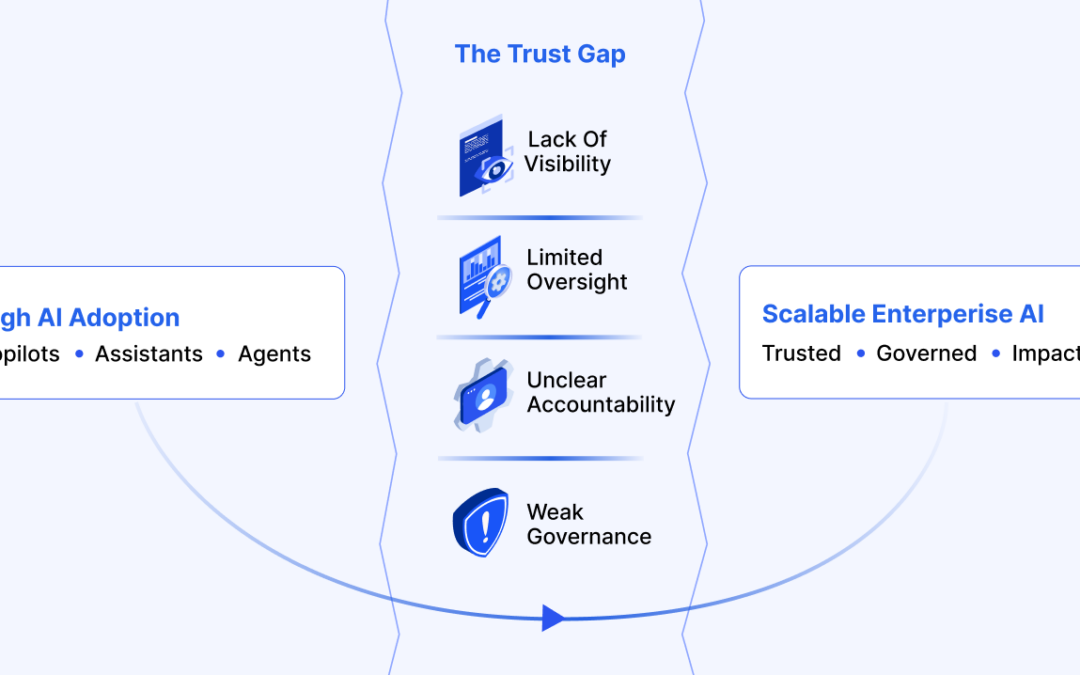
The AI Trust Gap: Why Governance Architecture Determines Enterprise Value
The trust gap surrounding enterprise AI is fundamentally an architectural challenge, and its solution is increasingly well understood.
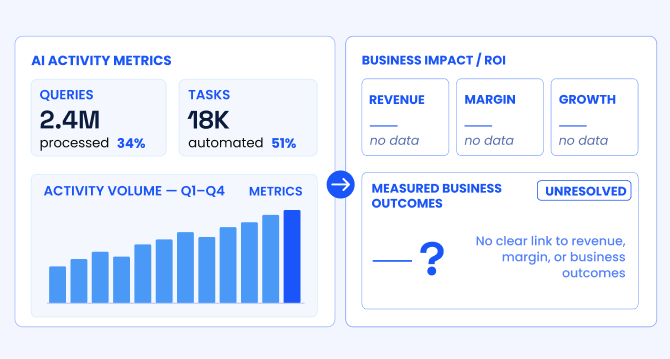
The AI ROI illusion: Why enterprises struggle to measure AI impact
Organizations with stronger measurement discipline are better positioned to link AI deployments to measurable business outcomes, prioritize high-impact use cases across the enterprise, allocate capital more effectively, and continuously refine models using real-world performance feedback.
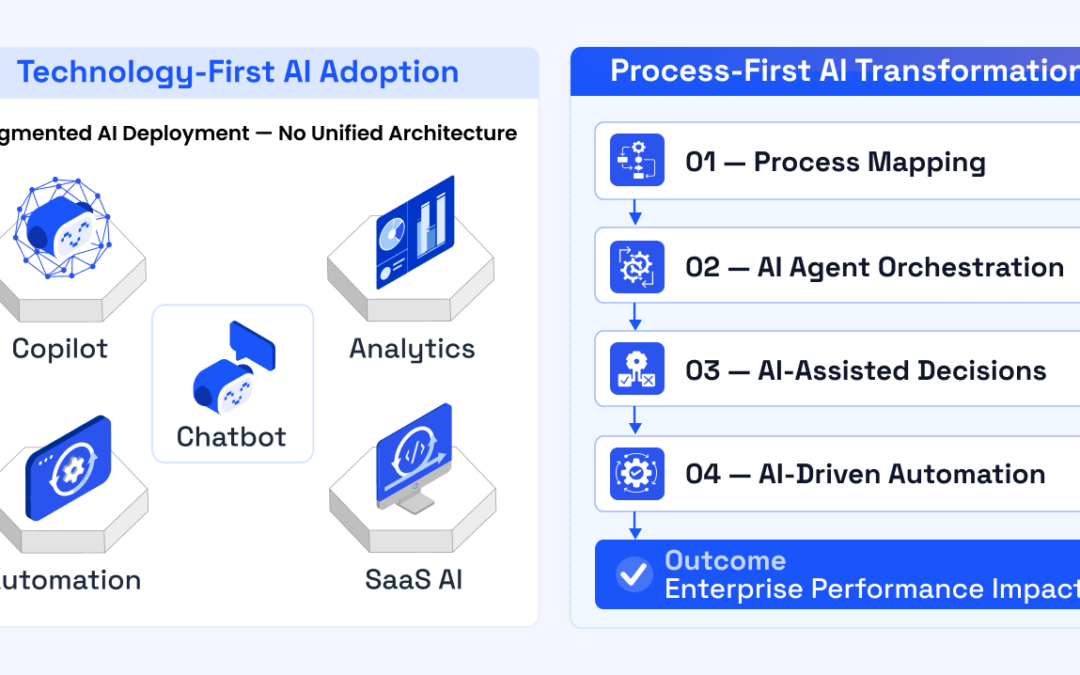
The agentic enterprise: Why AI success requires an operating model redesign
Organizations that redesign their operating models around agentic AI are beginning to outperform those that apply AI only incrementally.
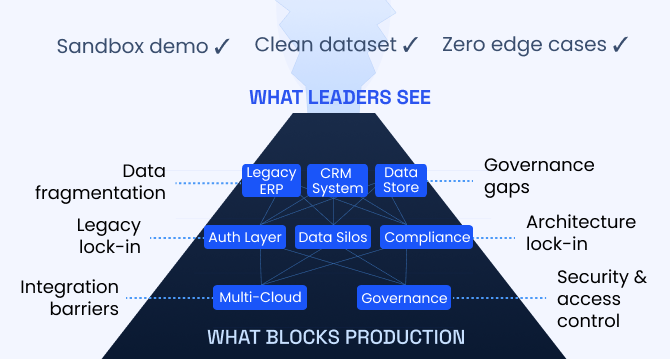
Enterprise AI pilot-to-production gap: Root causes & how to address them
The underlying cause is structural. In many enterprises, AI pilots are developed on infrastructure that was not designed to support production deployment.
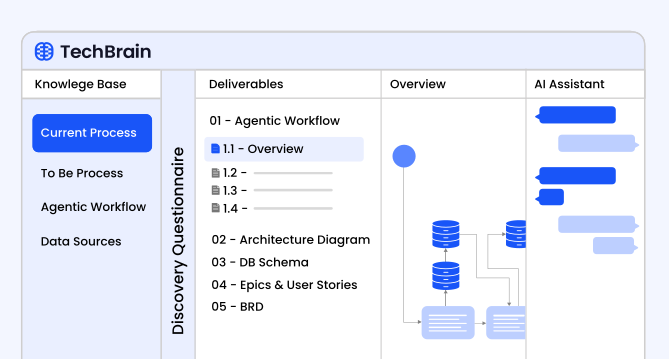
Solution architecture best practices: A guide for enterprise teams
The architecture design process culminates in a set of documented artifacts that communicate the solution to development, operations, and business teams.
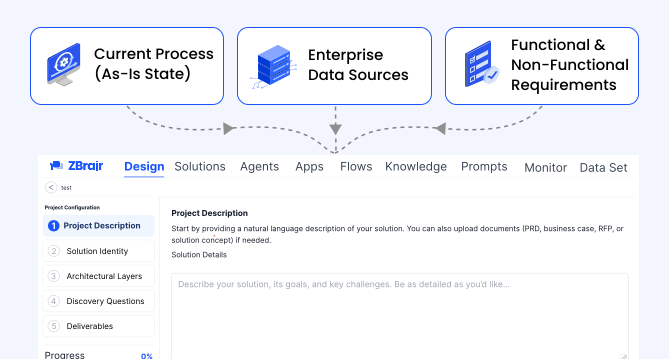
Common solution architecture design challenges and solutions
Solution architecture must evolve from fragmented documentation practices to a structured, collaborative, and continuously validated design capability.
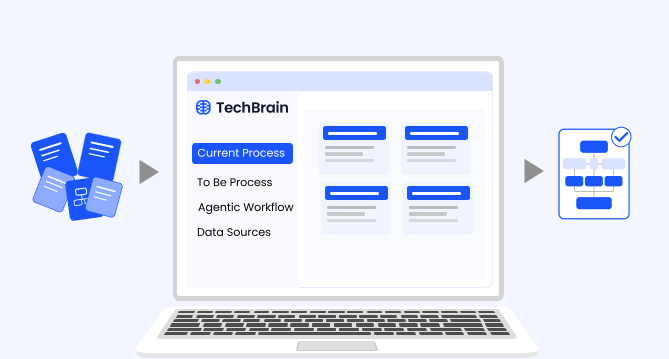
Why structured architecture design is the foundation of scalable enterprise systems
Structured architecture design guides enterprises from requirements to build-ready blueprints. Learn key principles, scalability gains, and TechBrain’s approach.
Intranet search engine guide: How it works, use cases, challenges, strategies and future trends
Effective intranet search is a cornerstone of the modern digital workplace, enabling employees to find trusted information quickly and work with greater confidence.
Company knowledge base: Why it matters and how it is evolving
A centralized company knowledge base is no longer a “nice-to-have” – it’s essential infrastructure. A knowledge base serves as a single source of truth: a unified repository where documentation, FAQs, manuals, project notes, institutional knowledge, and expert insights can reside and be easily accessed.

