Manufacturing
 Logistics
 Real Estate
 Retail
 Finance
 Healthcare
 Hospitality
 Automotive
Enterprise knowledge management guide: Strategy, scope, challenges, best practices, and solution
Listen to the article
Enterprise knowledge management (EKM) plays a critical role in helping organizations capture, organize, and leverage their knowledge assets effectively. From documents and data to processes and employee expertise, knowledge fuels innovation, informed decision-making, and operational efficiency. Yet in many enterprises, this knowledge remains fragmented and difficult to access.
Recent research highlights the impact of this fragmentation. While teams expect “quick questions” to be easy to answer, 34% of employees spend 30–60 minutes every day simply waiting for responses, in addition to the time spent searching.
The consequences extend well beyond inconvenience. Poor knowledge discovery contributes to productivity loss (45%), employee frustration (18%), duplicate work (11%), and downstream effects such as customer delays (15%) and missed deadlines (9%). What often appears to be a search or tooling issue is, in reality, a business-wide problem.
Effective enterprise knowledge management addresses this challenge by ensuring knowledge is discoverable, contextual, and accessible across systems and teams. Rather than focusing solely on content storage, modern EKM combines people, processes, and technology to activate knowledge where work happens—reducing friction, accelerating decisions, and improving outcomes.
This article explores the foundations of enterprise knowledge management, the common challenges organizations face, best practices for effective implementation of enterprise knowledge management, and how modern, AI-powered enterprise search solutions like ZSearch are redefining knowledge discovery at scale.
- What is Enterprise Knowledge Management (EKM)?
- Core capabilities of effective enterprise knowledge management
- Key challenges in enterprise knowledge management
- Strategic benefits of implementing enterprise knowledge management
- Best practices for modern enterprise knowledge management
- Simplifying enterprise knowledge management with ZSearch
- Future trends in enterprise knowledge management
What is Enterprise Knowledge Management (EKM)?
Enterprise Knowledge Management (EKM) refers to the systematic approach enterprises use to capture, organize, discover, and activate knowledge across the enterprise. It encompasses the processes, technologies, and governance models that ensure critical information—spread across systems, teams, and workflows—is accessible to the right people at the right time.
Unlike informal knowledge sharing or isolated repositories, EKM is built to operate at enterprise scale. Modern organizations generate and maintain knowledge continuously across documents, collaboration platforms, ticketing systems, code repositories, and business applications. EKM unifies access to these fragmented sources, enabling employees to search, retrieve, and apply knowledge without needing to know where it lives or who owns it.
Enterprise knowledge management is often mistaken for document management, but its scope is far broader. Document management focuses on storing and controlling files, while EKM emphasizes discoverability, context, and usability—ensuring knowledge can be found using natural queries, understood in its business context, and trusted for decision-making. Similarly, while personal or team knowledge tools help individuals or small groups organize information, they lack the structure, governance, and scalability required for enterprise-wide knowledge sharing.
EKM spans multiple forms of organizational knowledge. Structured knowledge resides in systems such as databases, CRMs, issue trackers, and ticketing platforms, where data is stored according to defined schemas. Unstructured knowledge includes documents, emails, chat conversations, messages, reports, articles, research papers, and other content that carry critical insights that are traditionally difficult to search across systems.
Tacit knowledge—the experience, judgment, and contextual understanding held by employees—remains one of the most valuable yet difficult forms of organizational knowledge to manage. While this knowledge is inherently human, modern enterprise knowledge management focuses on ensuring that insights shared through documents, discussions, decisions, and workflows are captured and made accessible over time. By improving the discoverability of documented expertise and institutional context, EKM helps organizations reduce knowledge loss and preserve critical understanding as teams evolve.
At a foundational level, enterprise knowledge management supports how knowledge is captured, retained, shared, and applied across the organization. Knowledge is continuously generated through daily work—projects, communications, decisions, and collaboration—and must be retained in ways that prevent loss as teams evolve. It must then be transferable across roles and departments, and ultimately applied in context to solve problems and drive decisions. Modern EKM systems operationalize these pillars by embedding knowledge access directly into workflows, enabling employees to discover and use relevant information at the moment of need rather than relying on manual documentation or institutional memory.
Core capabilities of effective enterprise knowledge management
Once enterprise knowledge is defined and understood, the next challenge is operationalizing it at scale. Enterprise knowledge management achieves this by supporting the full lifecycle of knowledge—from capture to discovery—across systems, teams, and workflows.
It typically enables four core capabilities:
Capture
Knowledge is continuously gathered from enterprise sources, including documents, collaboration platforms, ticketing systems, code repositories, reports, and ongoing conversations. This ensures that insights generated through daily work are retained rather than lost when projects end or teams change.
Organize
Captured knowledge is structured using metadata, taxonomies, reusable templates and automated indexing. This creates consistency across diverse content types and systems, making information easier to manage and reuse at an enterprise scale.
Share
Knowledge is securely shared across departments and roles through integrated access points and collaboration environments. Permissions and governance policies ensure that users see only the information they are authorized to access, while still enabling cross-functional visibility.
Retrieve
AI-powered, context-aware search enables employees to retrieve relevant information using keywords or natural-language queries—without needing to know where the content resides or which system contains it.
Beyond these core functions, modern enterprise knowledge management platforms apply intelligent indexing and semantic understanding to improve knowledge discovery and surface related information. This shifts knowledge access from manual searching to intelligent discovery.
By operationalizing knowledge in this way, enterprise knowledge management transforms dispersed information into a continuously accessible and actionable business asset.
Streamline your operational workflows with ZBrain AI agents designed to address enterprise challenges.
Key challenges in enterprise knowledge management
Enterprise knowledge management becomes increasingly complex as organizations scale, diversify their tool stacks, and operate across teams and geographies. Knowledge is created continuously, but without the right systems and practices, it becomes fragmented, difficult to discover required insights, and hard to maintain. The following challenges highlight the most common barriers enterprises face in managing knowledge effectively—and why traditional approaches often fall short.
Information silos and fragmentation
Departments often operate with their own tools, repositories, and processes, creating isolated pockets of knowledge across the organization. When insights, analyses, and lessons learned are confined to individual teams, other groups remain unaware that similar work has already been done. As a result, teams frequently recreate solutions, repeat research, or duplicate efforts instead of building on existing knowledge. This fragmentation not only leads to wasted time and inconsistent decisions, but also limits cross-functional collaboration. Over time, disconnected systems further increase security and compliance risks, as maintaining consistent visibility, access control, and governance becomes more difficult.
Information overload and poor discoverability
Enterprises generate vast amounts of content—documents, reports, messages, and data—but without effective discovery mechanisms, critical insights are buried under irrelevant information. Employees frequently rely on assumptions or partial knowledge because finding authoritative answers is too time-consuming.
Loss of tacit knowledge
Tacit knowledge—the experience, judgment, and institutional understanding held by employees—is among the hardest to capture. When experienced employees leave, a significant portion of this knowledge is lost, impacting continuity, efficiency, and long-term performance.
Inconsistent search experience across enterprise tools
Most enterprise applications offer their own built-in search, each with different capabilities, interfaces, and limitations. Employees are forced to learn and repeat multiple search experiences, often with inconsistent or incomplete results. This fragmentation increases search time, reduces confidence in results, and discourages effective knowledge reuse.
Lack of contextual knowledge retrieval
Traditional knowledge systems focus on returning documents rather than answers. Employees often find content but struggle to understand its relevance, recency, or applicability to their specific task. Without context-aware discovery, users must manually sift through multiple sources to piece together insights.
Technology and adoption barriers
Legacy systems and rigid folder-based storage fail to support modern, dynamic workflows. At the same time, employees may resist new platforms due to poor past experiences, complex interfaces, or tools that disrupt existing work patterns rather than enhance them.
Secure and compliant knowledge access
As information evolves rapidly, keeping knowledge current and trustworthy is a persistent challenge. Organizations must also balance accessibility with strict security, access control, and regulatory compliance—ensuring users see only what they are authorized to access without slowing productivity.
Limited insight into knowledge usage and gaps
Many organizations lack visibility into how knowledge is accessed, reused, or overlooked. Without understanding what information is frequently searched for—or where users fail to find answers—enterprises struggle to improve knowledge quality and coverage.
Unaddressed knowledge management challenges impact far more than internal efficiency. They slow decision-making, increase employee frustration, delay customer responses, and weaken an organization’s ability to compete.
Addressing these challenges requires more than storing information—it demands intelligent discovery, unified information access across systems, and secure, context-aware retrieval that works within existing enterprise environments. This is where modern, AI-powered enterprise knowledge management approaches play a critical role.
Strategic benefits of implementing enterprise knowledge management
Implementing enterprise knowledge management delivers value far beyond improved information storage. When knowledge is unified, discoverable, and accessible across systems, it becomes a strategic asset that drives efficiency, decision quality, and long-term competitiveness. A well-designed knowledge management system enables organizations to scale expertise, reduce operational friction, and respond faster to changing business demands.
Faster access to information and reduced time-to-action
By centralizing access to enterprise knowledge across documents, systems, and conversations, employees can quickly find the information they need without switching between tools or relying on tribal knowledge. This significantly reduces time spent searching and waiting for responses, enabling teams to act faster and stay focused on high-value work.
Improved decision-making and business agility
Enterprise knowledge management provides decision-makers with timely, relevant, and contextual information drawn from across the organization. With better visibility into past work, institutional knowledge, and current data, teams can make more informed decisions, reduce risk, and adapt more quickly to market or operational changes.
Elimination of redundant work and knowledge reuse
When previous work, insights, and best practices are easy to discover, organizations avoid recreating solutions that already exist. Knowledge reuse improves consistency, accelerates execution, and ensures that teams build on proven approaches rather than starting from scratch.
Preservation of institutional and tacit knowledge
A robust enterprise knowledge management approach helps capture and retain critical expertise that might otherwise be lost due to employee turnover or organizational change by systematically documenting experiential insights through retrospectives, decision records, and collaborative discussions. By embedding knowledge capture into everyday workflows and ensuring this information is searchable and accessible across teams, organizations reduce dependency on individual employees and preserve institutional knowledge over time.
Enhanced collaboration across teams and geographies
Unified access to shared knowledge breaks down organizational silos and enables cross-functional collaboration. Teams across departments and regions can build on each other’s insights, leading to better coordination, faster problem-solving, and more innovative outcomes.
Stronger security, compliance, and governance
Enterprise knowledge management systems enforce consistent access controls and governance policies across information sources. This ensures users only access authorized content while supporting regulatory compliance, audit readiness, and secure knowledge sharing at scale.
Scalable, future-ready knowledge infrastructure
Modern enterprise knowledge management solutions integrate seamlessly with existing tools and workflows, allowing organizations to scale without disruption. As AI capabilities mature, this foundation supports advanced use cases such as contextual recommendations, intelligent search, and AI-assisted decision support.
Streamline your operational workflows with ZBrain AI agents designed to address enterprise challenges.
Best practices for modern enterprise knowledge management
Successful enterprise knowledge management is not achieved by deploying a single tool or central repository. It requires a strategic, system-level approach that aligns technology, workflows, and organizational behavior. The following best practices reflect how modern enterprises build scalable, trusted, and high-impact knowledge management ecosystems.
1. Make knowledge capture invisible
One of the fastest ways to derail a knowledge management initiative is to make it additional work. Employees are unlikely to pause their daily tasks to document insights or update portals manually. Modern EKM systems should capture knowledge passively—directly from the tools employees already use, such as document management systems, collaboration platforms, and ticketing systems—so knowledge sharing becomes a natural byproduct of work rather than a separate obligation.
2. Prioritize real-time, in-flow access
Knowledge loses value when it arrives too late. Instead of forcing employees to search static repositories, enterprises should embed knowledge access directly into the workflow. Relevant answers, documents, and insights should surface instantly within familiar environments—such as enterprise search, collaboration tools, or project management tools—enabling faster decisions and uninterrupted execution.
3. Ground AI in trusted enterprise knowledge
AI can dramatically accelerate knowledge discovery, but speed without trust introduces risk. Generative systems that rely on unverified or incomplete data can produce misleading results, leading to automation bias and poor decision-making. Best-in-class EKM solutions ground AI in verified enterprise sources, enforce permissions, and preserve traceability—ensuring that AI-driven insights remain reliable, explainable, and aligned with human expertise.
4. Reduce redundancy through intelligent discovery
Repeated questions, duplicate documents, and outdated content quickly erode confidence in knowledge systems. Modern enterprise knowledge management platforms use intelligent indexing, semantic understanding, and surface related knowledge. This keeps the knowledge base clean, relevant, and immediately usable.
5. Design for seamless integration and scalability
Enterprise knowledge management systems must adapt to existing tools, workflows, and growth trajectories. Best practices emphasize solutions that integrate seamlessly with enterprise platforms, scale across departments and geographies, and evolve without disrupting operations. Flexibility in deployment and architecture ensures long-term viability as organizational needs change.
6. Enforce governance without blocking access
Strong governance is essential—but it should not come at the cost of usability. Modern EKM balances accessibility with enterprise-grade security by enforcing permission-aware access, auditability, and compliance controls at every layer.
7. Measure impact and continuously improve
Knowledge management is an ongoing discipline, not a one-time implementation. Enterprises should define clear metrics—such as search success rates, time saved, knowledge reuse, and decision speed—to assess effectiveness. Continuous feedback and analytics help identify gaps, refine knowledge coverage, and demonstrate measurable business value.
Simplifying enterprise knowledge management with ZSearch
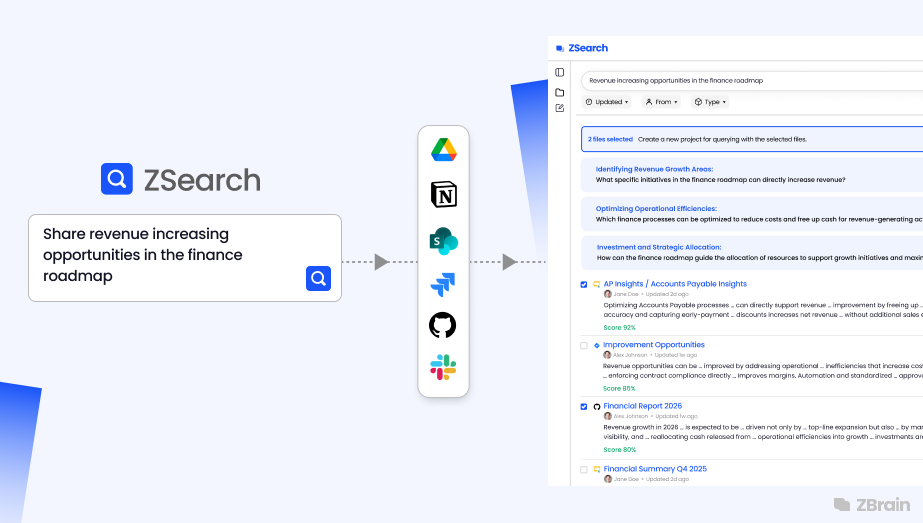
ZSearch is an AI-powered, enterprise search solution designed to help organizations discover information across their private enterprise data securely and efficiently. It integrates with internal systems such as Google Drive, SharePoint, Slack, Jira, GitHub, CRMs, wikis, and local file repositories, enabling employees to search across enterprise knowledge through a single, unified interface.

ZSearch operates strictly within organizational data boundaries. It respects existing permissions and access controls, ensuring users only see information they are authorized to access. This allows enterprises to unlock the value of their collective knowledge while maintaining security, governance, and compliance.
By unifying knowledge spread across multiple systems, ZSearch eliminates fragmented search experiences and enables users to retrieve precise, contextually relevant information using both keyword-based and natural language queries.
Key capabilities of ZSearch

- Natural language search: ZSearch supports both keyword-based and natural-language queries, allowing users to search using everyday language.
- Smart ranking for relevant results: Search results are intelligently ranked using relevance and contextual understanding, ensuring the most useful and trustworthy information appears first. This helps users find what they need faster and make more informed decisions.
- Targeted content discovery: Advanced filters allow users to refine results by data source, content type, and recency. This enables focused discovery within large and diverse enterprise datasets without compromising relevance.
- Automatic indexing and data synchronization: ZSearch automatically indexes and synchronizes enterprise content across connected systems. This ensures search results remain accurate and up to date as organizational knowledge evolves.
- Collaborative project workspaces: Users can select multiple search results and group them into shareable project workspaces. Each workspace includes a dedicated AI assistant that answers questions strictly based on the selected content, enabling teams to organize, explore, and act on enterprise knowledge together.
- Secure, permission-aware access: ZSearch enforces enterprise-grade security with end-to-end permission controls. It respects source-level access rules and Access Control Lists (ACLs), ensuring secure access. The platform supports enterprise identity integration, auditability, and alignment with major compliance frameworks.
ZSearch simplifies enterprise knowledge management by unifying secure, intelligent search across systems, enabling teams to access trusted information quickly and collaborate with confidence.
Future trends in enterprise knowledge management
Enterprise knowledge management is evolving in response to structural changes in how organizations operate, collaborate, and apply information. As enterprises manage growing volumes of content across distributed teams and systems, the focus is shifting from documentation toward intelligent, governed knowledge use. The following trends reflect broader changes shaping EKM over the next two years.
1. Increased use of AI for knowledge discovery and assistance
AI is becoming a core component of enterprise knowledge systems, particularly for discovery and summarization. Rather than replacing human expertise, AI is being used to reduce manual effort—helping employees locate relevant information faster, synthesize large volumes of content, and identify related knowledge across systems. Enterprises are prioritizing practical, assistive use cases over fully autonomous systems.
2. Context-aware retrieval over keyword-only search
Traditional keyword search is proving insufficient for complex enterprise environments. Organizations are increasingly adopting retrieval approaches that account for context, relationships, and intent—such as how information relates to projects, teams, and workflows. This enables more accurate discovery across structured systems and unstructured content without requiring users to know exact terminology.
3. Knowledge embedded in daily workflows
Knowledge access is moving closer to where work happens. Rather than expecting employees to switch tools or navigate dedicated knowledge portals, enterprises are embedding knowledge discovery into collaboration platforms, operational systems, and core workflows. This trend reflects the need to reduce friction and ensure knowledge is applied in real time.
4. Stronger emphasis on governance, trust, and accountability
As AI-driven knowledge systems become more prevalent, enterprises are placing greater emphasis on governance. This includes maintaining permission-aware access, ensuring information accuracy, and providing transparency into knowledge sources. Trust is becoming a prerequisite for adoption, particularly in regulated industries and risk-sensitive functions.
Looking ahead
The future of enterprise knowledge management is not defined by larger repositories or more documentation. It is shaped by the ability to make knowledge accessible, trustworthy, and usable in the flow of work. Organizations that align their knowledge strategies with these trends will be better positioned to reduce friction, retain institutional intelligence, and support informed decision-making as they scale.
Conclusion
Enterprise knowledge management has become a foundational capability for modern organizations operating in complex, information-rich environments. As knowledge spreads across systems, teams, and formats, the ability to discover, trust, and apply the right information at the right time is critical. By combining clear strategy, strong governance, and intelligent discovery, enterprises can transform knowledge from a fragmented resource into a driver of efficiency, collaboration, and informed decision-making.
As organizations scale and adopt more digital tools, unifying and securing enterprise knowledge becomes essential. Modern, AI-powered search platforms like ZSearch provide a practical foundation for this shift—helping enterprises move from fragmented information to informed action.
See how ZSearch helps teams find the information they need—without searching across multiple tools. Explore a smarter approach to enterprise knowledge management.
Listen to the article
Author’s Bio


CEO LeewayHertz
An early adopter of emerging technologies, Akash leads innovation in AI, driving transformative solutions that enhance business operations. With his entrepreneurial spirit, technical acumen and passion for AI, Akash continues to explore new horizons, empowering businesses with solutions that enable seamless automation, intelligent decision-making, and next-generation digital experiences.
Table of content
- What is Enterprise Knowledge Management (EKM)?
- Core capabilities of effective enterprise knowledge management
- Key challenges in enterprise knowledge management
- Strategic benefits of implementing enterprise knowledge management
- Best practices for modern enterprise knowledge management
- Simplifying enterprise knowledge management with ZSearch
- Future trends in enterprise knowledge management
Share Article


Frequently Asked Questions
What is enterprise knowledge management (EKM)?
How is enterprise knowledge management different from document management?
Why do enterprises struggle with knowledge management?
Enterprises struggle with knowledge management primarily because knowledge is created and stored across many disconnected systems. As organizations grow, this complexity increases, making it difficult to maintain visibility, accuracy, and access to critical information. Common challenges include:
- Knowledge silos created by multiple tools and repositories
- Difficulty finding relevant and up-to-date information
- Time lost searching for answers or recreating existing work
- Inconsistent governance and access control across systems
- Knowledge becoming outdated or inaccessible as teams evolve
Without addressing these challenges through unified discovery and governance, enterprises are unable to fully leverage the knowledge they already possess.
What is ZSearch?
What are the key capabilities of ZSearch?
ZSearch is designed to simplify enterprise knowledge discovery by combining intelligent search, security, and collaboration into a single solution. Its key capabilities include:
- Natural language and keyword search:
Enables users to search using everyday language or traditional keywords, making it easier to find relevant information without knowing exact terms or locations. - Smart, context-aware ranking:
Surfaces the most relevant and useful results first by understanding context and relevance, helping users reach accurate information faster. - Targeted content discovery:
Allows users to refine results using filters such as data source, content type, and recency to focus on specific information within large enterprise datasets. - Automatic indexing and synchronization:
Keeps enterprise knowledge continuously indexed and up to date across connected systems, ensuring results reflect the latest available information. - Collaborative project workspaces:
Enables teams to group search results into shared projects with a dedicated AI assistant, supporting collaborative research, document reviews, and structured knowledge exploration. - Secure, permission-aware access:
Enforces enterprise-grade security by respecting existing permissions and access controls, ensuring users only see authorized content.
How does ZSearch ensure secure and permission-aware enterprise search?
ZSearch enforces enterprise-grade security by respecting source-level permissions and Access Control Lists (ACLs) across all connected systems. Users can only access information they are authorized to view, with permissions enforced end-to-end throughout the search and retrieval process. The platform supports audit logging and source traceability to maintain transparency and accountability. ZSearch is designed to align with major compliance frameworks ensuring secure and compliant knowledge discovery across the organization.
How can organizations get started with ZSearch?
Organizations can get started with ZSearch by visiting our solution and booking a demo. During the demo, teams can explore how ZSearch connects to existing enterprise systems, enables secure and intelligent search across data sources, and supports collaboration using permission-aware access. The onboarding process is designed to integrate seamlessly with existing workflows, helping organizations quickly experience value without disrupting operations.
Insights
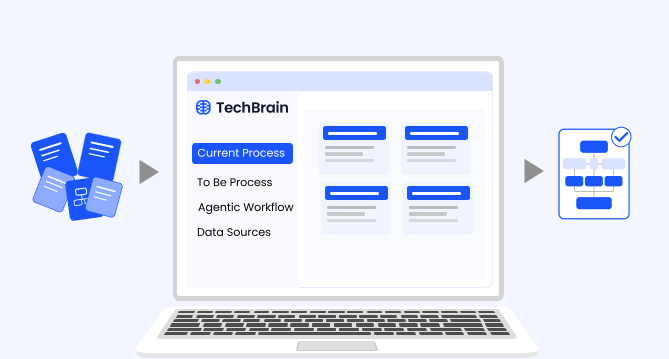
Common solution architecture design challenges — and how to overcome them
Solution architecture must evolve from fragmented documentation practices to a structured, collaborative, and continuously validated design capability.
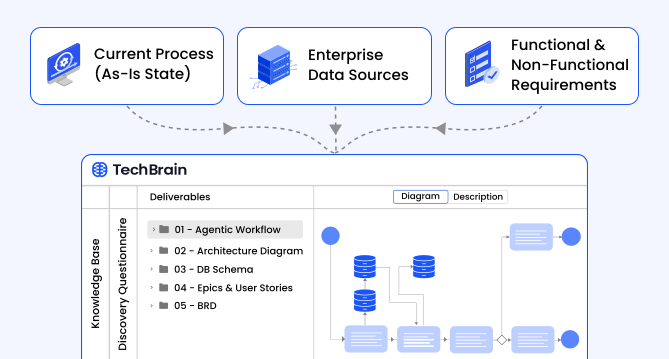
Why structured architecture design is the foundation of scalable enterprise systems
Structured architecture design guides enterprises from requirements to build-ready blueprints. Learn key principles, scalability gains, and TechBrain’s approach.
A guide to intranet search engine
Effective intranet search is a cornerstone of the modern digital workplace, enabling employees to find trusted information quickly and work with greater confidence.
Company knowledge base: Why it matters and how it is evolving
A centralized company knowledge base is no longer a “nice-to-have” – it’s essential infrastructure. A knowledge base serves as a single source of truth: a unified repository where documentation, FAQs, manuals, project notes, institutional knowledge, and expert insights can reside and be easily accessed.
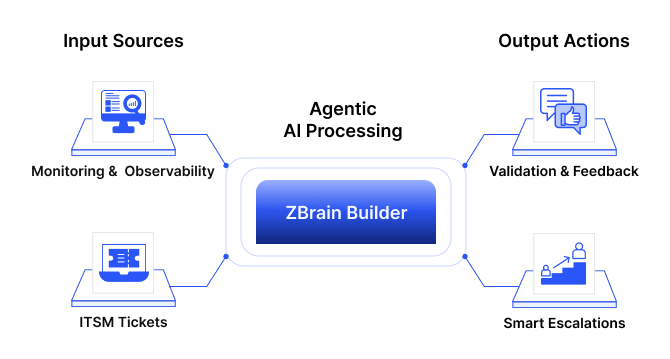
How agentic AI and intelligent ITSM are redefining IT operations management
Agentic AI marks the next major evolution in enterprise automation, moving beyond systems that merely respond to commands toward AI that can perceive, reason, act and improve autonomously.
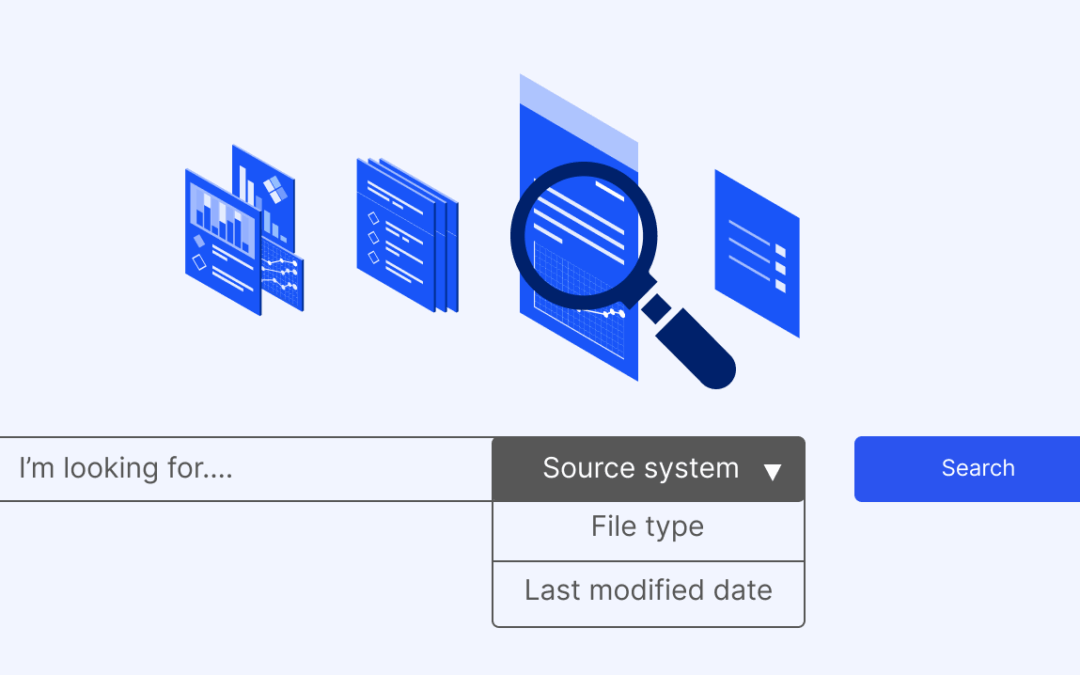
What is an enterprise search engine? A guide to AI-powered information access
An enterprise search engine is a specialized software that enables users to securely search and retrieve information from across an organization’s internal data sources and systems.
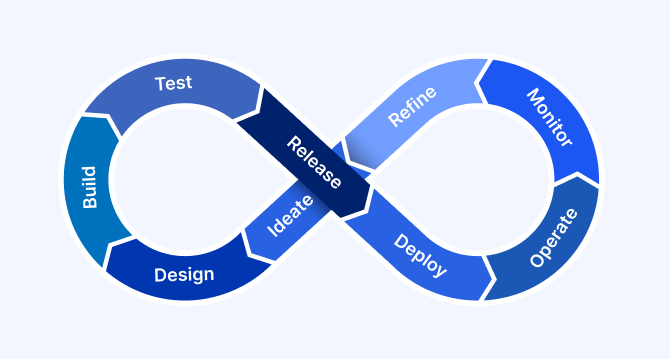
A comprehensive guide to AgentOps: Scope, core practices, key challenges, trends, and ZBrain implementation
AgentOps (agent operations) is the emerging discipline that defines how organizations build, observe and manage the lifecycle of autonomous AI agents.
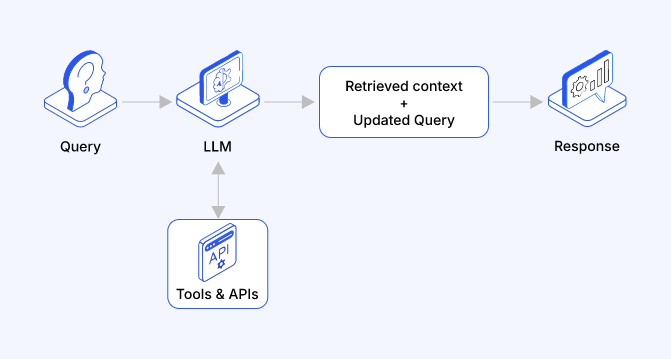
Adaptive RAG in ZBrain: Architecting intelligent, context-aware retrieval for agentic AI
Adaptive Retrieval-Augmented Generation refers to a class of techniques and systems that dynamically decide whether or not to retrieve external information for a given query.
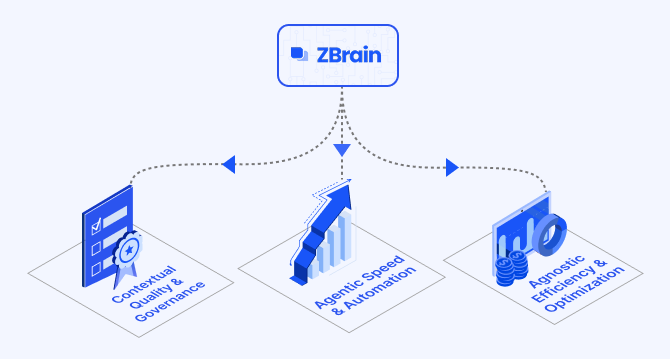
How ZBrain breaks the trade-offs in the AI iron triangle
ZBrain’s architecture directly challenges the conventional AI trade-off model—the notion that enhancing one aspect inevitably compromises another.