Manufacturing
 Logistics
 Real Estate
 Retail
 Finance
 Healthcare
 Hospitality
 Automotive
Why structured architecture design is the foundation of scalable agentic enterprise systems
Listen to the article
Modern enterprises don’t fail to deliver because they lack ideas, budgets, or engineering talent. They fail because execution depends on architecture, and architecture is too often produced through fragmented documents, ad-hoc diagrams, and undocumented institutional knowledge rather than a governed system of record. When architecture is not structured, changes become expensive, dependencies remain implicit, and coordination collapses into reactive firefighting. This is especially acute as organizations adopt microservices, event-driven integration, cloud platforms, and AI or analytics workloads and environments, where implicit assumptions compound into systemic risk.
A governed, structured approach to architecture design functions as the control plane for enterprise change. It consolidates requirements into a shared workspace, maintains traceability from business intent to build artifacts, records decision history, validates architectural completeness, and produces consistent outputs for engineering execution. This approach aligns with global architecture standards that formally incorporate stakeholder needs and design concerns, as well as enterprise architecture frameworks that integrate requirements management and governance into implementation.
The measurable upside is well established. MIT CISR research highlights that building the right enterprise architecture improves time-to-market and reduces IT costs. DORA’s [1] long-running delivery research ties architecture and delivery practices to measurable throughput, stability, and reduced deployment rework, metrics that predict both organizational performance and team well-being. Empirical software engineering studies [2] consistently observe that avoidable rework consumes 40–50% of project effort, and that defects discovered after design cost dramatically more to remediate than those addressed during requirements and architecture. These are not marginal improvements. They represent the difference between organizations that scale through structure and those that stall under the weight of accumulated ambiguity.
Yet the challenge is not a lack of best practices. Most organizations understand the principles of sound architecture. The gap lies in operationalizing them, creating systems that embed structure, traceability, and governance into everyday execution rather than treating architecture as a one-time design artifact. This article examines why structured, governed architecture design is the essential foundation for scalable enterprise systems. It explores the principles that future-proof IT investments, explains the operational gap that prevents most organizations from applying them, and introduces how the ZBrain Design module – ZBrain Design operationalizes structured architecture in practice.
- Architecture without governance: Where enterprise execution breaks down
- Defining structured architecture design
- Why structured architecture is the foundation of scalability
- How the ZBrain Design operationalizes governed, structured architecture
- Core principles of future-proof enterprise architecture
Architecture without governance: Where enterprise execution breaks down
Enterprise architecture design sits at the intersection of business intent, technical constraints, and organizational coordination. It should function as a governed, versioned system that translates strategy into coherent system behavior. Instead, in many enterprises, architecture is fragmented across meetings, spreadsheets, slide decks, diagram exports, ticketing systems, and disconnected tools with no unified system of record.
Without a governed approach:
- Requirements are scattered across structured and unstructured sources, with no consolidated baseline.
- Multiple mental models emerge across teams in the absence of a shared language or clearly defined boundaries.
- System dependencies are interpreted rather than explicitly defined.
- Integration contracts often lack clear ownership and disciplined version control.
- Identity, networking, infrastructure, and data residency constraints often surface late, often after the build has begun.
Design decisions are undocumented or disconnected from the business rationale that drove them.
This fragmentation is not a documentation problem. It is a structural risk. Architecture defines how systems behave under change. When the architectural process itself is unmanaged, system behavior becomes emergent rather than intentional.
How fragmentation becomes architectural drift
As complexity increases, more integrations, more domains, and more distributed teams lead to divergence that compounds. Domain boundaries blur. Services depend on undocumented data semantics. Events lack schema governance. APIs evolve without version rigor. What appears modular becomes implicitly coupled.
The result is architectural drift.
When traceability from business intent to architectural decisions, interface contracts, and implementation artifacts is absent, change impact cannot be assessed confidently. Requirement updates trigger unexpected downstream effects. Deployment policies invalidate integration logic. Compliance constraints surface after build. Rework becomes cyclical rather than exceptional.
Technical debt accumulates quietly in this environment. Short-term delivery decisions embed structural weaknesses into the foundation. Over time, innovation slows, not because ideas are lacking, but because the cost of safe modification becomes too high.
Where the risk intensifies
These dynamics become acute in modern hybrid and cloud environments, where identity models, network segmentation, regulatory constraints, and infrastructure policies must be embedded into design from the outset. When treated as downstream validation instead of primary architectural inputs, they emerge as late-stage blockers that force redesign under delivery pressure.
The consequences are visible across the delivery lifecycle:
-
Integration failures are surfacing during staging rather than design. Industry research [3] consistently finds that defects caught after the design phase cost five to ten times more to remediate than those caught during requirements and architecture, and the multiplier rises sharply once code reaches staging or production.
-
Compliance exposure discovered after development, not before
-
Configuration mismatches are propagating through the deployment pipelines
-
Repeated cross-team reconciliation meetings often address symptoms rather than root causes; in large enterprises, unresolved architecture and integration ambiguity consume significant senior engineering time in recurring syncs with little to no structural progress.
-
Increasing hesitation to modify core systems is the clearest signal that architecture has become a liability rather than an enabler
The compounding effect
Unstructured architecture does not fail immediately. It degrades incrementally through ambiguity, hidden coupling, version confusion, and accumulating debt until the enterprise becomes resistant to the very change it needs to compete.
This is not a tooling gap or a documentation gap. It is a structural gap between how architecture is practiced and what enterprise-scale delivery actually demands. Organizations that close this gap scale effectively. Those that don’t remain trapped in cycles of rework, reconciliation, and reactive coordination.
Closing it begins with treating structured architecture as an operational discipline, and, for AI-led initiatives, as the only foundation on which agentic solutions can be built reliably. The next section examines what that discipline actually looks like in practice.
Defining structured architecture design
Structured architecture design is the practice of translating validated solution requirements into technical blueprints through a governed, repeatable, and traceable process. It is not simply the act of producing architecture diagrams or writing technical specifications. It is the disciplined organization of the entire design workflow from requirement intake through system decomposition, dependency mapping, validation, and artifact generation within a framework that enforces consistency, completeness, and alignment at every stage.
At its core, structured architecture design has five defining characteristics.
A governed discipline, not a diagram
In many organizations, architecture begins and ends with visual representations: system maps, integration diagrams, flowcharts. While useful, diagrams alone do not constitute structured design.
Structured architecture means defining scope and boundaries explicitly, documenting assumptions about systems, data, and infrastructure, identifying dependencies across applications, APIs, and platforms, capturing design decisions alongside their rationale, and maintaining version history as the design evolves.
Architecture becomes governed when it operates within defined standards, review mechanisms, and traceable decision frameworks, not when it simply produces documentation. For example, in the ZBrain Design module, every initiative lives inside a governed workspace where the source documents, solution identity, architectural layers, design decisions, and generated deliverables are all maintained as a single, versioned system of record.
Explicit definitions over implicit assumptions
Unstructured design relies heavily on tacit knowledge. Teams assume data will be available, APIs will support required interactions, systems are compatible, security and compliance requirements are understood, and deployment environments will meet performance expectations.
Structured architecture design exposes these assumptions for validation and governance. It formalizes integration logic, data flow definitions, security constraints, performance requirements, and infrastructure dependencies, making each one a defined, reviewable element of the design rather than an unspoken expectation. For example, the ZBrain Design Module surfaces these through a contextual discovery questionnaire that explicitly asks about each assumption — hosting model, integration pattern, data residency and model and platform choice — and records the answer alongside the architecture.
By making assumptions explicit early, structured architecture reduces ambiguity before implementation begins, when change is far less costly.
Traceability from business intent to technical execution
One of the defining characteristics of structured architecture is end-to-end traceability. Every technical component, integration, or workflow should map back to a validated business requirement. Without this linkage, architecture drifts systems become over-engineered, misaligned, or disconnected from the value they were intended to deliver.
Structured architecture design maintains a clear chain:
Business objectives → Solution requirements → Technical blueprint → Implementation artifacts
This traceability protects IT investments and preserves strategic alignment as systems evolve. It also enables confident impact analysis: when a requirement changes, the downstream effects on architecture, contracts, and build artifacts are visible and assessable.
Dependency awareness as a primary concern
Modern enterprise environments are not linear. They are ecosystems of interconnected systems, data platforms, SaaS applications, and cloud infrastructure where a change in one component can ripple across dozens of others.
Structured architecture design treats dependencies as core architectural elements rather than secondary details. It deliberately models cross-system integrations, data ownership and flow, human-in-the-loop decision points, external vendor interactions, and deployment environment constraints. For example, the ZBrain Design Module makes these visible through generated data flow diagrams, integration logic specifications, and end-to-end architecture views, each grounded in the solution identity rather than drawn from a generic template.
By surfacing interdependencies early, structured design prevents the cascading failures that emerge during implementation and scaling when these relationships are left implicit.
A living system, not a static deliverable
Structured architecture is not rigid. Governance does not mean inflexibility; it means controlled iteration.
As requirements change or constraints evolve, architecture is refined through documented revisions, version control, stakeholder validation, and structured impact analysis. Each iteration builds on the previous one rather than overwriting it, preserving the decision history that future teams will need to understand why the architecture is shaped the way it is.
This ensures adaptability without sacrificing coherence, enabling the design to evolve in response to change while maintaining architectural integrity.
In essence, structured architecture design is the deliberate operationalization of architectural thinking. It replaces ambiguity with definition. It replaces reactive coordination with governed collaboration. It replaces static diagrams with traceable, executable blueprints. Most importantly, it establishes architecture as a strategic foundation, not a downstream artifact, enabling enterprise systems to scale with control rather than complexity.
Unstructured vs. governed architecture: a comparative view
|
Dimension |
Unstructured practices |
Governed, structured practices |
|---|---|---|
|
Requirements intake |
Scattered across docs and meetings, interpretation drift is common |
Consolidated into a governed baseline; changes are tracked and impact-assessed |
|
Time-to-delivery |
Faster start, slower finish; late ambiguity triggers redesign and coordination delays |
Slower start, faster finish; early validation reduces downstream rework |
|
Cost control |
Cost drift via hidden dependencies and compounding tech debt; budgets diverted to debt remediation |
Cost managed via explicit trade-offs, modular boundaries, and cost/risk reviews |
|
Artifact consistency |
Static diagrams often diverge from specifications and implementation |
Structured artifacts (views, interface definitions, data flows, deployment assumptions) evolve together; reviews ensure consistency |
|
Traceability |
Decision rationale lost; repeated debates; difficult impact analysis |
Explicit traceability using decision records and linked artifacts; decisions tied to drivers and constraints |
|
Observability and operability |
Monitoring bolted on; low visibility into dependencies and user journeys |
Observability requirements embedded; telemetry standards and SLOs defined upfront |
|
Completeness checks |
Relies on individual expertise; gaps emerge late |
Structured, question-driven reviews and validation workflows prioritize unresolved concerns |
|
Integration and data-flow clarity
|
Interfaces described informally; schemas and versioning are inconsistent |
Event/API contracts are explicit; data lineage and flow dependencies are modeled and reviewed |
|
Interoperability |
Integrations implemented ad hoc; inconsistent semantics; fragile interfaces |
Explicit interoperability goals; standardized contracts; reference architectures guide decisions |
|
Rework rate
|
High avoidable rework (empirically cited as a major share of total effort) |
Reduced avoidable rework via explicit requirements, validation questions, and decision records |
|
Risk and compliance
|
Reactive audit evidence; unclear system boundaries increase compliance risk |
Proactive evidence data processing records, and security planning artifacts |
|
Scalability |
Tight coupling proliferates; teams block each other as dependencies grow |
Looser coupling; clearer interfaces and decision rights enable parallel delivery |
|
Deployment realism
|
Environment constraints are identified late in the delivery cycle, leading to configuration mismatches and deployment failures |
Deployment and environment assumptions embedded early (config, identity, reliability constraints) |
|
Outcome measurement |
Hard to connect architecture quality to delivery outcome |
Metrics connect architecture quality to delivery stability, throughput, and rework reduction |
The contrast is not theoretical. Organizations operating on the left side of this table experience the symptoms described in the previous section: architectural drift, cyclical rework, and increasing resistance to change. Those on the right lay the foundation that enables scalability, adaptability, and confident execution.
Streamline your operational workflows with ZBrain AI agents designed to address enterprise challenges.
Why structured architecture is the foundation of scalability
Enterprise scalability is rarely a function of raw engineering talent alone; it depends on how systematically architecture decisions are made, governed, and implemented. Structured architecture design provides this foundation in several essential ways.
Absorbing complexity before it reaches implementation
Enterprise initiatives involve dozens of systems, hundreds of integration points, and thousands of design decisions. Without structure, this complexity overwhelms teams during build. A structured architecture front-loads the work of understanding and resolving complexity, ensuring that engineering teams receive a blueprint that has already accounted for the interactions, dependencies, and constraints they will encounter. The complexity doesn’t disappear; it is resolved in design rather than discovered in development.
Enabling independent scaling of components
When architectures clearly decompose systems into discrete components with explicit interfaces and dependencies, those components can evolve, scale, and be replaced independently. This is the technical foundation of scalability. Without explicit decomposition, without knowing exactly where one system ends and another begins, scaling any single component risks destabilizing the whole. Clear boundaries are what make selective scaling possible.
Establishing stable contracts between teams
In large organizations, architecture is the shared agreement that allows multiple teams to build in parallel. A structured architecture makes this contract explicit: defined interfaces, agreed data formats, and documented assumptions. When the contract is clear, teams can work independently without constant re-coordination, which is what enables organizations to scale delivery capacity alongside system complexity.
Supporting change without regression
Scalable systems must evolve. Regulations shift, business models change, and platforms are upgraded. Structured architectures, because they document dependencies, design rationale, and extension points, allow teams to assess the impact of proposed changes before making them. This is the difference between controlled evolution and risky, ad hoc modification. The architecture doesn’t resist change; it makes change accessible.
Reducing the cost of growth
Every gap or ambiguity left in an architecture design becomes a cost multiplier during implementation. Structured design systematically reduces these gaps, thereby decreasing the marginal cost of adding new capabilities, integrations, or capacity as the architecture matures. This compounding efficiency is the economic logic of scalability, and the reason structured architecture pays for itself over the lifecycle of an initiative, not just at the point of delivery.
These benefits compound. Clear decomposition enables stable contracts, stable contracts enable parallel delivery, and reduced ambiguity lowers the cost of every future change, creating an architectural advantage that strengthens as the enterprise scales.
These pressures intensify in agentic systems. Every scaling concern named above, managing complexity, decomposing components, holding stable contracts, absorbing change, and lowering the cost of growth, is amplified when the architecture has to coordinate multiple agents, evolving model behavior, tool integrations, and human-in-the-loop checkpoints, all while the underlying models themselves are still being iterated. A structured approach is not a nice-to-have for agentic initiatives; it is the only way to keep the design coherent as agents, tools, and prompts change underneath it. The next section examines how the ZBrain Design Module operationalizes this discipline in practice.
How the ZBrain Design Module operationalizes governed, structured architecture
Principles alone are insufficient to bridge the divide between architectural design and practical implementation. In numerous organizations, teams develop roadmaps and static diagrams that seldom endure through the implementation phase, not due to deficiencies in architectural concepts, but because these concepts are not effectively operationalized. Addressing this disconnect requires adopting tools that integrate structured architectural frameworks directly into the execution workflow.
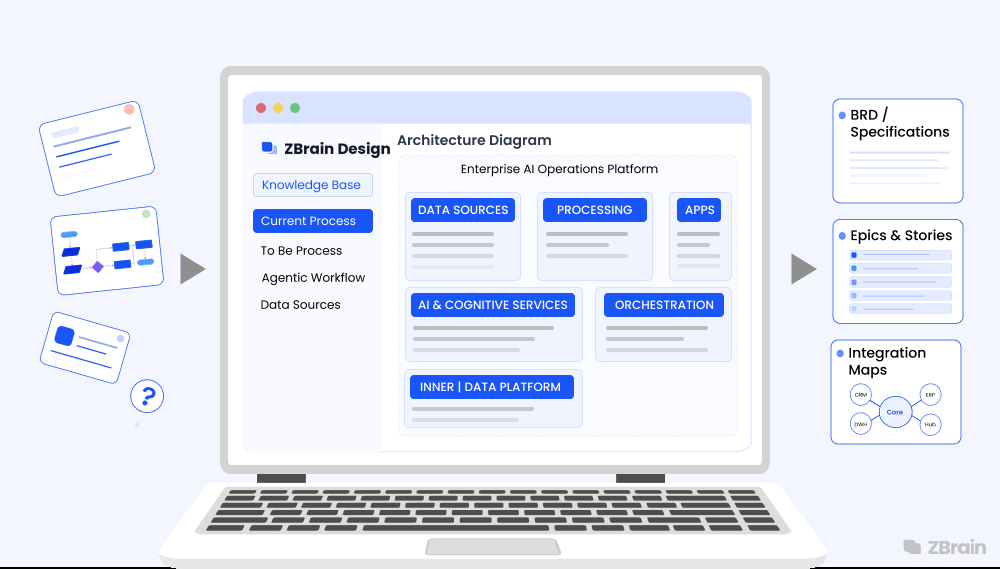
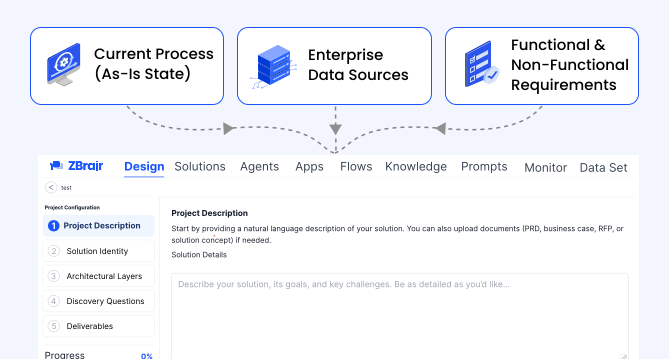
The ZBrain Design module in ZBrain’s enterprise-grade, AI-assisted platform, ZBrain Builder, helps design agentic solutions. It transforms validated solution requirements into structured, build-ready technical blueprints within a single, governed workspace — and those blueprints flow directly into Solution Builder, ZBrain’s downstream module that turns the ZBrain Design Module’s blueprints into a coordinated agent crew, validated end-to-end against synthetic or uploaded data before scaling and POC validation. The result is a continuous path from business intent to working solution, with traceability, governance, and architectural integrity preserved end-to-end.
The ZBrain Design Module provides the structural scaffolding that enables architectural work to be done with the rigor and consistency that enterprise-scale delivery demands. It consolidates requirements into a governed baseline, surfaces gaps through AI-assisted validation, captures design decisions and their rationale across iterations, and generates implementation-ready artifacts — all within a single environment where context is preserved, and traceability is maintained end-to-end. It supports architecture design across enterprise initiatives, with particular focus on agentic AI systems, workflow automation, system integrations, data platforms, modernization programs, and large-scale enterprise transformation efforts.
How the ZBrain Design Module works in practice
Every initiative inside the ZBrain Design Module follows a sequenced, AI-assisted workflow. Each stage produces validated artifacts, such as PRD, DRD, BRD, scope of work, etc., and each artifact feeds into the next stage — so the design is never disconnected from its source requirements, and the handoff to engineering or to Solution Builder is never improvised.
Project intake: The architect creates a workspace for the initiative, uploads the source documents (PRDs, BRD, supporting context), and provides a brief solution description. The platform validates and chunks the source so every downstream artifact can be grounded in the original input rather than in tacit knowledge or interpretation. An AI evaluation engine flags weak or missing inputs with specific recommendations, so gaps surface before the architecture stage rather than after the build begins.
Solution identity: The platform proposes the solution name, business domain, problem statement, success criteria, target users, core data entities, known constraints, hard requirements, and compliance posture, all extracted from the uploaded source. Each field is editable.
Architecture layer: Based on the validated identity, the platform identifies the architectural layers required for the specific agentic solution and proposes a primary set. Layers are dynamic — grounded in the uploaded documents and the solution identity, not selected from a fixed template — which means the architecture reflects what the initiative actually needs rather than a generic reference model.
Discovery questions: A contextual questionnaire engine generates technical questions specific to the initiative — hosting model, target cloud, integration patterns, model and data choices, deployment posture and governance framework — and provides a recommended answer for each, drawn from the source context. The architect accepts, overrides, or skips each question. Every answer is preserved as part of the design record.
Deliverable generation: The platform generates the full set of build-ready deliverables in a single pass: BRD, ETL pipeline, system and end-to-end architecture diagrams, agentic design, data flow diagrams, DB schema and ERDs, user journey, integration logic, epics and user stories ready for Jira, compliance and security documentation, and scope of work. Each deliverable is traceable to the source requirements and consistent with all other deliverables in the package.
In-context refinement: An embedded AI assistant lets the architect modify any deliverable through natural-language prompts inside the same workspace. “Remove the compliance reporting service from the architecture.” “Add a vendor notification node to the agentic flow.” “Change the database from MongoDB to PostgreSQL.” Modifications are executed in place, and each change is captured in the design history rather than overwritten.
Export and handoff: Deliverables can be exported as a complete zip package. The same package becomes the direct input to Solution Builder, which reads the design and assembles the agent crew to execute it.
AI assistance, in context — not in a separate window
Most architecture platforms treat AI as a side tool: open a chat, paste a question, copy the answer back. The ZBrain Design Module’s embedded AI assistant lives inside the design workspace itself. It can read every artifact in the current initiative, modify diagrams and agentic workflows directly, surface gaps across integration, data, security, and deployment dimensions, and capture the rationale behind each change. Architectural judgment stays with the architect; the assistant absorbs the mechanical work of keeping artifacts consistent as the design evolves.
The table below maps each ZBrain Design Module capability to what it implements in practice, what improves measurably, and the executive benefit it delivers.
| ZBrain Design Module capability | What it implements in practice | What improves measurably | Executive reduction benefit |
|---|---|---|---|
| Governed initiative workspace | Single system of record for source documents, solution identity, architecture, design decisions, deliverables, and version history. | Faster cross-team alignment; reduced ambiguity; lower coordination overhead. | Reduction of architecture cycle time; approval lead time. |
| Solution identity | Extracts the solution name, domain, problem statement, success criteria, constraints, and compliance posture from source documents. | Fewer late-stage clarifications. | Reduction in mid-build requirement changes; faster path to a stable scope. |
| Dynamic architecture layer modeling | Identifies the architectural layers required for the specific agentic solution from the validated identity, rather than from a fixed template. | Higher relevance of generated architecture; less manual restructuring. | Increased architect productivity per initiative; reuse rate across initiatives. |
| Contextual discovery questionnaire | Generates technical questions tied to the initiative — hosting, platform, integration, model, deployment — with recommended answers grounded in source context. | Fewer unanswered design assumptions at the start of the build. | Build-stage rework rate; first-time-right design rate. |
| End-to-end deliverable generation | Produces the full set of build-ready artifacts in a single pass: BRD, ETL pipeline, architecture diagrams, agentic design, DFDs, schemas, user journey, integration logic, epics, user stories, compliance and security docs and scope of work. | Time from design start to engineering handoff; consistency across artifacts. | Increased architecture-to-build cycle time; documentation cost per initiative. |
| Embedded AI assistant | Lets architects modify diagrams, agentic flows, schemas, and deliverables through natural-language prompts inside the same workspace, with change history preserved. | Iteration speed; consistency between artifacts after change. | Cost of architectural revisions; design responsiveness to stakeholder input. |
| Traceable handoff to Solution Builder | Deliverables flow directly into Solution Builder for agent generation, synthetic-data testing, and POC validation. | Time from approved design to validated POC; alignment between design and built solution. | Concept-to-POC cycle time; design-to-execution drift. |
The ZBrain Design Module’s deliverables are not a documentation artifact to be filed away. They are an executable handoff. The same package that engineers receive — architecture diagrams, schemas, integration logic, agentic flows, epics, and user stories — flows directly into Solution Builder, where it becomes the input for solution generation and POC validation. Solution Builder reads the design, proposes a coordinated agent crew to the workflow, generates synthetic test data or accepts uploaded sample data, and runs the agents end-to-end against that data to validate the POC before scaling. This is what makes the ZBrain Design Module’s blueprints “build-ready” in a way that diagramming tools and general-purpose architecture platforms cannot match: the design does not stop at the diagram, and the handoff does not depend on interpretation.
Streamline your operational workflows with ZBrain AI agents designed to address enterprise challenges.
Core principles of future-proof enterprise architecture
Effective large-scale architecture design requires a clear set of enterprise principles. Embedding enterprise architecture principles into the design workflow ensures technology investments stay aligned, adaptable, and resilient over time. These are not abstract ideals; they are operational guardrails that shape how architecture decisions are made, validated, and sustained.
Business-driven architecture
Every system, integration, or platform decision must trace back to a business objective. In structured architecture, this is enforced through requirement-to-execution traceability. Technology choices are justified by business impact rather than technical preference, and business alignment becomes verifiable rather than assumed.
Standardization and interoperability
Standardization keeps frameworks, protocols, and tools consistent across the organization, reducing integration friction and preventing teams from reinventing foundational capabilities with every initiative. The goal is not a rigid stack but clear guidelines: common API standards, consistent data formats, unified identity management, and shared infrastructure patterns. In structured design, interoperability is a constraint defined upfront, not an afterthought validated during testing.
Security and compliance by design
If security is not embedded from the outset, it becomes a late-stage bottleneck or a post-deployment vulnerability. Structured architecture integrates security as a primary input, including authentication models, encryption standards, access controls, data classification, and compliance checks defined at the architecture level. When governed within the design workflow, audit readiness becomes a byproduct of the architecture rather than a separate exercise.
Scalability, modularity, and future-proofing
Scalability and modularity are inseparable. Systems scale reliably only when they are decomposed into independent components with explicit interfaces that can evolve, be replaced, or scale without destabilizing the broader system. Future-proofing extends this further: API-first design, explicit extension points, and deliberate decomposition ensure that what is built today can be extended without full rewrites. In structured design, modularity is not emergent; it is a documented architectural decision, and scalability is a verifiable property of the design rather than an aspiration.
Data as a governed enterprise asset
Structured architecture treats data governance as an architectural concern, defining ownership, lineage, quality standards, and access controls within the blueprint itself. Instead of departments managing separate datasets in silos, a governed approach creates a single source of truth with explicit rules for how data flows between systems and for maintaining accuracy. Data dependencies are design elements, not assumptions left to implementation teams.
Platform strategy and technology agnosticism
A technology-agnostic architecture prevents lock-in to vendors or proprietary systems, but agnosticism does not mean avoiding platform-specific capabilities. It means making technology and deployment decisions intentionally: choosing between cloud, on-premises, or edge based on an explicit evaluation of security, compliance, latency, and performance requirements, with a documented rationale and a migration strategy for every platform dependency. Structured architecture ensures that these decisions are visible and reversible rather than implicit and permanent.
Automation and workflow efficiency
Automation delivers speed, but only when governed. Without standards, teams automate in silos, creating inconsistent workflows that compound operational risk. Structured architecture defines which processes are automated, which tools are sanctioned, and how automation integrates with the broader system, making automation decisions repeatable and auditable rather than fragmented and fragile.
User-centric design
If the systems built on an architecture are difficult to use, their value is diminished regardless of technical sophistication. Structured architecture incorporates user experience as a design consideration, ensuring that decisions on response times, data availability, and cross-platform consistency support a coherent digital experience. When UX requirements sit alongside functional and technical requirements, the result is systems that are not only well-built but well-used.
Observability and continuous monitoring
Real-time visibility into applications, infrastructure, and workflows is essential in complex environments. Observability goes beyond basic monitoring, encompassing logging, distributed tracing, and automated alerting to understand not just what failed, but why. Structured architecture embeds observability from the outset: telemetry standards, service-level objectives, and monitoring points defined as architectural requirements rather than post-deployment additions.
Governance and accountability
Governance defines who makes decisions, how technologies are selected, and how compliance is maintained, but only works when coupled with clear accountability and defined ownership of systems, data, and compliance domains. In structured architecture, governance is not a review gate at the end of the process; it is embedded in the design workflow itself, strengthening delivery rather than constraining it.
When embedded into a structured design workflow, these principles collectively transform IT investments from tactical expenditures into strategic, future-proof foundations.
Endnote
The complexity of enterprise technology will only intensify more integrations, expanding platform ecosystems, and increasingly compressed cycles of change. In this environment, architecture is not a phase to be completed and archived; it is the continuously maintained structural logic that holds complex systems together. A structured architecture design, governed, traceable, and validated before build, is what makes sustainable scale possible, enabling organizations to absorb complexity, adapt without regression, and maintain alignment between business intent and technical execution. Without it, every new initiative reintroduces the same risks: rework, technical debt, and fragmented delivery. The enterprises that lead will be those that treat architecture as an operational discipline and equip their teams accordingly. The ZBrain Design Module is built for exactly this, transforming enterprise architecture principles into an operational system where teams design with clarity, collaborate with structure, and deliver with confidence.
Still designing architecture through fragmented documents and disconnected tools? Learn how ZBrain Design Module transforms solution requirements into structured, build-ready technical blueprints, with governance, traceability, and control.
Listen to the article
Author’s Bio


CEO LeewayHertz
An early adopter of emerging technologies, Akash leads innovation in AI, driving transformative solutions that enhance business operations. With his entrepreneurial spirit, technical acumen and passion for AI, Akash continues to explore new horizons, empowering businesses with solutions that enable seamless automation, intelligent decision-making, and next-generation digital experiences.
Table of content
- Architecture without governance: Where enterprise execution breaks down
- Defining structured architecture design
- Why structured architecture is the foundation of scalability
- How the ZBrain Design operationalizes governed, structured architecture
- Core principles of future-proof enterprise architecture
Share Article


Frequently Asked Questions
What is structured architecture design, and how does it differ from traditional architecture practices?
How is intranet search different from web search?
Additionally, intranet search must understand organizational structure, internal terminology, and compliance requirements—factors that are irrelevant in public web search but critical inside enterprises.
What is architectural drift, and why is it a risk for enterprises?
How does structured architecture reduce rework and implementation cost?
Research consistently shows that avoidable rework consumes 40–50% of total project effort, and that defects discovered after design cost dramatically more to fix than those caught during requirements and architecture. Structured architecture reduces this by making assumptions explicit, validating completeness before build begins, and maintaining traceability so that change impact is assessable. Every gap closed during design is a cost multiplier avoided during implementation.
What is the ZBrain Design Module?
The ZBrain Design module in ZBrain’s enterprise-grade, AI-assisted platform ZBrain Builder helps design agentic solutions. It transforms validated solution requirements into structured, build-ready technical blueprints within a single, governed workspace, enabling solution architects and technical teams to move from approved solution concepts to executable architecture with clarity, traceability, and control.
The platform generates the full set of artifacts required for engineering execution: architecture overviews and end-to-end system design blueprints, functional specifications, business requirement documentation (BRDs), epics and user stories aligned to finalized designs, schema definitions and data models, information architecture, agentic design, data flow diagrams, and integration and interface specifications.
An embedded AI assistant supports architects throughout the design lifecycle. It clarifies requirements, identifies missing dependencies, validates completeness, surfaces architectural gaps, and lets architects modify diagrams, agentic flows, and schemas through natural-language prompts inside the same workspace. Rather than replacing architectural judgment, it augments it — accelerating structured design while reinforcing governance and traceability.
The ZBrain Design Module is the upstream module of the ZBrain ecosystem. Its deliverables flow directly into Solution Builder, where they become the input for agent generation and POC validation — closing the loop from business intent to working agentic solution. It supports architecture design across enterprise initiatives, with particular focus on agentic AI systems, workflow automation, system integrations, data platforms, modernization programs, and large-scale enterprise transformation efforts.
How does the ZBrain Design Module operationalize structured architecture?
The ZBrain Design Module embeds structured architecture into the execution workflow itself, rather than leaving it as a separate documentation exercise. It does this through a sequenced, AI-assisted workflow where every stage produces validated artifacts that feed the next.
It begins with project intake, where the architect creates a governed workspace for the initiative and uploads the source documents — PRDs, BRDs, supporting context — which the platform validates and chunks so every downstream artifact stays grounded in the source. From there, the platform proposes the solution identity — name, business domain, problem statement, success criteria, target users, core data entities, constraints, and compliance posture — extracted from the uploaded source.
Based on the validated identity, the ZBrain Design Module identifies the architecture layers required for the specific agentic solution, dynamically derived from the source rather than a fixed template. It then runs a contextual discovery questionnaire that surfaces the technical questions specific to the initiative — hosting, integration patterns, model and data choices, deployment posture — and provides recommended answers grounded in the source context. Each answer becomes part of the design record.
The platform then generates the full set of build-ready deliverables in a single pass: BRD, architecture diagrams, agentic design, data flow diagrams, DB schemas, integration logic, user journey, epics and user stories ready for Jira and compliance documentation. Each artifact is traceable back to the source requirements and consistent with every other artifact in the package. An embedded AI assistant supports in-context refinement, letting the architect modify any deliverable through natural-language prompts inside the same workspace, with each change captured in the design history.
The workflow closes with export and handoff: deliverables can be exported individually or as a complete zip package, and the same package flows directly into Solution Builder, where it becomes the input for agent generation and POC validation. The result is a continuous, governed pipeline where architecture is designed, validated, refined, and handed off — all within one environment, with traceability preserved end-to-end.
How does the ZBrain Design Module relate to Solution Builder?
The ZBrain Design Module and Solution Builder are two stages of the same ZBrain workflow. The ZBrain Design Module is the upstream module: it transforms validated requirements into a structured, build-ready architecture, complete with diagrams, schemas, agentic flows, integration logic, and engineering-ready epics and user stories. Solution Builder is the downstream module: it reads those deliverables, proposes a coordinated agent crew sized to the solution, generates synthetic test data (or accepts uploaded samples), and runs the agents end-to-end so a POC can be validated before scaling.
Together, they form a continuous path from business intent to a working, testable agentic solution.
What types of enterprise initiatives does the ZBrain Design Module support?
ZBrain Design Module supports architecture design across a wide range of enterprise initiatives, including AI and advanced analytics systems, workflow automation programs, enterprise application enhancements, cross-system integrations, data platform modernization, and cloud and infrastructure transformation. It is designed for any initiative where translating solution requirements into a structured, build-ready technical architecture is critical to delivery success.
Who is the ZBrain Design Module designed for?
The ZBrain Design Module serves three primary audiences. Solution architects and technical leads use it to move from validated concepts to executable architecture with structure, traceability, and AI-assisted completeness checks. Engineering and delivery leaders benefit from receiving implementation-ready blueprints and artifacts that reduce ambiguity and downstream rework. CTOs and enterprise architecture leads use it to establish a governed, repeatable design discipline that shortens architecture cycles, reduces technical debt, and creates measurable operational visibility across initiatives.
How is the ZBrain Design Module different from diagramming tools or general-purpose architecture platforms?
Diagramming tools produce static visual representations of architecture; they do not govern the design process, validate completeness, or maintain traceability. General-purpose architecture platforms often focus on repository management or portfolio-level modeling rather than initiative-level design execution. The ZBrain Design Module is purpose-built for the design workflow itself: it consolidates requirements, generates and refines architecture blueprints through structured collaboration, validates design completeness using AI-assisted checks, and produces execution-ready artifacts, all within a single governed workspace where context, decisions, and traceability are preserved end-to-end.
More fundamentally, neither diagramming tools nor general-purpose architecture platforms were built for agentic systems — they have no native concept of agent orchestration, agent crew design, tool governance, model selection, or human-in-the-loop checkpoints as priority architectural elements; the ZBrain Design Module was built around exactly these concerns. It is the difference between a tool that documents architecture and a platform that operationalizes it for the systems enterprises are actually building today.
How can my organization get started with the ZBrain Design Module?
Getting started with the ZBrain Design Module typically begins by identifying an upcoming enterprise initiative, such as a system integration, modernization program, workflow automation, or transformation effort, where architecture design is critical to delivery. ZBrain teams work with your solution architects and technical leads to onboard the initiative into a governed workspace, consolidate existing requirements and technical context, and demonstrate how the platform supports the full design-to-artifact workflow. Organizations can request a walkthrough at Book a Demo – ZBrain to see how the ZBrain Design Module can help their existing architecture and delivery processes.
Insights
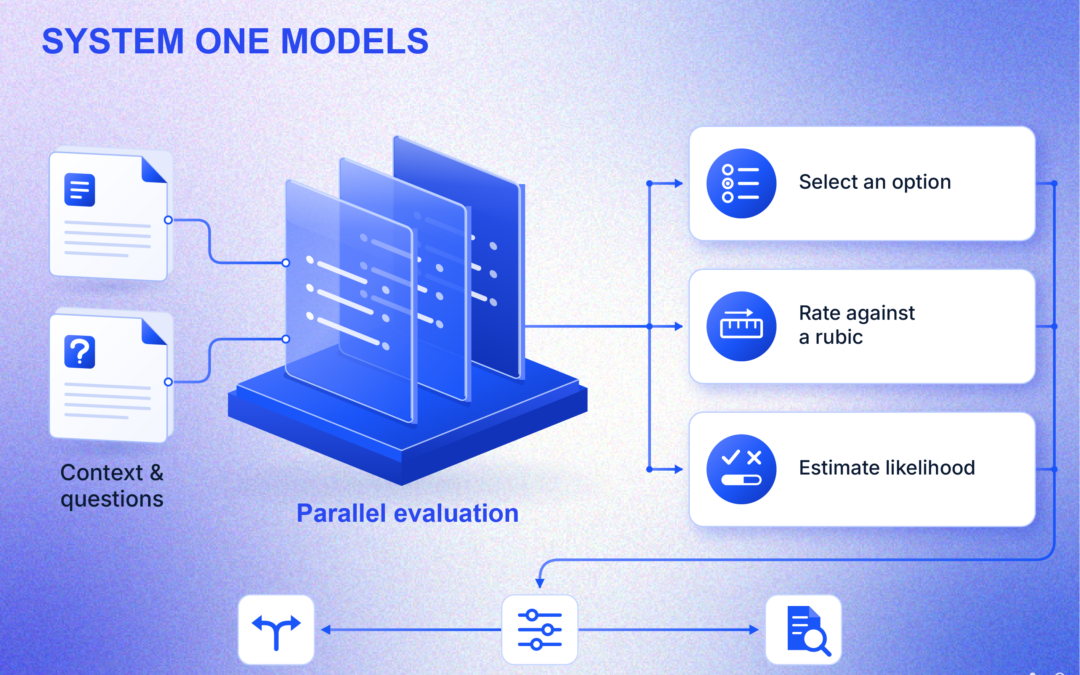
System One Models: A Technical and Enterprise Architecture Deep Dive
A System One model is a proposed class of AI model optimized for fast, bounded judgments that software can consume directly.
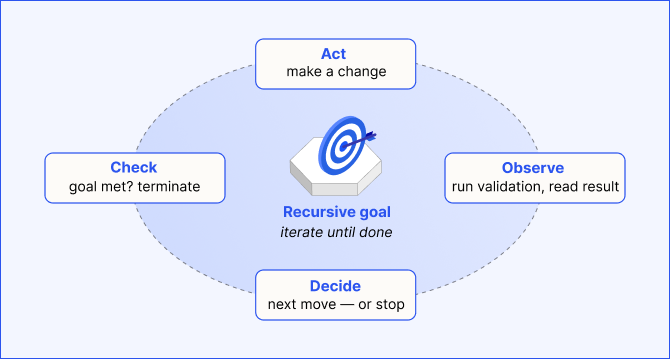
Loop engineering for AI agents: Building reliable autonomous systems
Loop engineering is the practice of designing, operating, and improving the feedback systems that let an AI agent plan, act, observe the results, and revise its approach until a goal is reached without a human driving every turn.
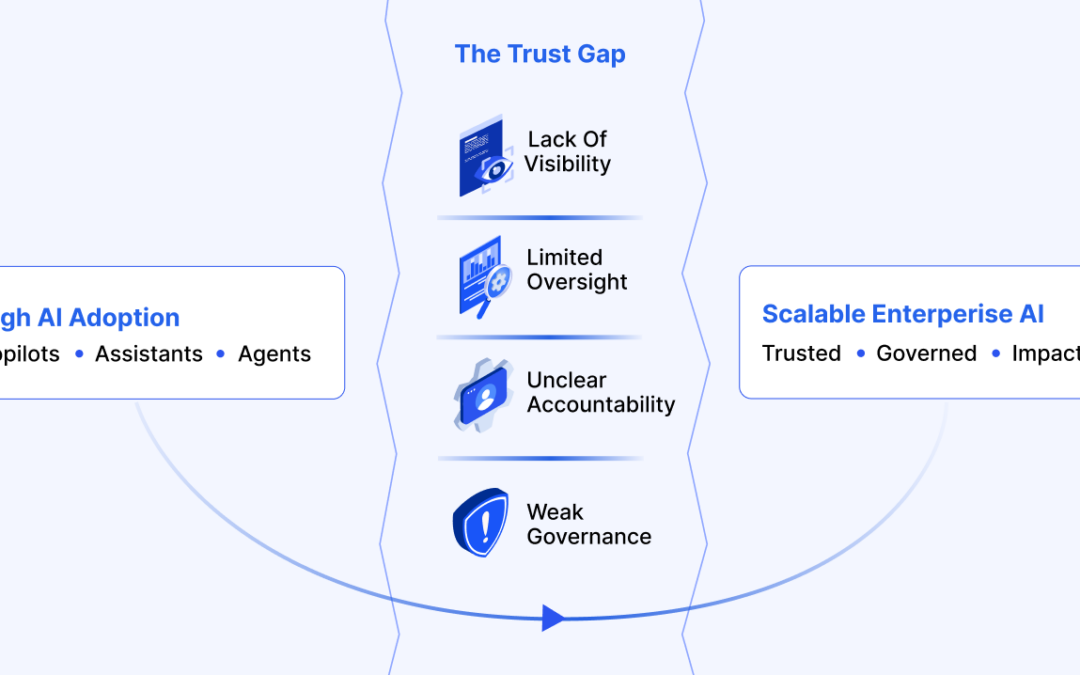
The AI trust gap: Why governance architecture determines enterprise value
The trust gap surrounding enterprise AI is fundamentally an architectural challenge, and its solution is increasingly well understood.
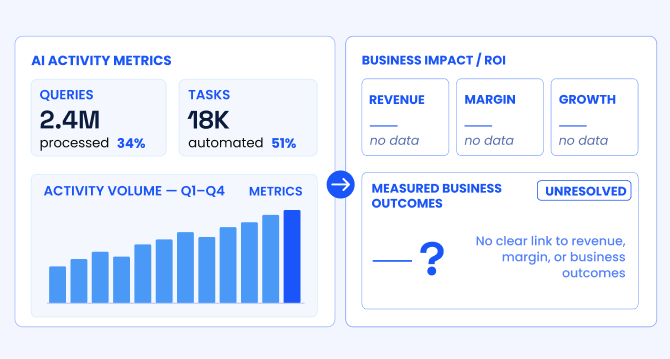
The AI ROI illusion: Why enterprises struggle to measure AI impact
Organizations with stronger measurement discipline are better positioned to link AI deployments to measurable business outcomes, prioritize high-impact use cases across the enterprise, allocate capital more effectively, and continuously refine models using real-world performance feedback.
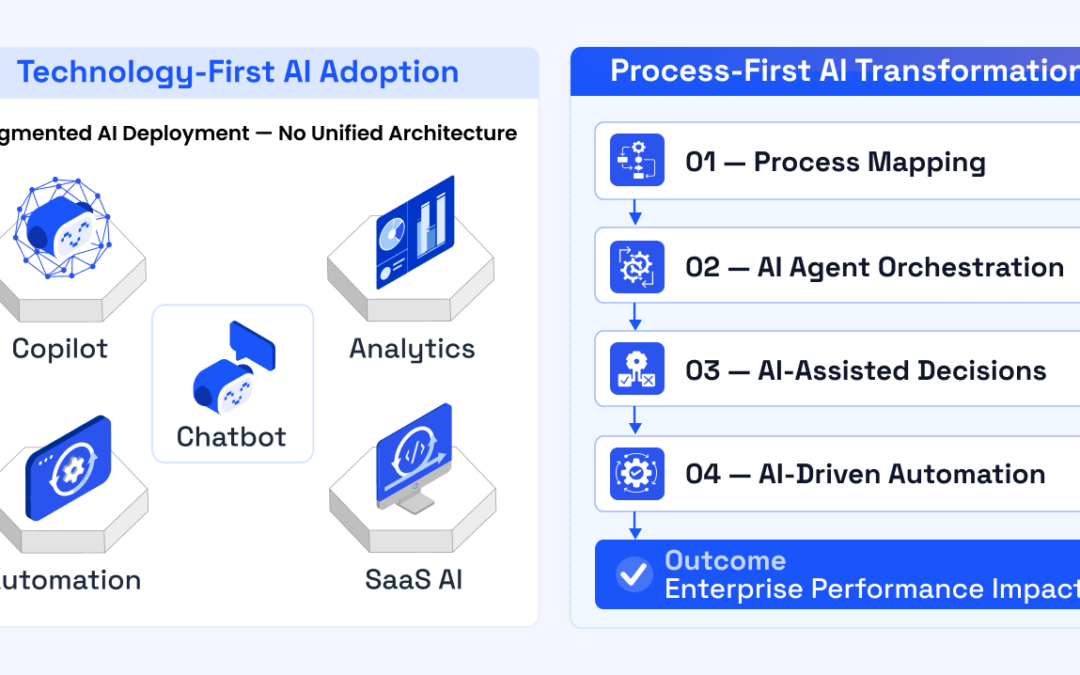
The agentic enterprise: Why AI success requires an operating model redesign
Organizations that redesign their operating models around agentic AI are beginning to outperform those that apply AI only incrementally.
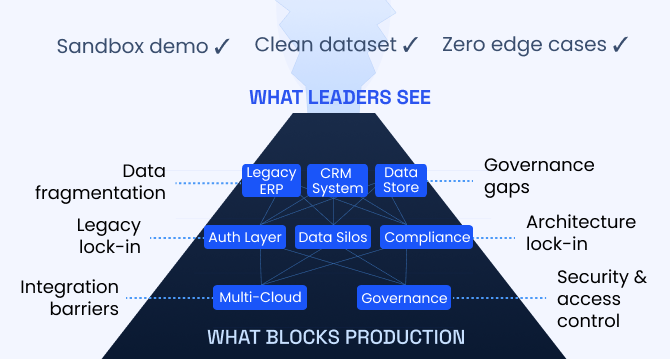
Enterprise AI pilot-to-production gap: Root causes & how to address them
The underlying cause is structural. In many enterprises, AI pilots are developed on infrastructure that was not designed to support production deployment.
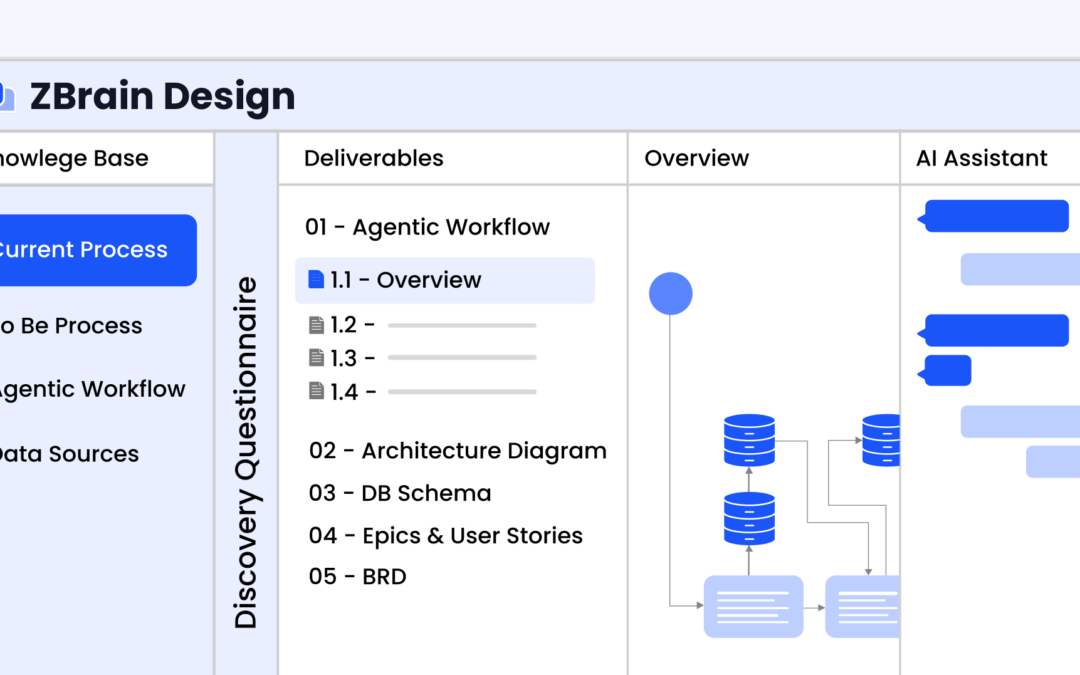
Solution architecture best practices: A guide for enterprise teams
The architecture design process culminates in a set of documented artifacts that communicate the solution to development, operations, and business teams.
Common solution architecture design challenges and solutions
Solution architecture must evolve from fragmented documentation practices to a structured, collaborative, and continuously validated design capability.
Intranet search engine guide: How it works, use cases, challenges, strategies and future trends
Effective intranet search is a cornerstone of the modern digital workplace, enabling employees to find trusted information quickly and work with greater confidence.