Manufacturing
 Logistics
 Real Estate
 Retail
 Finance
 Healthcare
 Hospitality
 Automotive
Adaptive RAG in ZBrain: Architecting intelligent, context-aware retrieval for agentic AI
Listen to the article
Large Language Models (LLMs) such as GPT-5 exhibit advanced reasoning and generative capabilities but remain constrained by the static nature of pre-training. Their knowledge is limited by a training cutoff, lacks real-time awareness, and often excludes proprietary or highly specialized domain data. While fine-tuning can address some domain gaps, it is costly, slow, and impractical in environments where knowledge evolves continuously. Retrieval-Augmented Generation (RAG) emerged to mitigate these limitations by retrieving relevant external information at query time and injecting it into the model’s context, enabling grounded, up-to-date, and domain-specific responses without retraining. By anchoring outputs in external evidence, RAG reduces hallucinations and improves factual alignment.
However, traditional RAG follows a rigid retrieve-then-generate paradigm, executing retrieval for every query regardless of complexity or necessity. Even simple factual questions trigger database searches, increasing latency and infrastructure costs while risking irrelevant or noisy context injection. More critically, static RAG treats retrieval as a fixed pipeline stage rather than a reasoning decision. In practice, some queries can be answered from parametric knowledge alone, while others require decomposition, iterative refinement, multi-hop reasoning, or integration with structured tools and heterogeneous data sources. This variability becomes especially pronounced in enterprise environments, where queries differ in ambiguity, compliance sensitivity, and temporal dependence.
These challenges have driven the evolution toward Adaptive Retrieval-Augmented Generation (ARAG) and, more broadly, agentic AI systems. Adaptive RAG introduces policy-driven decision-making, determining whether retrieval is necessary, which sources to use, how much context to inject, and whether iteration is required. In agentic architectures, retrieval becomes one tool within a reasoning–action loop, enabling planning, tool selection, evidence evaluation, and iterative refinement. Time-awareness further strengthens this shift, as systems must recognize temporal intent and route queries to live data sources when freshness is critical. This article examines that progression—from static RAG to adaptive and agentic systems—detailing the mechanisms that enable retrieval routing, iteration, and time-aware governance, and illustrating how these principles are operationalized in enterprise-grade platforms such as ZBrain Builder.
- Retrieval-augmented generation (RAG): An overview
- Challenges with traditional RAG
- The rise of agentic AI: From pipelines to autonomous systems
- What is adaptive retrieval-augmented generation (ARAG)?
- Benefits of adaptive RAG
- Techniques for RAG adaptivity
- Incorporating time awareness (TA) in retrieval
- What is time-aware adaptive retrieval (TA-ARE)?
- Time-Aware Adaptive Retrieval in agentic systems
- Implementing adaptive RAG in practice
- ZBrain’s approach and perspective
Retrieval-Augmented Generation (RAG): An overview
RAG is a framework that integrates LLMs with external knowledge sources to produce more informed answers. Instead of relying solely on the LLM’s fixed parametric memory, a RAG system actively retrieves relevant documents or data based on the user’s query and feeds that information into the generation process. The typical RAG workflow has two main stages:
-
Retrieval: The system takes the user’s query and searches across one or more knowledge bases for supporting information. This could involve a vector similarity search in an internal document index, a keyword search on the web, a database lookup, or other domain-specific queries. The result is a set of relevant texts (passages, articles, records, etc.), often called context documents.
-
Generation: The retrieved context is appended to the original question (usually in a prompt template), and the combined text is passed to the LLM. The LLM then generates an answer that draws upon the provided context as needed. Essentially, the model is prompted with, “Here is some reference information; now use it to answer the question.”
By augmenting the prompt with external information, RAG enables the model to produce answers that are both up-to-date and grounded in facts. This approach addresses several challenges: it fills knowledge gaps on topics the model has never encountered during training, it provides authoritative sources that reduce open-ended guessing, and it can significantly reduce hallucinations by tethering the generation to real reference text. For example, a question about a niche scientific discovery in 2025 can be answered by retrieving the relevant research article and letting the LLM summarize or explain it, which would be impossible for a standalone model trained only on data up to 2021.
However, traditional RAG, as originally conceived, is not selective about retrieval. Classic RAG pipelines perform the retrieval step for every single query, regardless of whether the query actually needs external input. The design assumption was that more information is always better – if the model already knows the answer, extra context won’t hurt, and if it doesn’t, the context will help. In practice, this assumption doesn’t always hold, leading to the efficiency and quality issues discussed next.
Streamline your operational workflows with ZBrain AI agents designed to address enterprise challenges.
Challenges with traditional RAG
Although RAG enhances LLM performance in many scenarios, the naïve use of retrieval for every query (sometimes referred to as “blind retrieval”) has notable drawbacks. Key challenges include:
Blind retrieval for all queries
Standard RAG indiscriminately fetches documents for every question, treating a simple factoid and a complex analytical query the same way. This can lead to unnecessary steps for easy queries. Research has noted that many questions can be answered using just the LLM’s internal knowledge, yet traditional RAG still fetches external documents unnecessarily, wasting time and computing resources. Always retrieving also risks pulling in irrelevant data that doesn’t actually answer the question. Since the pipeline isn’t aware of whether the LLM could handle it alone, it may add noise to an otherwise straightforward query. In short, indiscriminate retrieval can be inefficient and sometimes counterproductive.
Outdated knowledge and knowledge gaps
LLMs have incomplete knowledge of recent events or highly specific “long-tail” facts. That’s precisely why RAG exists – but even so, a naive RAG system might fail if the retrieval component isn’t intelligent. If the user asks about something after the LLM’s training cutoff (e.g., a news event from last month), a traditional LLM would be clueless. Similarly, if the query is about an obscure detail (say, a minor character in a niche novel), the answer might not be in the model’s memory. Traditional RAG will attempt to retrieve information for such queries, but it might not know how or where to look effectively, especially for very new or specialized topics.
Sometimes the relevant info isn’t in the indexed knowledge base at all. In those cases, a static RAG approach still might not yield correct answers if the retrieval step isn’t smartly used – for example, if it searches the wrong knowledge source or uses poor search terms (this is a limitation by design). Furthermore, LLMs lack “new world” knowledge by default and struggle with long-tail knowledge that wasn’t prominent in their training data. Without a clever retrieval strategy, RAG won’t fully overcome those gaps.
Inference cost and latency
Performing retrieval and processing retrieved documents incurs overhead. Each query in a RAG system might involve multiple database lookups or API calls, followed by feeding a larger prompt (the question + retrieved text) into the LLM for inference. This added work increases latency – the user waits longer for answers – and compute cost (especially if calling external APIs or using a more expensive model to handle longer prompts). In enterprise settings, this can translate to higher operational costs and slower response times for end-users. Many simple queries don’t justify that overhead. In a customer service bot, for instance, a question like “What is your return policy?” might trigger a retrieval from a policy document every single time, even though the answer is always the same and could be handled directly from a cached answer or the model’s knowledge. Over thousands of queries, that inefficiency adds up.
In summary, while RAG is powerful, a non-adaptive implementation that treats all queries uniformly can lead to wasted effort, higher costs, and, in some cases, even worse answers (if irrelevant context distracts the LLM). These challenges set the stage for Adaptive RAG, which seeks to make the retrieval process smarter and more situation-aware.
The rise of agentic AI: From pipelines to autonomous systems
The evolution from static AI pipelines to agentic systems marks one of the most significant architectural shifts in modern artificial intelligence. Early LLM applications were largely prompt-driven: a user submitted a query, the model generated a response, and the interaction ended. Even when augmented with retrieval, the system remained fundamentally linear—retrieve, append context, generate.
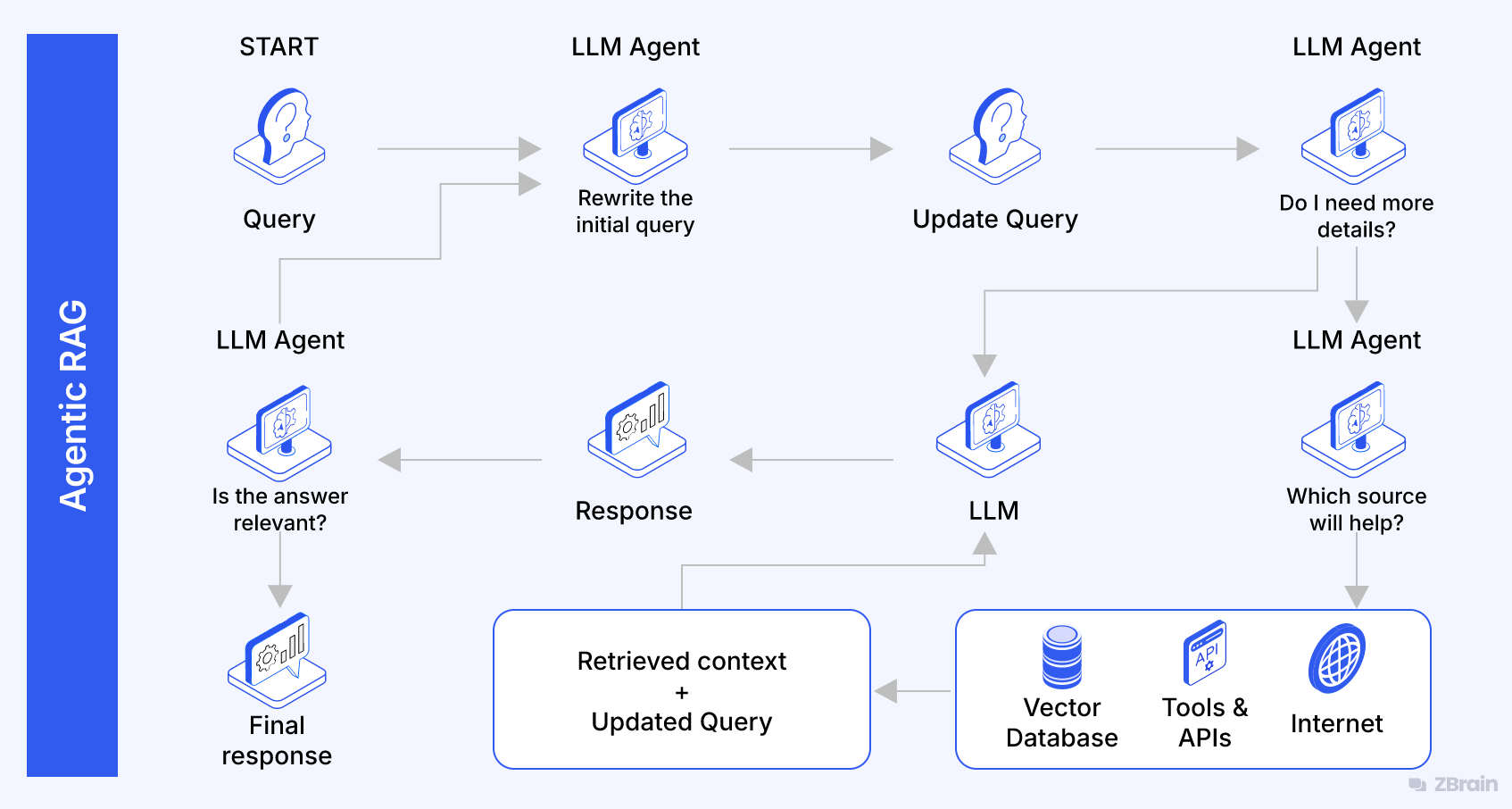
Agentic AI represents a different paradigm. Instead of executing a fixed sequence of steps, the system dynamically reasons about the problem, selects actions, evaluates intermediate outcomes, and iterates until it reaches a satisfactory solution. This shift transforms AI from a passive responder into an active problem-solving system.
What makes an AI system “Agentic”?
An AI system is considered agentic when it demonstrates goal-directed autonomy within defined constraints. Rather than producing a single response from a static prompt, an agentic system:
- Maintains an explicit objective.
- Plans intermediate steps to achieve that objective.
- Selects and invokes tools or data sources as needed.
- Evaluates outcomes and adapts its strategy.
- Operates within governance, safety, and resource boundaries.
Agentic behavior introduces structured decision-making into LLM-based systems. The model is no longer limited to generating text—it participates in orchestrating actions. These actions may include retrieving documents, querying databases, invoking APIs, executing code, or requesting clarification from the user.
Importantly, agentic systems are not fully autonomous in an unconstrained sense. In enterprise contexts, they function within policy frameworks that regulate permissions, cost budgets, security controls, and compliance requirements. Autonomy exists within guardrails.
In short, agentic AI adds three core capabilities beyond traditional LLM workflows:
- Planning – determining how to approach a task.
- Action selection – deciding which tools or information sources to use.
- Self-evaluation – assessing whether intermediate steps are sufficient or require revision.
These capabilities fundamentally change how retrieval should be designed and integrated.
Reasoning–acting loops and tool use
Traditional LLM applications follow a single-pass execution model: input → generate output. Agentic systems operate in iterative reasoning–acting loops:
- Interpret the task.
- Reason about the next best action.
- Execute that action (e.g., call a tool).
- Observe the result.
- Decide whether to continue, refine, or conclude.
This loop continues until the system meets a termination condition—such as sufficient evidence, a confidence threshold, a cost limit, or a user-defined objective completion.
Tool use is central to this architecture. In agentic systems, tools are structured capabilities that extend the model’s abilities beyond simple tasks, such as text generation. Examples include:
- Vector and hybrid search systems
- Structured databases (SQL/NoSQL)
- Knowledge graphs
- Web search APIs
- Code execution environments
- Internal enterprise systems
The model does not simply “know” everything—it knows how to access what it needs.
This distinction is critical. An agentic AI system separates reasoning from capability. The LLM performs cognitive tasks (planning, interpretation, evaluation), while tools execute operational tasks (searching, calculating, retrieving, updating). The orchestration layer coordinates these interactions.
Such loops make AI systems significantly more powerful, but they also introduce new complexities: multi-step failure modes, tool misuse, infinite loops, increased latency, security vulnerabilities and cost amplification. Therefore, structured orchestration frameworks and explicit state management become essential.
Why retrieval becomes a tool (Not a step)
In static RAG architectures, retrieval is a mandatory stage in the pipeline. Every query triggers a search before generation. This rigid design assumes retrieval is always beneficial.
Agentic systems challenge that assumption.
In an agentic architecture, retrieval is no longer a compulsory preprocessing step—it becomes a conditional action. The agentic system first evaluates whether retrieval is necessary. If the model’s internal knowledge is sufficient, it proceeds directly to generation. If the task requires external evidence, freshness validation, or domain-specific grounding, it invokes retrieval deliberately.
This seemingly subtle change has profound implications:
1. Selective invocation
Retrieval is used only when warranted and justified, reducing unnecessary cost and latency.
2. Dynamic source selection
Instead of querying a single vector index, the agent may select from multiple knowledge sources—such as policy documents, compliance databases, CRM systems, and real-time feeds—based on the task intent.
3. Iterative refinement
If the retrieved evidence is insufficient, the agent can:
- Rewrite the query,
- Decompose the problem into sub-questions,
- Switch retrieval modes (e.g., vector → structured query → graph),
- Or escalate to a human review path.
4. Multi-tool coordination
Retrieval may be one of several tools used within a larger workflow. For example:
- Retrieve policy text.
- Extract structured data.
- Perform calculations.
- Generate a summary with citations.
Retrieval becomes part of a broader decision ecosystem rather than an isolated operation.
5. Governance and control
When retrieval becomes an explicit, callable tool within an agentic system, it can be governed, monitored, and policy-constrained like any other enterprise capability, instead of operating as a rigid, opaque pipeline step.
Treating retrieval as a tool enables explicit controls:
- Access permissions per data source
- Audit logging of queries
- Cost budgeting
- Source trust scoring
- Freshness constraints
This transformation is central to adaptive RAG. Adaptivity emerges when retrieval decisions are governed by a policy layer that considers task complexity, temporal relevance, cost constraints, and confidence thresholds.
In essence, agentic AI reframes RAG from a static architectural pattern into a dynamic capability embedded within a reasoning-driven system. Retrieval is no longer assumed—it is chosen. Context is no longer injected blindly—it is curated strategically. And the model is no longer a passive text generator—it is an orchestrator of information and action.
This shift lays the foundation for Adaptive Retrieval-Augmented Generation as a core component of modern agentic AI systems.
What is Adaptive Retrieval-Augmented Generation (ARAG)?
Adaptive Retrieval-Augmented Generation (ARAG) is an evolution of traditional RAG that introduces dynamic decision-making into the retrieval process. Rather than executing retrieval as a fixed preprocessing step for every query, ARAG evaluates whether retrieval is necessary, determines how it should be performed, and adjusts its strategy based on context, complexity, and constraints.
In conventional RAG systems, retrieval is deterministic: every query triggers a search, results are appended to the prompt, and the model generates a response. ARAG breaks this rigidity. It treats retrieval as a conditional and controllable capability—one that can be invoked, refined, skipped, or iterated upon depending on the task.
At its core, ARAG addresses three structural inefficiencies of static RAG:
- Over-retrieval for simple queries – Static RAG retrieves external documents even when the model can reliably answer from parametric knowledge.
Example: A query such as “What is the capital of France?” unnecessarily triggers vector searches and database lookups, adding latency and cost without improving answer quality. - Under-retrieval for complex, multi-hop, or ambiguous queries – Static pipelines often perform only a single retrieval pass, even when deeper or iterative evidence gathering is required.Example: A question like “How did the latest EU AI Act amendments impact compliance requirements for U.S.-based SaaS providers?” may require breaking the query into sub-questions, retrieving regulatory updates, cross-referencing jurisdictional clauses, and possibly consulting multiple sources—something a single retrieval step cannot adequately handle.
- Unstructured retrieval that injects noisy or irrelevant context – Static RAG retrieves documents based solely on similarity scores without evaluating relevance, trustworthiness, or freshness. Example: In an enterprise knowledge base, a query about the “current remote work policy” may retrieve outdated HR documents or draft versions, leading to confusion if freshness constraints and source validation are not enforced.
By introducing selective retrieval, dynamic routing, evidence evaluation, and iterative refinement, ARAG improves both efficiency and reliability. However, when implemented within modern orchestration frameworks, ARAG becomes more than an optimization—it becomes a strategic policy embedded in an agentic system.
Adaptive RAG as a policy, not a rigid pipeline
The most important conceptual shift in ARAG is moving from a pipeline mindset to a policy mindset.
A pipeline executes predefined steps in a fixed order. A policy makes decisions based on conditions.
In static RAG, the workflow looks like:
Query → Retrieve → Generate
In Adaptive RAG, the workflow becomes conditional:
Query → Evaluate → (Retrieve?) → Assess evidence → Iterate or Generate
This evaluation layer introduces intelligence before and during retrieval. The system may decide to:
- Skip retrieval if internal knowledge is sufficient.
- Choose among multiple data sources (vector search, hybrid search, structured databases, knowledge graphs, real-time APIs).
- Adjust retrieval depth (top-k, semantic threshold, filtering).
- Decompose complex questions into sub-queries.
- Iterate retrieval if initial evidence is weak or incomplete.
- Terminate early if sufficient confidence is reached.
This distinction is critical in enterprise settings, where cost, latency, security, data access permissions, and auditability must be actively managed. A policy-driven approach enables:
- Budget-aware retrieval decisions
- Source trust weighting
- Freshness enforcement
- Governance and compliance controls
Adaptive RAG, therefore, is best understood not as an improved search mechanism but as a retrieval decision framework integrated into intelligent orchestration.
Key differences: RAG vs Adaptive RAG
The progression from RAG to Adaptive RAG to Agentic RAG reflects increasing levels of intelligence, autonomy, and orchestration.
| Dimension | Traditional RAG | Adaptive RAG (ARAG) |
| Architecture model | Linear pipeline | Conditional workflow |
| Retrieval trigger | Always executed | Executed conditionally |
| Decision layer | None | Query-level evaluation |
| Complex query handling | Single-pass retrieval | Query rewriting and iterative retrieval |
| Tool ecosystem | Primarily vector search | Multiple retrievers (vector, hybrid, structured) |
| Evidence evaluation | Minimal or absent | Relevance and quality checks |
| Temporal awareness | Limited | Freshness-aware retrieval policies |
| State management | Stateless per query | Limited contextual state |
| Cost and latency control | Fixed overhead per query | Reduced via selective retrieval |
| Governance and security | Basic filtering | Source-level control |
| System role of retrieval | Mandatory step | Adaptive capability |
Adaptive Retrieval-Augmented Generation represents a structural shift from rigid information injection to strategic knowledge orchestration. When integrated into agentic AI systems, ARAG becomes a policy-driven capability that determines not only how knowledge is retrieved but also whether, when, and to what extent it should influence the model’s reasoning process.
This transformation positions ARAG as a foundational component of next-generation enterprise AI architectures.
Benefits of Adaptive RAG
By matching the effort to the problem complexity, adaptive RAG offers several advantages:
-
Efficiency: Easy queries get handled immediately by the LLM alone, avoiding the time and expense of needless retrieval. This can significantly speed up responses for trivial questions and reduce API calls or database load. Overall, the compute and token usage is better aligned with the query’s needs, saving resources in aggregate.
-
Focused retrieval for challenging queries: For difficult or knowledge-intensive questions, the system proceeds with retrieval to ensure a complete and accurate response – in fact, it can perform additional retrieval steps if needed. Adaptive RAG ensures that complex queries still invoke the full power of RAG (and even multi-step search) so that accuracy is maintained or improved relative to a static single-step approach. Essentially, it avoids under-searching on the hard cases while avoiding over-searching on the easy cases.
-
Reduced noise: By not retrieving when it’s unnecessary, the system minimizes the injection of irrelevant context. The LLM’s prompt remains concise and focused for queries it can handle, which can lead to clearer, more direct answers. This also reduces token consumption, as you’re not cluttering the prompt with unnecessary documents.
-
Balanced accuracy and cost: Studies have found that an adaptive approach can achieve accuracy on par with always-retrieve systems, but with far fewer retrieval calls. For instance, one hybrid prompting method was shown to answer questions as well as a static RAG baseline while triggering retrieval only a fraction of the time. This translates to a better cost-performance trade-off: you pay for retrieval and longer prompts only when they’re likely to pay dividends in answer quality.
-
Dynamic scaling: Adaptive RAG enhances system scalability across diverse query types. It can handle a mix of queries (simple factual ones, complex analytical ones, time-sensitive ones) without a one-size-fits-all latency. Users asking easy questions get snappy answers, while those with complicated requests implicitly allow the system to take a bit longer and do extra work to ensure a correct answer. This dynamic adjustment creates a more responsive and satisfying overall user experience.
In summary, Adaptive RAG tailors its strategy to query difficulty, skipping retrieval for trivial factoids, performing a single lookup for moderately complex queries, and executing multi-step retrieval for multipart or challenging questions. Being selective prevents unnecessary work: easy queries don’t waste time searching databases, while difficult ones get the full pipeline. Overall, this adaptive approach enhances efficiency without compromising the quality of the answers.
Techniques for RAG adaptivity
Adaptive RAG systems must intelligently decide whether a query warrants external retrieval. Three common techniques enable this decision-making:
Threshold-based calibration
A simple method involves generating an initial response without retrieval and evaluating model confidence—via token probabilities or prompt-based self-assessment. If confidence falls below a predefined threshold, the system triggers retrieval. Alternatively, thresholds can be set based on question complexity (e.g., keyword count, syntactic patterns). While this is easy to implement, calibrating the threshold across domains and models is challenging; overly strict settings can miss needed retrieval, while loose ones reduce efficiency.
Gatekeeper classifier models
Instead of static thresholds, trained classifiers—often lightweight models or small LLMs—predict retrieval needs. These models categorize queries (e.g., “simple,” “moderate,” “complex”) and guide whether to skip, perform single-step, or multi-hop retrieval. Classifiers leverage features such as query length, named entities, or temporal indicators. This method offers greater nuance than thresholds but requires ongoing training and tuning as data patterns evolve.
LLM-based prompting
Another emerging approach is to prompt the LLM itself to assess if it needs external information. Prompts like: “Today is [DATE]. Should you retrieve information to answer this question: [QUERY]?” elicit “Yes” or “No” responses. If “Yes,” the system retrieves and re-prompts; if “No,” it proceeds with generation. Variants include asking the LLM to explain its reasoning or flag uncertainty, which helps reduce overconfidence. These zero- or few-shot methods require no training but heavily depend on the quality of the prompt and model consistency.
Each technique has strengths and trade-offs. Many advanced systems combine them—e.g., using prompt-based gating with fallback thresholds—to maximize precision. All aim to reduce unnecessary retrieval while preserving answer quality.
Next, we examine how adaptive systems manage time-sensitive queries using temporal awareness.
Incorporating Time Awareness (TA) in retrieval
In adaptive RAG, it’s not just how hard a question is that matters, but also what kind of information it needs. Temporal factors play a crucial role. A system might determine that a query is easy in a general sense, but if it asks for current information, even a trivial question could necessitate retrieval (because the model’s training knowledge is outdated).
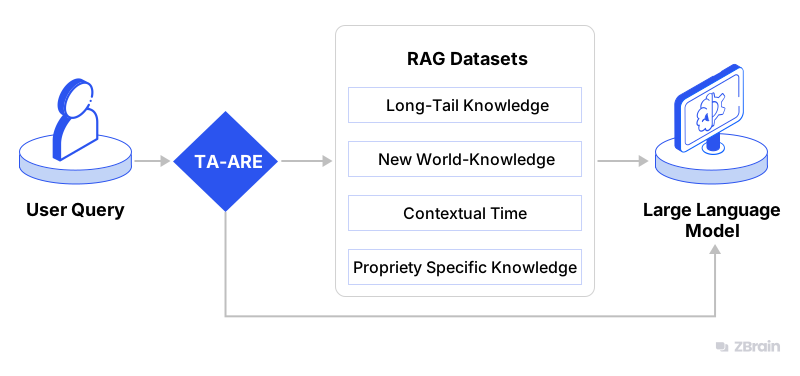
Let’s explore the importance of time awareness:
Why time matters
Time-sensitive knowledge is any information that can change with time – news events, weather, new research findings, product releases, etc. LLMs are typically trained on data up to a certain cutoff date (e.g., GPT-4’s knowledge as of early 2023). Anything after that, the model wouldn’t have seen. So when a user’s query deals with “the latest” on something or explicitly mentions a date or time frame beyond the model’s knowledge cutoff, the LLM’s otherwise strong abilities won’t help – it simply doesn’t have that information. For example, if today is 2025-11-04 and someone asks, “What happened at the UN climate summit in October 2025?” – a standard pretrained LLM without external augmentation will not know, because that event occurred after its training.
From an enterprise perspective, time matters for internal data as well. Imagine an AI assistant for a company’s knowledge base: if it’s answering questions about policies or data that get updated regularly (say, quarterly financial figures, or an HR policy updated last week), a time-aware approach is needed to ensure the assistant fetches the most recent version of the information, rather than relying on an old cached answer.
In short, time creates knowledge gaps: as time passes, an LLM’s once-correct knowledge can turn incomplete or incorrect. A robust RAG system needs to recognize queries that require timely information and adjust its retrieval strategy accordingly. One key advantage of RAG is precisely that it enables access to the latest information for generating reliable outputs – but to leverage that, the system must know when to tap into fresh data.
Identifying time-sensitive queries
How can a system detect that a query is time-sensitive? There are a few heuristic cues and strategies:
-
Explicit date or time references: Queries that contain dates (e.g., “in 2025, …”, “last year”, “this month”) or words like “today”, “current”, “latest”, “recent”, “new” are strong indicators that the user expects up-to-date info. For example, “What is today’s weather in Paris?” clearly cannot be answered from a static knowledge base from last year. A query like “latest news on X” or “recent developments in AI” similarly implies that the user wants the most up-to-date or very recent events. An adaptive system can employ simple keyword checks: if the query contains specific terms, mark it as requiring a real-time lookup. In the research literature, these are sometimes referred to as temporal query indicators.
-
Known evolving topics: Some topics are inherently time-linked, even if not explicitly stated. For instance, queries about COVID-19 policies, sports scores, tech product releases, etc., are likely asking for current data. If the system has domain awareness, it might flag queries in certain categories as time-sensitive. For example, a question like “What is the price of Bitcoin?” doesn’t mention a date, but the price changes daily – a savvy system would treat that as time-dependent by default.
-
Outdated answers in memory: Another approach is to let the LLM attempt an answer from memory and see if it produces a clue that it might be outdated. If the model answers in the past tense (“As of 2021, …”) or expresses uncertainty about recency (“I don’t have the latest data, but…”), the orchestration could catch that and decide to retrieve a fresh answer. This is a bit more advanced and not foolproof, but it’s a way for the system to notice that its internal knowledge might be out-of-date.
In practice, combining these cues is most effective. By detecting phrases that hint at time sensitivity, the system’s initial query analysis can tag the query as requiring live retrieval. This might route the query to a different tool (e.g., a web search API) or a special index of recent documents.
Temporal adaptation in prompts
Beyond simply deciding whether to retrieve up-to-date information, time awareness can also be incorporated into the LLM’s reasoning process through prompting. One simple yet powerful technique is to explicitly inform the LLM of the current date or context, allowing it to reason about what might be outside its knowledge. For example, a prompt might start with: “Today’s date is November 4, 2025.” Then, when the model sees a question, it can internally compare the dates. If the question asks about something in 2025, the model knows that’s “today” or recent, and that it likely has no training knowledge of it, thus it should seek external info. This is exactly what the TA-ARE method does (a prompting strategy for adaptive retrieval): prefixing the prompt with “Today is [date]” nudges the model to realize which questions involve post-training events.
Another prompting strategy is to include a few-shot examples highlighting time awareness. For instance, you might give the model an example QA pair: “Q: Who won the World Cup in 2026? A: [Yes]” (meaning yes, retrieval is needed, because 2026 is in the future relative to training) and another: “Q: Who won the World Cup in 2010? A: [No]” (meaning no retrieval needed, as that info is likely in training data). By providing demonstrations of when to use external resources and when not to, the model can learn the pattern.
Time awareness can also influence how retrieval is done. A time-adaptive system might automatically include a date filter or sort in its search. For example, if the query is “What are the newest features of Product Z?”, the retrieval component could prioritize documents from the past year. Some search engines allow queries like “Product Z features 2025” to ensure that results are fresh. In an enterprise setting, the system might search the latest version of documentation or recent meeting notes rather than older archives.
In summary, handling time sensitivity in adaptive RAG involves: (1) identifying queries that likely need fresh data (through cues or model introspection), and (2) using strategies (prompting or specialized retrieval queries) to ensure the model gets the timely information it needs. By doing so, the system remains aware of its temporal knowledge boundary – it “knows what it doesn’t know” with respect to time and compensates via retrieval. Next, we’ll take a deeper dive into the TA-ARE approach as a concrete example of time-aware adaptive retrieval in action.
What is Time-Aware Adaptive Retrieval (TA-ARE)?
To illustrate adaptive RAG concepts, consider Time-Aware Adaptive Retrieval (TA-ARE), a method introduced by Zhang et al. in 2024. TA-ARE specifically aims to help an LLM decide when to retrieve information by making it aware of time and knowledge limitations, all through prompting (no extra training). Let’s break down the key aspects:
What is TA-ARE?
TA-ARE is essentially a prompting strategy for adaptive retrieval. It augments the LLM’s prompt with temporal context and a few examples, allowing the model to output a decision on whether external knowledge is needed for a given question. In other words, TA-ARE turns the retrieval decision into a task that the LLM can perform on the fly. The output is binary: “[Yes]” or “[No]” to the question “Do I need to retrieve info to answer this?”. By being “time-aware,” it explicitly reminds the model of today’s date, which is a cue to help it realize if a question is asking about something beyond its training data.
The strength of TA-ARE is its simplicity: no separate classifier or threshold is required, no fine-tuning of the model – just a cleverly designed prompt. Despite this simplicity, it was found to be effective at improving adaptive retrieval decisions.
How TA-ARE works
The core of TA-ARE is the prompt template. It looks roughly like this (simplified):
Today is {current_date}.

Given a question, determine whether you need to retrieve external resources, such as real-time search engines, Wikipedia, or databases, to answer the question correctly. Only answer "[Yes]" or "[No]".

Here are some examples:
1. Q: {Example question 1 that needs retrieval}
   A: [Yes]
2. Q: {Example question 2 that needs retrieval}
   A: [Yes]
3. Q: {Example question 3 that does NOT need retrieval}
   A: [No]
4. Q: {Example question 4 that does NOT need retrieval}
   A: [No]

Question: {User’s question}
Answer:
Let’s unpack this:
-
The first line Today is {current_date} explicitly injects the current date. If today’s date is, say, Nov 4, 2025, the model now knows any question referencing events after 2023 (for example) might be something it needs to look up.
-
The instruction then clearly tells the model its task: to decide if external resources are needed, output only “[Yes]” or “[No]”.
-
Then we have examples. TA-ARE uses four demonstration examples in the prompt. Two are “[Yes]” examples (questions where retrieval was necessary), and two are “[No]” examples (questions answerable by common knowledge). The clever part is how they select these examples: for the “[Yes]” cases, they choose questions from their test set that the model previously got wrong when it didn’t retrieve, implying that those are cases where retrieval would have been helpful. This automatically gives strong hints of the kind of scenarios where the model lacks knowledge. The “[No]” cases are manually created simple questions (or ones the model can easily answer).
-
Finally, the user’s actual question is posed, and the model is expected to output “[Yes]” or “[No]” accordingly.
When this prompt is run, if the model answers “[Yes]”, the system will then proceed to perform a retrieval (e.g., conduct a web search or query the knowledge base) and feed the resulting text into another prompt to obtain the final answer. If the model answers “[No]”, the system trusts the model to answer directly without retrieval.
The result is an LLM-driven retrieval decision checkpoint that inherently accounts for time (via the date) and for the model’s own weaknesses (via the examples of failures). It’s like asking the model: “Do I already know this or should I look it up?” – with some coaching in the prompt to make that decision more reliable.
Because TA-ARE doesn’t require training new models or setting manual thresholds, it’s very practical. It essentially transforms the problem into a prompt engineering exercise, leveraging the LLM’s capabilities. And since it’s just text, it can work with closed-source models too (as long as you can prompt them), making it a flexible solution.
Effectiveness
According to the study and subsequent evaluations, TA-ARE proved to be a simple yet effective method for adaptive retrieval. It helped LLMs better assess when they needed outside help, improving the overall question-answering accuracy on their mixed dataset without incurring the overhead of always retrieving. Notably, it achieved this without requiring extensive parameter tuning or additional training, which is a significant advantage for maintainability.
In comparative tests, approaches like vanilla prompting (simply asking the model if it’s certain) were insufficient – models would either over-retrieve or under-retrieve because their self-assessment was unreliable. TA-ARE’s prompt design with the date and examples significantly outperformed those naive approaches, and came close to the performance of an oracle (ideal) strategy that knows exactly which questions need retrieval. In essence, TA-ARE closed much of the gap between a non-adaptive system and a perfectly adaptive one, at a fraction of the complexity.
One can imagine, however, that TA-ARE’s effectiveness might depend on the quality of the examples and the assumption that recent/obscure = needs retrieval. There could be edge cases (e.g., a very recent question that the model happened to see in training, if the cutoff was late, or the data got updated). However, by and large, the method addresses two major categories (temporal and long-tail knowledge) where retrieval is typically required.
Now that we have discussed the adaptive RAG conceptually and through the specific lens of TA-ARE, let’s shift to a practical viewpoint: how one might implement adaptive RAG in a real system, and how these ideas manifest in an enterprise-grade platform like ZBrain Builder.
Time-Aware Adaptive Retrieval in agentic systems
Time is one of the most underestimated variables in AI system design. While much attention is given to model size, retrieval quality, and orchestration logic, temporal relevance often determines whether an answer is merely coherent or truly correct.
Large Language Models operate with a fixed training horizon. Their parametric knowledge reflects the state of the world at the time of training. However, enterprise environments are dynamic—policies are updated, regulations change, financial metrics fluctuate, product specifications evolve, and news events unfold continuously. In such settings, correctness is inseparable from recency.
Within static RAG pipelines, retrieval may incorporate external information, but it does not inherently reason about time. Agentic systems, by contrast, must treat time as a first-class constraint. Time-aware adaptive retrieval introduces temporal reasoning into the decision layer—ensuring that information is not only relevant, but current, contextually scoped, and aligned with the user’s temporal intent.
Why temporal context matters
Temporal context affects both factual accuracy and decision integrity.
Consider the following categories of queries:
- Real-time queries: “What are the latest interest rates?”
- Futuristic queries: “What are the projected compliance changes for 2026?”
- Time-scoped queries: “What was our Q3 revenue in 2022?”
- Policy-driven queries: “What is the current travel reimbursement policy?”
In each case, the validity of the answer depends on temporal alignment. An outdated policy document or stale financial record can lead to incorrect conclusions and operational risk.
There are three primary temporal challenges in AI systems:
- Knowledge cutoff limitations
LLMs cannot natively access events or facts beyond their training data horizon. - Version drift
Enterprise documents are revised frequently. Multiple versions may coexist, and older content may still be indexed. - Implicit temporal intent
Users do not always specify time explicitly. Phrases such as “current,” “latest,” “as of now,” or even context-dependent queries imply recency requirements.
Without explicit time awareness, a system may retrieve semantically relevant but temporally obsolete information. In regulated industries, such errors are not trivial; they can have compliance and liability implications.
Time-aware adaptivity ensures that temporal signals influence retrieval decisions at the policy level.
Modeling freshness and temporal constraints
To operationalize temporal intelligence, agentic systems must incorporate structured models of freshness and time constraints.
Key mechanisms include:
1. Freshness detection
The system should analyze the query for temporal signals, both explicit (“in 2023,” “today,” “last quarter”) and implicit (“latest,” “updated,” “current”). This detection can trigger dynamic routing to real-time data sources or newer index partitions.
2. Timestamp-aware indexing
Documents in the knowledge base must carry metadata such as:
- Creation date
- Last modified date
- Effective date
- Expiry date
- Version identifiers
Temporal filtering during retrieval allows the system to exclude outdated documents when freshness is required.
3. Recency weighting
In many scenarios, newer information should influence ranking without automatically overriding relevance. Recency weighting adjusts retrieval scores by combining semantic similarity with temporal proximity—so highly relevant documents are prioritized, while more recent ones receive an appropriate boost rather than being selected solely because they are new.
4. Time-scoped retrieval
For historical analysis queries, the system must retrieve documents aligned to a specific time window. For example, answering “What was the pricing model in 2021?” requires restricting retrieval to archived content from that period, not current policy documents.
5. Temporal validation layer
After retrieval, the system should validate whether the selected evidence satisfies the required time constraint. If not, it should trigger:
- Query refinement
- Source switching
- Escalation to a real-time API
In an agentic framework, these checks are embedded within the reasoning loop rather than implemented as static filters.
Time-Aware Adaptive Retrieval (TA-ARE) as an agent module
Time-Aware Adaptive Retrieval (TA-ARE) extends Adaptive RAG by embedding temporal reasoning into the agent’s policy layer.
Instead of treating freshness as a ranking heuristic, TA-ARE operates as a modular decision component within the orchestration system.
A TA-ARE module typically performs the following steps:
- Temporal intent classification
Determine whether the query is: -
- Real-time dependent
- Historically scoped
- Time-agnostic
- Policy adjustment
Based on classification, adjust: -
- Allowed data sources
- Recency thresholds
- Retrieval depth
- Citation requirements
- Source routing
Route queries requiring live data to: -
- External APIs
- News feeds
- Operational databases
- Streaming systems
- Temporal verification
Validate that the retrieved evidence satisfies freshness constraints before passing it to the generation step. - Iteration if necessary
If no sufficiently recent data is found, the system may: -
- Broaden search parameters
- Notify the user of data availability limits
- Escalate to alternative information channels
By encapsulating temporal reasoning within a dedicated module, TA-ARE ensures that time-sensitive decisions are explicit and auditable. This is particularly important in enterprise contexts where data governance and compliance tracking are required.
In effect, TA-ARE transforms temporal awareness from an implicit assumption into a structured control mechanism.
Handling evolving knowledge bases
Enterprise knowledge bases are not static repositories. They evolve continuously:
- Policies are updated.
- Contracts are amended.
- Technical documentation is revised.
- Regulatory guidance changes.
- Data schemas are modified.
This evolution introduces two risks:
- Stale embeddings
Older vector representations may persist even after documents are updated. - Conflicting versions
Multiple document versions may coexist, leading to inconsistent retrieval.
Agentic systems must implement lifecycle-aware knowledge management strategies:
Version control integration
Knowledge ingestion pipelines should preserve version lineage. Retrieval policies can then prioritize:
- Latest approved versions
- Officially published documents
- Documents within an active validity window
Incremental re-indexing
As documents change, embeddings must be refreshed. Stale representations degrade retrieval precision over time.
Archival segmentation
Historical content should be segmented into time-bounded indices to prevent accidental mixing of legacy and current information.
Change monitoring
Adaptive systems can incorporate signals that detect frequent updates within certain domains (e.g., regulatory updates), automatically increasing retrieval frequency or switching to authoritative live sources.
Governance and audit trails
Every retrieval decision—especially for time-sensitive queries—should be traceable:
- Which document version was retrieved?
- What was its timestamp?
- Was freshness filtering applied?
This level of transparency is essential for compliance, especially in highly regulated sectors.
Time-aware adaptive retrieval represents a critical maturity milestone in the evolution of agentic AI systems. It ensures that intelligence is not only contextually grounded but temporally aligned. In dynamic enterprise environments, the difference between “relevant” and “correct” often lies in timing.
By embedding temporal reasoning directly into retrieval policies and agent orchestration loops, organizations can build AI systems that remain accurate, compliant, and resilient amid constant change.
Implementing Adaptive RAG in practice
Designing and deploying an adaptive retrieval-augmented generation system requires orchestrating multiple components in a decision flow. Here we outline a general approach to building such a system, and then we’ll see how tools and frameworks can assist:
Multi-stage decision flow
A typical adaptive RAG pipeline can be thought of as a flowchart with decision nodes. One straightforward design is:
-
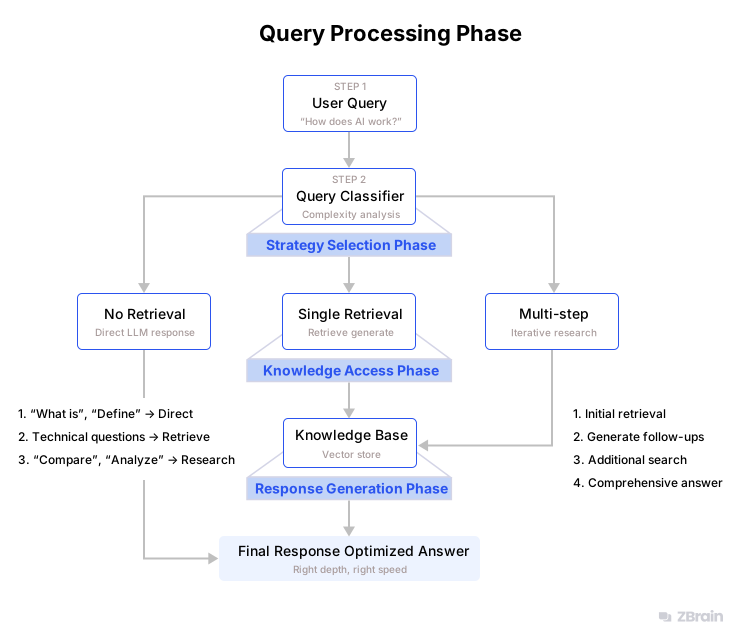
Query analysis stage: When a query arrives, first run a quick analysis to decide if retrieval is needed. This could be a classifier model prediction (simple/moderate/complex), a prompt to the LLM to gauge confidence (as in TA-ARE or other prompting strategies), or even heuristic rules (like checking for certain keywords). This stage outputs a decision: e.g., “No retrieval”, “Retrieve once”, or “Retrieve multiple times”. It’s effectively the gatekeeper stage.
-
Retrieval stage (conditional): If the decision is to retrieve, the system then formulates a query (which might just be the original question or a refined version of it) and searches the knowledge source. The knowledge source might be an internal vector database of enterprise documents, a web search engine, or any relevant data store. If multiple retrieval rounds are allowed (for complex queries), this stage might loop – for instance: retrieve -> see partial answer -> decide to retrieve more -> and so on, until criteria are met.
-
Knowledge integration and answer generation: If retrieval was done, the retrieved snippets are vetted for relevance (perhaps discarding obviously off-base results) and then combined with the original question to feed into the LLM. If no retrieval is done, the original question alone is sent to the LLM. In either case, the LLM now generates the final answer. Optionally, if multiple pieces of information were gathered (like in a multi-step process), another component might synthesize or merge them before prompting the LLM.
Optionally, a final post-answer check can be in place: for example, verifying that the answer cites the retrieved sources or verifying that the answer actually addresses the question. If not, the system might decide to do an additional retrieval or rephrase the query and try again. This is more relevant in high-accuracy-demand scenarios.
The above flow ensures that a retrieval step is encapsulated by logic that can skip or repeat it as needed. At runtime, a simple query likely takes the path: Query Analysis -> (decide no retrieval) -> Answer via LLM immediately. A complex query may go: Query Analysis -> (decide retrieval needed) -> Retrieve -> Integrate -> (maybe Query Analysis again on a sub-question or after seeing partial info) -> possibly another Retrieve -> … -> Generate Answer.
This multi-stage orchestration can be implemented in code with if/else logic, loops, or more sophisticated orchestration frameworks or dynamic workflow engines. The complexity depends on how advanced the adaptivity is meant to be.
Tools & frameworks
Building an adaptive RAG system from scratch can be involved, but fortunately, there are emerging frameworks that help manage these decision flows and agent-like behaviors:
-
LangChain and LangGraph: LangChain is a popular framework for developing LLM agents, and it provides abstractions for chains (sequential processes) and agents (which can use tools like web search). An extension of LangChain called LangGraph enables defining workflows as a graph of nodes (each node could be an LLM call or a tool call), complete with conditional branches. This is very useful for adaptive RAG because you can visually or programmatically lay out the decision nodes (e.g., a classifier node feeding into a conditional branch: if “needs retrieval” go to a search node, else go to an answer node). In fact, LangGraph was explicitly designed to handle complex agentic flows, making it easier to orchestrate retrieval decisions and iterative loops in a reliable way. By using such a framework, developers can implement adaptive behavior declaratively, rather than manually handling all control logic.
-
Orchestration platforms: Tools like ZBrain Builder (from ZBrain) or other enterprise AI orchestration platforms offer a higher-level interface for creating these flows. ZBrain Builder, for instance, offers a low-code, visual interface to configure multi-agent or decision-driven workflows. Under the hood, it leverages frameworks (such as LangGraph or others) that you can add. This can accelerate the implementation of adaptive RAG in an enterprise context, as it allows for the setup of retrieval gating logic and knowledge base connections with minimal coding. Other orchestration frameworks include Microsoft’s Semantic Kernel and Google ADK, which also allow for conditional logic and the use of external tools.
-
APIs for real-time data: To integrate real-time information, developers can use APIs (e.g., search engine APIs, news feeds). Many LLM agent frameworks have tools to call web search or other APIs. Ensuring your pipeline has access to such a live data tool is essential for time-sensitive queries. For example, one might incorporate a “WebSearchTool” that is only invoked if the query is classified as time-sensitive.
-
Vector databases and indexes: On the retrieval side, having a well-maintained vector index of your knowledge base allows rapid similarity search for relevant documents. Tools like FAISS, Qdrant, or Pinecone can be used for this. An adaptive system might even maintain multiple indices (e.g., one for static knowledge like documentation, and one that’s continuously updated with recent info or user-generated content). Then the decision logic could choose which index to query based on context (for instance, use the “recent updates” index if a question is time-sensitive). Some frameworks can handle this routing of queries to different indexes automatically through a router component.
-
Evaluation & feedback loop: Implementing adaptive RAG isn’t just about the live system – you also need to test and refine it. One might use logging to see how often retrieval was triggered and whether it correlated with better answers. Human-in-the-loop evaluation or user feedback can highlight cases where the system should have retrieved but didn’t (or vice versa). This feedback can then be used to adjust the classifier threshold, retrain the gatekeeper model, or add more prompt examples to the LLM gating prompt. Over time, the system “learns” when to retrieve more accurately.
The combination of these tools essentially gives you an agentic system – the LLM (or a set of LLM agents) can make decisions (like whether to use a tool, which tool to use, etc.). In adaptive RAG, the main decision is “Use the retrieval tool or not?” which can be considered a simplified form of an agent deciding on an action.
Real-time data integration
Since adaptivity often entails recognizing the need for up-to-date info, integrating real-time data sources is a key practical aspect. There are a few ways to achieve this:
-
Periodic knowledge base updates: If you have an internal knowledge base (e.g., company documents), ensure it’s updated frequently. An adaptive system could detect that something is not found in the current KB and might then query a broader source (like the web). Some enterprise systems allow for the scheduled ingestion of new documents (for instance, ingesting new files daily into the vector store).
-
Hybrid search strategies: Implement both vector similarity search and keyword search. Vector search is great for semantic relevance, but for very recent info, a keyword search on a live index or web might be better. An adaptive retriever might try vector search first on a static index, and if that yields nothing useful (or if the query has temporal markers), it could then fall back to a web search. This ensures that if the answer isn’t in the known documents, the system has a chance to find it externally on the fly.
-
Temporal indexing: Some advanced designs involve time-tagged indexes. For example, maintaining snapshots or segmented indices by year. Then, if a query asks “in 2023, what was…”, the system can direct the search to the 2023 slice of data specifically. This is more relevant in large-scale archives or news repositories.
-
Caching recent responses: If certain time-sensitive queries repeat (e.g., “What’s the weather now?” asked by many users), the system can cache the latest answer for a short period. Strictly speaking, this is not about retrieval adaptivity, but it improves efficiency. The adaptive part is recognizing that a question is time-based, retrieving the answer once from an API, and then reusing it for a window of time.
One must also consider that real-time integration comes with challenges: external search APIs may have rate limits, data sources may be unreliable or have varying formats, and the system needs to parse and filter the retrieved information for the LLM. All these need to be handled gracefully. Often, developers include a fallback – if the real-time search fails or yields no results, the system may then attempt to answer with what it knows (with a disclaimer, if appropriate). Maintaining a good user experience means that even when retrieval cannot obtain fresh information, the system should respond sensibly (“I’m sorry, I cannot find the latest information on that”).
Overall, implementing adaptive RAG involves carefully designing the control flow and leveraging the right tools to execute it. It’s an investment in making the QA system smarter and more efficient. Next, we’ll examine how these principles are exemplified in ZBrain’s approach, showcasing a real-world application of agentic, adaptive RAG in an enterprise AI assistant.
ZBrain’s approach and perspective
ZBrain Builder is a modular agent orchestration platform purpose-built for enterprise AI. One of its key capabilities is enabling agentic retrieval—a paradigm where autonomous agents make retrieval decisions dynamically as part of their reasoning workflows. While agentic retrieval is not synonymous with adaptive RAG, it is a powerful enabler of it. ZBrain Builder leverages this approach to deliver fine-grained, context-aware, and efficient Retrieval-Augmented Generation across enterprise knowledge systems. Alongside, ZBrain Builder’s Agent Crew orchestration enables multiple agents to collaborate using modular retrieval via KB search tools and external sources, guided by Model Context Protocol (MCP) for context-aware, time-sensitive decisions.
Agentic retrieval in ZBrain Builder
In traditional RAG systems, retrieval is a fixed step—every query triggers a document fetch, regardless of whether it is necessary or not. ZBrain Builder replaces this static behavior with agentic decision-making. Within ZBrain Builder, every query is processed by an orchestrated network of intelligent agents that evaluate whether retrieval is needed, where to retrieve from.
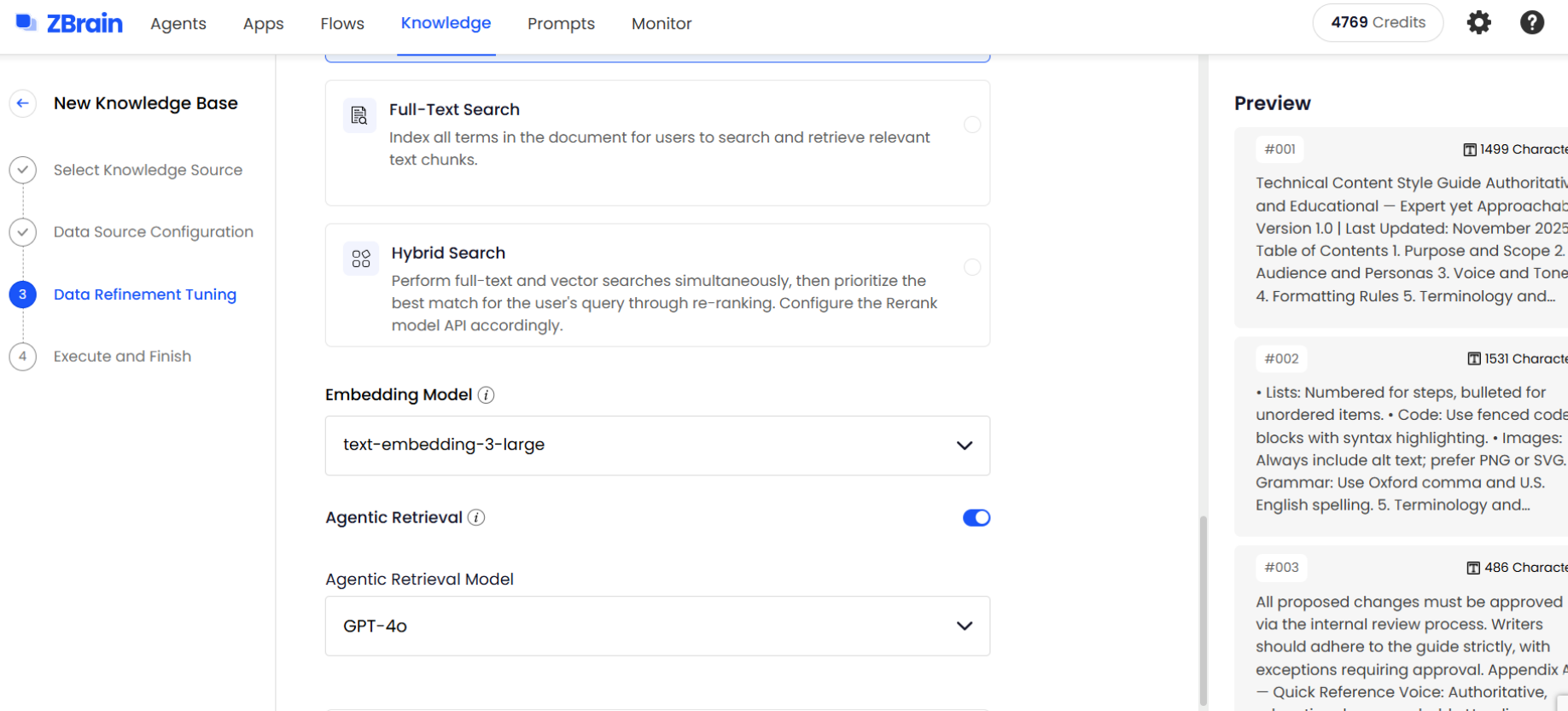
In enterprise use cases, this adaptivity is critical. For example, the agent may skip retrieval for well-known facts, conduct shallow lookup for moderately complex questions, or activate a deep retrieval plan involving multiple tools for hard, multi-hop queries. ZBrain utilizes LangGraph-based orchestration underpins these dynamic flows, allowing real-time branching, retries, and tool invocation across agents.
Multi-agent collaboration with retrieval tools
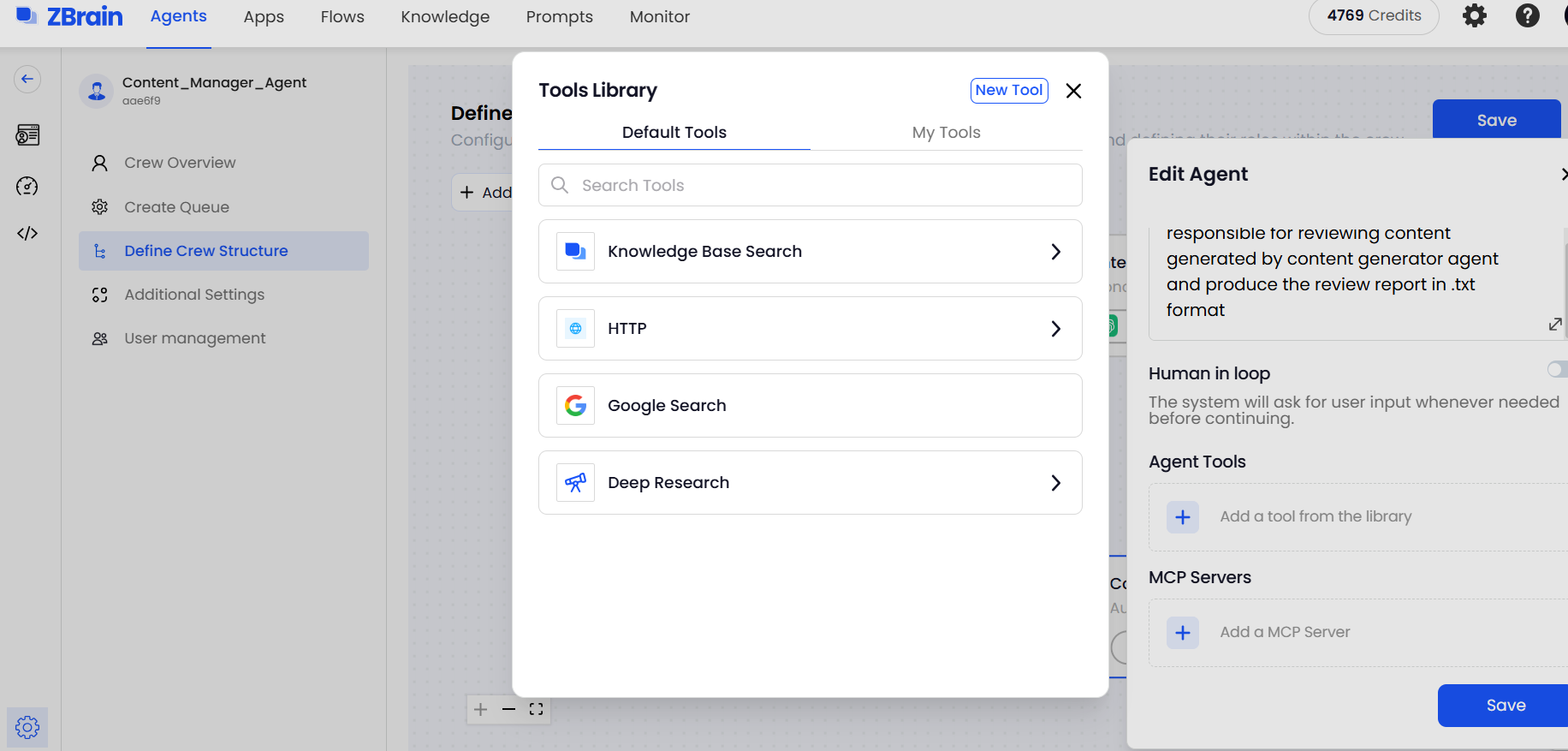
ZBrain Builder also supports Agent Crew orchestration, where multiple specialized agents collaborate to fulfill complex tasks. Within these crews, retrieval is a modular capability—not tied to a single model or service. Agents can use ZBrain’s built-in knowledge base search tools or call external sources (e.g., APIs, databases, or real-time feeds) depending on the nature of the query and its time sensitivity.
-
For instance, a Retrieval Agent might query the knowledge base.
-
A separate Database Agent might handle SQL queries to live systems.
-
A Validator Agent could cross-check the retrieved results for compliance or relevance.
Because these agents can work in parallel and invoke tools as needed, ZBrain Builder enables a highly adaptive RAG architecture—one that is both modular and composable. Retrieval is no longer a monolith, but a flexible and intelligent action within an evolving reasoning loop.
Modular, time-aware, and contextual
This adaptive RAG design allows ZBrain Builder to deliver several advantages:
-
Selective retrieval: The system determines whether retrieval is necessary, thereby avoiding wasteful or redundant lookups.
-
Time-aware strategies: ZBrain agents detect time-sensitive queries and prioritize fresh data or invoke real-time tools if a prompt indicates that it requires recent data.
-
Modular scaling: New agents, retrievers, or data connectors can be added without changing the core workflow—ideal for evolving enterprise environments.
In summary, agentic retrieval in ZBrain Builder enables adaptive RAG by giving agents the autonomy to reason about when, how, and from where to retrieve—making enterprise AI both more efficient and contextually aligned. It moves beyond the rigid RAG pipelines of yesterday and toward an architecture that adapts to user intent, query complexity, and enterprise knowledge in real time.
How adaptive retrieval logic is used in ZBrain Builder
Every query in ZBrain Builder passes through an initial decision node that effectively asks, “Do I (the AI agent) already know the answer, or should I retrieve additional information?” This is implemented as the first step of the agent’s reasoning. When a user question is received, the agent will internally evaluate it and determine whether to consult the knowledge base.
In practice:
-
The agent (LLM) might be prompted to check its confidence or knowledge – akin to the prompting strategy we discussed (the exact method may be proprietary, but it aligns with the idea of the agent being self-aware of its knowledge limit).
-
If the agent decides no retrieval is needed, the workflow simply skips to generating an answer. If retrieval adds no value (e.g., the query is trivial or can be answered from memory), the flow terminates quickly. This saves time and cost, as no further processing is done beyond the LLM formulating an answer from what it already knows.
-
If the agent decides retrieval is required, it proceeds to call the retrieval tool (the knowledge base search).
This kind of gating logic mirrors exactly the concept of adaptive RAG: the system itself makes a judgment call on retrieval. Under the hood, this could be implemented via a small prompt to the LLM or via heuristics; the key is that the agent has an opportunity to decide, not just retrieve by default.
Time and context awareness
ZBrain’s agentic RAG is also context-aware in choosing which data sources or tools to use. Enterprises often have multiple knowledge silos, including documentation, databases, an internal wiki, and possibly even internet access for specific queries. A rigid system might only search one index, but ZBrain’s agents can route queries intelligently. For example, a routing agent could decide that a query about employee records should be directed to a SQL database, whereas a query about general product information should be routed to the documentation knowledge base. If a question seems to be about very recent news (e.g., “What is the weather today?”), the agent could invoke an external API or web search, provided it’s configured to do so.
By factoring in the context and intent of the query, ZBrain’s orchestration can dynamically choose the appropriate tool. This is how time-awareness might manifest: if it recognizes a query as time-sensitive (based on context or phrasing), it might engage a “live data” tool rather than relying on a possibly stale knowledge base. In ZBrain Builder, connectors known as Model Context Protocol (MCP) connectors enable agents to interact securely with external systems and APIs. An agent could use an MCP connector to fetch the latest information from, for example, a company news feed or a web search for the most recent article on a topic, and integrate that into its response.

In practical terms, ZBrain Builder functions as a coordinated ecosystem of agents and tools working in concert to solve complex tasks. Some agents handle the decision (“should I search?”), some handle the action of searching, and some may handle other tasks (like calculations or API calls) as needed. They maintain an awareness of context.
Time-aware retrieval with prompt manager in ZBrain Builder
ZBrain Builder enhances retrieval precision through time-aware retrieval, enabled by its built-in prompt manager. When creating prompts within the prompt manager, users can append the current date and time, embedding temporal context directly into the prompt template using variables. This feature is particularly valuable in enterprise settings where data relevance often changes over time—such as legal updates, financial records, or time-bound policies.

Once configured, these time-stamped prompts can be seamlessly integrated into Flows or agents during knowledge base retrieval operations. This allows ZBrain solutions to intelligently surface the most temporally relevant information, ensuring that the AI response is grounded not just in the right content, but in the right timeframe.


By incorporating temporal context at the prompt level, ZBrain enables more context-aware decision-making and supports advanced use cases like regulatory compliance tracking, versioned document search, and real-time situational analysis—making its RAG (Retrieval-Augmented Generation) workflows significantly more robust and accurate.
Technical implementation (LangGraph and Orchestration)
Under the hood, ZBrain Builder leverages an orchestration framework to manage these complex interactions.
-
The framework’s role is to define the graph of nodes (decision nodes, tool nodes, etc.) and enforce the logic (e.g., if the agent says “need retrieval,” then call the tool node).
-
The LLM’s role is to carry out the reasoning at each step: interpreting the query, deciding on retrieval, formulating search queries, evaluating results, and ultimately generating the answer.
ZBrain Builder provides a low-code interface for workflow/agent design, but conceptually, it’s using these building blocks:
-
A classifier or router agent (could be an LLM prompt or model) at the start to determine query handling.
-
A knowledge base search tool that is agentic (as described).
-
Possibly other tools (like external search, database query) that can be invoked if the workflow calls for it.
-
A loop mechanism to allow query refinement if needed.
-
A final answer generation step using the main LLM agent.
The use of an orchestration framework is crucial for enterprise readiness because it allows explicit control and transparency. Each node in the workflow is defined and observable, which means the developers can monitor, log, and debug the process (important for enterprise compliance and troubleshooting). It also means that if a particular decision strategy isn’t working, it can be adjusted in isolation (for example, swapping out the prompt used in the retrieval-decision node, or adjusting the number of examples).
In essence, ZBrain Builder has adopted a modular, agent-based architecture: one can plug in different tools, define decision criteria, and the LLM agents will navigate that graph. This makes the system highly adaptable. For example, if an organization wants its agent to incorporate a new data source or follow a new rule (such as always verifying an answer from two sources before responding), the graph can be updated to accommodate this. The separation of concerns (workflow vs LLM reasoning) means the heavy-lifting LLM (like GPT-5) is used efficiently – it focuses on reasoning and language tasks, while the framework handles the procedural routing and integration.
Efficiency and impact for enterprise
The net result of ZBrain’s adaptive, agentic retrieval strategy is a system that scales efficiently in an enterprise setting while delivering accurate, context-rich answers. By avoiding unnecessary retrievals, it reduces latency and compute costs for the numerous routine queries that employees or customers may ask. By engaging in retrieval (and even complex multi-hop retrieval) for tough questions, it ensures that the answers don’t suffer in quality – difficult queries receive the additional knowledge and reasoning steps they require.
This blend of adaptability and temporal awareness is crucial for enterprise AI assistants. Enterprises deal with a broad spectrum of queries, ranging from simple FAQs to complex analytical questions, and from static historical data to breaking news that affects the business. A one-dimensional approach would either waste resources or fail to handle some cases well. ZBrain’s approach, as we’ve seen, tackles this by dynamically adjusting to each scenario.
For example, if an executive asks, “Generate a summary of our company’s financial performance in the last quarter,” the agent knows to pull the latest quarterly report from the knowledge base (since it’s time-bound data) and maybe even cross-check figures from a financial database. If another user asks, “What is the capital of France?” in the same system, the agent will simply answer “Paris” without bothering the document store – a trivial case handled instantly. This kind of responsiveness fosters user trust because the AI appears to “know” when it needs to look something up versus when it can simply answer, which makes its responses faster and often more precise.
From an efficiency standpoint, ZBrain’s KB logging has likely shown a reduction in the average number of documents retrieved per query and a decrease in average response time for easy questions, because of adaptive retrieval. At the same time, user satisfaction with hard questions improves because the system is more likely to retrieve the right information and produce correct answers (instead of either guessing incorrectly or giving an “I don’t know” if it has no retrieval).
Streamline your operational workflows with ZBrain AI agents designed to address enterprise challenges.
Endnote
ZBrain Builder demonstrates how agentic (tool-using) behavior and adaptive retrieval logic can be fused to create an enterprise AI that is both smart and efficient. It validates in a real product what research has been suggesting: that selective retrieval – deciding when to retrieve and how to tailor that retrieval – is a game-changer for building reliable, scalable AI assistants. By learning from each query and continuously incorporating new data (via updated knowledge bases or real-time search), such a system remains current and accurate.
Adaptive RAG, especially when combined with an agentic orchestration platform like in ZBrain, represents a next step in the evolution of AI assistants: moving beyond static QA systems to ones that actively reason about their own knowledge and actions. This leads to interactions that feel more natural (the AI doesn’t overdo things when it’s not necessary) and more trustworthy (the AI seeks information when it should, instead of making things up). For any organization looking to deploy AI on top of their ever-changing, growing bodies of data, this approach is likely to become the gold standard – ensuring both precision and efficiency in information retrieval and generation.
Design agents that reason, retrieve, and act contextually. Explore how ZBrain Builder enables you to operationalize adaptive RAG for real-world impact. Book a demo today!
Listen to the article
Author’s Bio


CEO LeewayHertz
An early adopter of emerging technologies, Akash leads innovation in AI, driving transformative solutions that enhance business operations. With his entrepreneurial spirit, technical acumen and passion for AI, Akash continues to explore new horizons, empowering businesses with solutions that enable seamless automation, intelligent decision-making, and next-generation digital experiences.
Table of content
- Retrieval-augmented generation (RAG): An overview
- Challenges with traditional RAG
- The rise of agentic AI: From pipelines to autonomous systems
- What is adaptive retrieval-augmented generation (ARAG)?
- Benefits of adaptive RAG
- Techniques for RAG adaptivity
- Incorporating time awareness (TA) in retrieval
- What is time-aware adaptive retrieval (TA-ARE)?
- Time-Aware Adaptive Retrieval in agentic systems
- Implementing adaptive RAG in practice
- ZBrain’s approach and perspective
Share Article


Frequently Asked Questions
What is Adaptive Retrieval-Augmented Generation (RAG)?
Adaptive RAG is an advanced variant of standard RAG architecture that intelligently decides when and how to retrieve external knowledge. Unlike traditional RAG systems that retrieve documents for every query, adaptive RAG selectively performs retrieval based on the nature and complexity of the question. This decision-making process enhances efficiency, reduces latency, and improves response quality by avoiding unnecessary retrievals.
Why is adaptivity important in RAG pipelines?
Static RAG pipelines treat all queries the same—triggering retrieval even for simple questions that an LLM can answer from its internal knowledge. This leads to redundant processing, increased latency, and sometimes lower answer quality due to the injection of irrelevant or noisy context. Adaptive RAG addresses these issues by employing techniques such as confidence thresholds, classifier models, or LLM-based prompting to retrieve information only when necessary.
What are the key techniques used to implement Adaptive RAG?
Three common techniques include:
-
Threshold-based calibration, where retrieval is triggered based on query complexity or confidence scores.
-
Gatekeeper classifiers, which use a separate ML model to predict whether retrieval is needed.
-
LLM-based prompting, where the LLM itself decides (via prompt engineering) if external knowledge is required before answering.
These methods may be used individually or in combination to fine-tune retrieval behavior based on context and performance goals.
How does adaptive RAG handle time-sensitive queries?
Adaptive RAG incorporates time-awareness by detecting temporal cues in user queries (e.g., “latest update,” “as of 2025”) and dynamically fetching the most recent data. This is crucial because LLMs have fixed knowledge cutoffs and cannot answer real-time questions without up-to-date retrieval. Time-aware adaptive RAG ensures the model fetches fresh, relevant content when the query context demands it.
What are the business advantages of Adaptive RAG for enterprises?
Enterprises benefit through:
-
Reduced latency and cost by skipping unnecessary retrievals.
-
Improved accuracy by focusing retrieval on complex or time-sensitive queries.
-
Greater scalability, with optimized resource usage across high query volumes.
-
Regulatory alignment, as selective retrieval, limits the injection of outdated or incorrect knowledge in critical workflows.
How does ZBrain Builder implement adaptive retrieval and determine when to invoke it?
ZBrain Builder employs a modular, agentic orchestration approach in which retrieval is treated as a dynamic capability—not a fixed pipeline step. At the core of this architecture is the Agent Crew model, where specialized agents—each with defined capabilities—collaborate to solve complex tasks. These agents are coordinated using Model Context Protocol (MCP), which ensures structured memory sharing, tool access control, and consistent context handoff across agents during execution. This orchestrator coordinates task execution, retrieval logic, and decision routing across the agent network.
When Agentic Retrieval is enabled during KB setup, each agent in the crew can independently assess whether a query warrants external retrieval. This assessment considers multiple factors, including query complexity, confidence thresholds, time sensitivity, and knowledge coverage.
Key aspects include:
-
Retrieval as a tool: Instead of hardcoded logic, retrieval is implemented as an on-demand tool that agents can invoke as part of their reasoning loop. This enables agents to retrieve from knowledge bases, call APIs, or connect with real-time data sources only when needed.
-
Tool integration layer: ZBrain agents can leverage third-party search tools, internal databases, or proprietary KBs as modular retrieval backends. These are pluggable into the reasoning workflow, allowing dynamic selection based on the context of each query.
-
Temporal and contextual routing: The MCP ensures domain-specific queries are routed to appropriate retrievers—e.g., selecting real-time search vs. static KB lookup depending on the inferred user intent.
-
Adaptive decision flow: Retrieval decisions are embedded within the reasoning flow graph (via orchestration framework), enabling agents to evaluate intermediate outcomes and revise retrieval strategies mid-execution if necessary.
This architecture enables retrieval to be both context-aware and agent-governed, ensuring optimal information access while minimizing unnecessary lookups. The result is a scalable, efficient, and intelligent enterprise RAG framework aligned with the principles of modularity and adaptive AI.
What makes ZBrain Builder’s approach to adaptive RAG unique?
ZBrain’s uniqueness lies in its modular, agentic design. It allows:
-
Agent crews orchestrate multi-step reasoning with specialized agents.
-
Tool-based retrieval, where a KB search tool is called only when needed.
-
Framework-based orchestration, enabling branching logic and conditional workflows.
This makes retrieval a skill, not a rule—enhancing flexibility and contextual precision.
What performance or scalability benefits does adaptive RAG bring to ZBrain customers?
ZBrain’s adaptive RAG reduces response times by avoiding retrieval for trivial queries and focuses resources on complex tasks. This not only improves answer quality but significantly reduces compute/API overhead, making enterprise AI deployments faster, leaner, and more cost-efficient—especially at scale.
Why should enterprise leaders prioritize adaptive RAG in AI deployments?
Adaptive RAG aligns with enterprise priorities by enabling intelligent, resource-efficient, and scalable AI solutions. It ensures:
-
Operational efficiency, through selective processing.
-
Compliance-readiness, by reducing misinformation risks from outdated knowledge.
-
Strategic adaptability, by future-proofing AI assistants with modular, dynamic capabilities.
ZBrain’s implementation exemplifies how adaptive AI architecture can deliver trustworthy, real-time, and business-aligned automation.
How do we get started with ZBrain™ for AI development?
To begin your AI journey with ZBrain™:
-
Contact us at hello@zbrain.ai
-
Or fill out the inquiry form on zbrain.ai
Our dedicated team will work with you to evaluate your current AI development environment, identify key opportunities for AI integration, and design a customized pilot plan tailored to your organization’s goals.
Insights
Common solution architecture design challenges — and how to overcome them
Solution architecture must evolve from fragmented documentation practices to a structured, collaborative, and continuously validated design capability.
Why structured architecture design is the foundation of scalable enterprise systems
Structured architecture design guides enterprises from requirements to build-ready blueprints. Learn key principles, scalability gains, and TechBrain’s approach.
A guide to intranet search engine
Effective intranet search is a cornerstone of the modern digital workplace, enabling employees to find trusted information quickly and work with greater confidence.
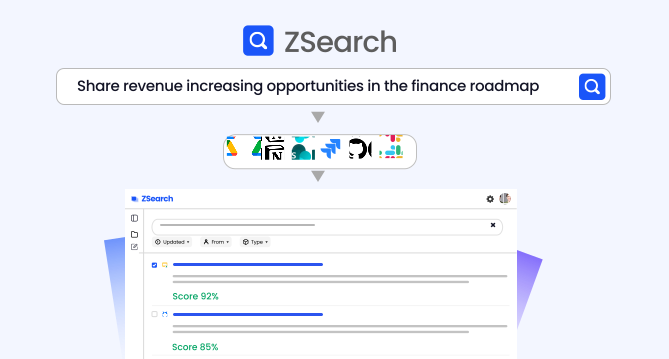
Enterprise knowledge management guide
Enterprise knowledge management enables organizations to capture, organize, and activate knowledge across systems, teams, and workflows—ensuring the right information reaches the right people at the right time.
Company knowledge base: Why it matters and how it is evolving
A centralized company knowledge base is no longer a “nice-to-have” – it’s essential infrastructure. A knowledge base serves as a single source of truth: a unified repository where documentation, FAQs, manuals, project notes, institutional knowledge, and expert insights can reside and be easily accessed.
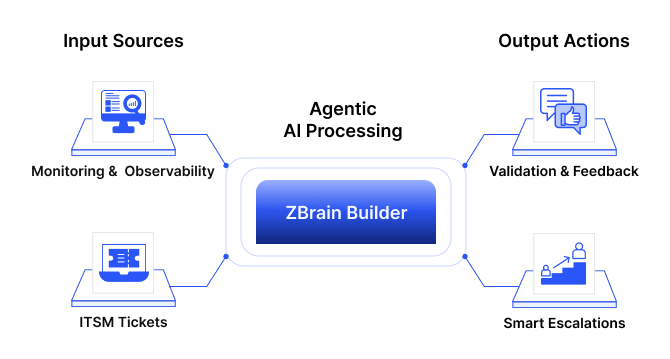
How agentic AI and intelligent ITSM are redefining IT operations management
Agentic AI marks the next major evolution in enterprise automation, moving beyond systems that merely respond to commands toward AI that can perceive, reason, act and improve autonomously.
What is an enterprise search engine? A guide to AI-powered information access
An enterprise search engine is a specialized software that enables users to securely search and retrieve information from across an organization’s internal data sources and systems.
A comprehensive guide to AgentOps: Scope, core practices, key challenges, trends, and ZBrain implementation
AgentOps (agent operations) is the emerging discipline that defines how organizations build, observe and manage the lifecycle of autonomous AI agents.
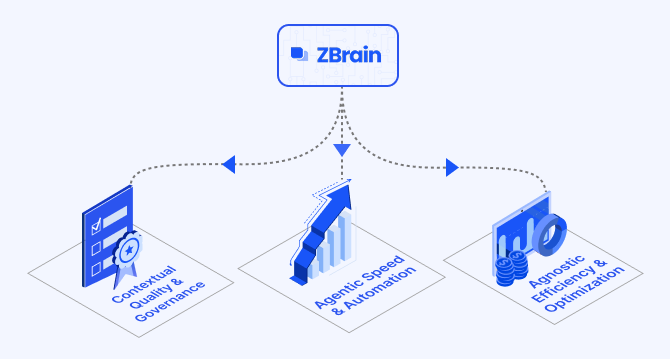
How ZBrain breaks the trade-offs in the AI iron triangle
ZBrain’s architecture directly challenges the conventional AI trade-off model—the notion that enhancing one aspect inevitably compromises another.