Manufacturing
 Logistics
 Real Estate
 Retail
 Finance
 Healthcare
 Hospitality
 Automotive
What is vibe coding? AI-powered software development explained

Listen to the article
Vibe coding is transforming how software is written. Coined by AI expert Andrej Karpathy, the term refers to a programming style where developers rely heavily on AI models to generate, refine, and debug code. Instead of meticulously crafting every line, programmers issue high-level commands and let AI handle the details. This transformation ushers in a new era of coding, where AI acts as a co-developer, making programming faster, more accessible, and intuitive. Collins Dictionary named vibe coding its Word of the Year 2025, and by early 2026, 90% of developers worldwide report using at least one AI tool at work, confirming that what began as a fringe experiment has become the default mode of software creation.
This article explores in detail vibe coding, tools, advantages, real-world applications, and its impact on software development.
- What is vibe coding?
- Historical background: The evolution of vibe coding
- Core methodologies and techniques
- The three levels of vibe coding
- Key tools & frameworks enabling vibe coding
- How vibe coding works
- What can you build with vibe coding?
- Advantages of vibe coding
- Limitations of the vibe coding approach
- Critiques and concerns about AI-generated code
- Real-world applications and adoption
- From vibe coding to agentic engineering
- Current status and future of vibe coding
- Final thoughts
What is vibe coding?
Vibe coding is a term popularized by AI expert Andrej Karpathy to describe a new style of programming where developers let AI do the heavy lifting of writing code while they guide it with high-level instructions. Rather than painstakingly writing and debugging every line of code, the programmer “fully give[s] in to the vibes” of an AI assistant and almost “forgets that the code even exists.” In practice, this means describing what you want in plain English (or even voice), accepting the AI’s code suggestions, and iteratively refining the program through conversation. Karpathy quipped that when vibe coding, “I just see stuff, say stuff, run stuff, and copy-paste stuff, and it mostly works.”
Historical background: The evolution of vibe coding
The roots of vibe coding can be traced through the long-running trend of increasing abstraction in software development. For decades, programmers have sought ways to hide complexity behind simpler interfaces, from the leap of assembly language over binary machine code in the 1950s to modern high-level languages and frameworks. Each step – such as the move from C to Python or from hand-coded UIs to GUI designers – raised the level of abstraction and initially met resistance from traditionalists. Vibe coding is the latest chapter in this story, aiming to abstract away implementation details entirely by letting AI generate the code while the human focuses on the idea. Early precursors of this concept include the rise of low-code/no-code platforms in the 2010s, which let users build apps with visual tools or templates instead of typing code. These platforms showed an appetite for more intuitive, natural ways to create software. However, they were limited to specific domains and still required understanding the tool’s mechanics.
The emergence of powerful AI models for code in the last few years set the stage for true vibe coding. From its conceptual origins to today’s buzz, vibe coding has rapidly evolved alongside AI technology. Key milestones illustrate how this approach has matured with each leap in AI capability:
-
2010s – Early AI assistance: Before modern generative models, developers benefited from “smart” coding aids like autocomplete and static analysis. These weren’t true AI, but they paved the way. Research experiments in program synthesis and natural-language programming hinted at what was to come, but were often limited in scope.
-
2021 – AI pair programmers: The debut of OpenAI’s Codex and GitHub Copilot marked the first major deployment of AI for coding. Copilot (launched in 2021) could suggest code in dozens of languages by interpreting comments and context. Developers started to rely on Copilot for boilerplate code and got comfortable with an AI “completing” their thoughts. Around the same time, other players like Tabnine and Amazon CodeWhisperer emerged with similar ML-driven code suggestion tools.
-
Late 2022 – Conversational coding: The release of ChatGPT to the public was a watershed moment. Suddenly, millions of people could interact with an AI agent capable of understanding detailed natural language queries and outputting working code snippets or even entire programs. ChatGPT’s success demonstrated that one could have a back-and-forth dialogue with an AI to develop software iteratively. This period saw AI confidently writing everything from simple scripts to complex algorithms based on plain English prompts. It was during this time that the phrase “The hottest new programming language is English” became popular, reflecting how AI models could use human language as the interface for coding.
-
2023 – Mainstream adoption: As AI coding assistants proved their usefulness, adoption skyrocketed. By 2023, roughly 44% of developers were already using AI coding tools, with another 26% planning to start, according to Stack Overflow’s annual survey. GitHub Copilot gained hundreds of thousands of users and was writing significant portions of code in many projects. New models like GPT-4 (2023) improved code generation quality and allowed handling larger projects with longer context. Companies like Microsoft, Google, and OpenAI began integrating AI deeper into development tooling. This year also saw the emergence of specialized IDEs and plugins built around AI-first coding, hinting at the “vibe” approach. Developers were no longer just accepting line-by-line suggestions; some were now attempting to have the AI generate whole modules or apps via chat. The term “vibe coding” had not yet been coined, but the practice was visibly taking shape within developer communities.
-
2024 – Refinement and ecosystem growth: With growing enthusiasm, a mini-ecosystem formed around AI-assisted development. New tools and frameworks made the vibe coding workflow easier. For example, startups like Cursor released AI-focused code editors that let users converse with an AI about their code. Anthropic introduced Claude with a “Sonnet” model geared for coding, offering large context windows that could handle entire codebases. AI became a feature in many IDEs (Visual Studio’s AI Extensions, Replit’s Ghostwriter, etc.), enabling more developers to code by prompting. Importantly, lessons learned from early adopters led to better practices – such as how to structure prompts for maintainable code – indicating an evolution from ad-hoc usage to a more disciplined approach. Despite improvements, challenges (like getting AI to refine code correctly in later iterations) became well known, tempering some of the initial hype (developers learned that an AI can rapidly get you a first draft, but polishing that draft might still be tricky).
-
2025 – “Vibe coding” era: By 2025, AI-assisted coding reached a tipping point in awareness and capability. Karpathy’s viral post in early 2025 naming the phenomenon as “vibe coding” crystallized the movement. Silicon Valley embraced the buzzword – as one headline put it, “Silicon Valley isn’t just coding anymore. It’s also vibe coding.” Companies started showcasing examples of entire apps built through conversational AI. Replit launched a mobile app where users could literally chat with an AI agent to build and deploy software from a phone. Collins Dictionary named “vibe coding” Word of the Year 2025 after search interest skyrocketed by 6,700% that spring. The quality of AI-generated code continued to improve, thanks to model fine-tuning and larger training sets, making the vibe coding approach more viable for complex projects than it was a couple of years prior. At the same time, the community also became more cognizant of the limitations, leading to ongoing efforts to mix human oversight with AI generation. In short, by 2025 vibe coding had evolved from a fringe experiment into a mainstream trend in software development, enabled by each breakthrough in AI and validated by a growing body of real-world successes.
-
2026 — Maturation and accountability: By early 2026, the debate over vibe coding was effectively over. Adoption reached near-universal levels, with 90% of developers worldwide using AI tools at work and 46% of all new code being AI-generated. The conversation shifted decisively from whether to adopt vibe coding to how to govern it responsibly, a move prompted in part by high-profile incidents including the Lovable security breach and the Replit database deletion, both of which exposed the risks of accepting AI-generated output without sufficient review. The trust paradox emerged as the defining tension of the year: usage was universal, but trust in AI code had dropped from 40% to 29% in twelve months. Andrej Karpathy responded to this maturation moment by proposing the successor concept of “agentic engineering” in February 2026, a more disciplined framework in which AI agents handle implementation while human engineers retain ownership of architecture, review, and quality assurance. The field had moved from “give in to the vibes” to something more structured, more accountable, and more suited to the production systems it was increasingly powering.
Core methodologies and techniques
Vibe coding represents a shift in methodology from traditional hands-on programming to a more collaborative, AI-driven workflow. Its core principles and techniques include:
-
Natural language prompting: At the heart of vibe coding is expressing the desired behavior or feature in natural language. Instead of writing code, a developer might say “I need a web form with two input fields that calculates a mortgage payment” or “Decrease the padding on the sidebar by half”. The AI interprets this request and generates the corresponding code. In essence, the developer writes specifications or intentions in English (or another human language), acting almost like a client or project manager giving requirements to a very fast engineer (the AI). This is a stark contrast to traditional development, where such intent must be manually translated into code syntax. In vibe coding, English (or any natural language) becomes the coding language.
-
AI as a coding partner: In this approach, the AI functions as a pair-programmer or assistant. The human’s role shifts to guiding the AI, reviewing its output, and clarifying requirements. Andrej Karpathy explained that when he’s vibe coding, “I just see stuff, say stuff, run stuff, and copy-paste stuff, and it mostly works.” He treats the AI almost like an autonomous intern: he describes what he wants, the AI writes the code, and he executes it to see if it works. If the result is not right, he will refine the instruction or ask the AI to fix the issue. The developer becomes a director or editor, orchestrating what needs to be done, rather than typing out every character of the implementation. This is fundamentally different from traditional coding, where the developer is responsible for each line of code. In vibe coding, the “codegen” (code generation) responsibility is largely offloaded to the AI.
-
Iterative feedback loop: Vibe coding is highly iterative. After the AI generates code based on an initial prompt, the developer will test or run it to see the outcome. If there are errors or the functionality isn’t as expected, the developer feeds that information back to the AI in natural language. A common technique is simply copy-pasting error messages or exceptions into the chat with the AI and asking it to fix the problem. Karpathy notes that when he gets an error, he’ll drop the error message into the AI with no additional comment, and “usually that fixes it”. The AI will analyze the error and adjust the code accordingly. This rapid debug cycle means even those with minimal coding experience can troubleshoot – they rely on the AI to diagnose and solve issues. The process continues in a loop: prompt, code, run, feedback, and revised code, until the software behaves as desired. This iterative refinement is somewhat analogous to traditional debugging and refactoring, but the human isn’t manually writing the patch – the AI is. The developer’s job is to accurately describe the problem or the change needed in each iteration.
-
“Accept all” mentality: One striking aspect of vibe coding, as described by early adopters, is a tendency to trust the AI and accept its suggestions wholesale. For example, Karpathy mentioned he often clicks “Accept All” on the changes the AI proposes without even reading the diffs line by line. This highlights a key cultural difference in methodology: vibe coders are comfortable letting the AI make broad changes across the codebase in seconds – changes that a human would normally carefully review. The rationale is that if something breaks, the AI can fix it in the next round. This approach sacrifices some precision and understanding for speed and convenience. This methodology has some trade-offs (it can introduce errors or technical debt), but it characterizes the “move fast and fix things on the fly” ethos of vibe coding.
-
Prompt engineering & guidance: Getting good results from an AI often requires skill in phrasing prompts – a practice known as prompt engineering. Vibe coding involves learning how to ask for what you want in ways the AI understands. For instance, if the AI’s first attempt at building a feature is messy or suboptimal, the developer can refine the prompt with more detail or constraints (e.g., “Rewrite this function to be more efficient” or “Use a responsive design for the layout”). Users might also provide high-level guidance or constraints to steer the AI, such as specifying a particular framework (“Create this as a React application”) or style (“follow RESTful API conventions”). Over time, vibe coders develop an intuition for how the AI responds – effectively learning how to talk to the AI to get the best output. This is quite different from traditional coding techniques, but analogous to learning a new (human) collaborator’s strengths and weaknesses. In vibe coding, knowing what to ask is as important as knowing how to code used to be.
-
Voice and multimodal inputs: While not a requirement, vibe coding often embraces new input methods beyond the keyboard. Since the core idea is describing what you want, some practitioners use voice commands to “chat” with the AI assistant. For example, Karpathy has used an AI speech-to-text tool (OpenAI’s Whisper, via a tool called SuperWhisper) to speak his programming instructions to the AI. This means he can code by talking, without typing. Other experimental setups involve sketching a UI or providing an example (image or text) and having the AI generate code from it. The burgeoning field of voice-driven coding even saw the release of a VS Code extension called Vibe Coder, which lets developers guide an AI with voice commands in an IDE. These techniques align with the spirit of vibe coding – making the act of creating software as natural and frictionless as having a conversation or expressing an idea in one’s own words.
-
Built-in deployment and full-stack generation: Early vibe coding tools functioned as smart autocompletes; they accelerated coding but required manual wiring, infrastructure configuration, and deployment.That gap has closed significantly. Modern vibe coding platforms can take a single prompt, “build me a SaaS app where users can upload CSV files, run basic analysis, and share results with a link”, and return a working application with a front end, a back end, a database schema, authentication, and a hosted deployment URL. The entire stack, from the first line of code to a live URL, can be produced without the developer touching a terminal or a configuration file.
In a classic workflow, a developer designs a solution, writes code line-by-line, debugs errors by inspecting code, and maintains a mental model of the entire codebase. In vibe coding, the developer describes the solution, the AI writes the code, and debugging involves asking the AI to resolve issues. The human oversees the process and provides direction and critical feedback, but often does significantly less manual coding. This approach prioritizes speed and accessibility over fine-grained control. It’s important to note that vibe coding doesn’t eliminate the need for understanding programming – rather, it demands a different kind of understanding: the ability to communicate effectively with the AI and to validate and refine the AI’s output. Good vibe coders develop a strong sense of how to translate what they want into prompts and how to spot where the AI’s output deviates from the intention. It’s a new skill set on top of traditional programming knowledge.
The three levels of vibe coding
Vibe coding encompasses a spectrum of AI-human collaboration in software development. Where a team positions itself on this spectrum determines the balance of writing, reviewing, and trusting AI-generated code. Incorrect calibration, either by under-utilizing AI and leaving productivity unrealized, or by over-delegating without sufficient oversight, is a common challenge when adopting these tools.
-
Assisted coding is where most developers first encounter AI in their workflow. The AI suggests completions, answers inline questions, and fills in boilerplate code as the developer types. The human remains the primary author, with AI accelerating individual steps without taking over the logic or structure. GitHub Copilot’s autocomplete is the canonical example. It functions as a highly capable assistant that removes friction but does not decide what to build. This tier requires substantial coding knowledge. Developers should know what they want and validate the AI’s suggestions. In regulated environments such as finance, healthcare, and defense, this may remain the permanent operational tier. Every line of code in the codebase is authored or explicitly approved by a human, which is critical for auditability.
-
Collaborative coding represents the current mainstream of vibe coding and the mode described by Karpathy when he coined the term. In this tier, the AI writes entire functions, files, or modules from natural language descriptions while the developer reviews, edits, and iterates on the output. Tools such as Cursor Composer and Claude Code exemplify this tier. The workflow is conversational: the developer describes a feature, the AI drafts it, the output is tested, and corrections are requested iteratively. This loop can occur dozens of times within a single session, compressing a day of coding into a few hours. The human no longer writes every line but directs the process, specifying requirements and validating outcomes. The skill required in this tier emphasizes precise specification and critical review rather than traditional coding syntax.
-
Autonomous coding is the frontier of AI-assisted development. In this mode, AI agents plan, implement, test, and deploy features end-to-end with minimal human instruction. Multiple specialized agents manage different components of a project in parallel, including frontend, backend, and testing, coordinated by a planning agent that handles dependencies and handoffs. Platforms such as Replit Agent and emerging background coding agents are progressing toward this tier. A developer may describe a feature in broad terms and return to a completed pull request. The human’s role shifts from reviewing individual code changes to approving completed units of work. This tier is still early-stage for production use in 2026. The failure modes are more severe and less predictable than in the collaborative tier. Incidents such as the autonomous deletion of a production database at Replit illustrate the importance of carefully defining agent boundaries. While speed is significant, the potential impact of errors is substantial.
Understanding these three levels is practically important. A developer building an internal dashboard may benefit most from the collaborative tier, which is fast, flexible, and provides sufficient oversight. A startup aiming to validate an MVP quickly might leverage autonomous generation to maximize output per hour, accepting higher risk in exchange for speed. An enterprise team working on regulated systems may remain at the assisted tier to maintain accountability, which is a requirement rather than a preference. Experienced practitioners often move fluidly between all three tiers depending on the task, using autonomous generation for initial scaffolding, collaborative coding to refine business logic, and assisted coding for high-risk or security-sensitive components.
Key tools & frameworks enabling vibe coding
The rise of vibe coding has been fueled by a host of AI-powered tools, frameworks, and platforms. These are some of the most important technologies that make vibe coding possible, by allowing natural language inputs and AI-driven code generation:
-
Large Language Models (LLMs) for code: At the core of most vibe coding tools are advanced LLMs trained on source code. Notable examples include OpenAI’s GPT-5.4, Google’s Gemini 3.1, Meta’s Llama 3, and Anthropic’s Claude Sonnet 4.6. These models are the brains that interpret prompts and produce code. They have been trained on vast amounts of programming data and can generate code in many languages. For instance, GPT-4 (accessible through ChatGPT) can take an English prompt and output a Python or JavaScript program to meet the description. Similarly, Anthropic’s Claude (with its “Sonnet” model variant) has been used for vibe coding due to its ability to handle large code context, making it suitable for more complex projects. These models are often accessed via APIs or integrated into specialized tools.
-
GitHub Copilot: One of the trailblazers in AI coding assistance, Copilot is an extension for popular code editors (VS Code, JetBrains IDEs) developed by GitHub and OpenAI. Copilot uses the Codex model to suggest code completions and even entire functions based on the current file’s contents and comments. It essentially lets you code by comment: for example, you can write a comment saying, “sort a list of strings alphabetically” and Copilot will suggest the code to do that. It was reported that by mid-2023 Copilot’s adoption was huge – in Stack Overflow’s survey it was the most admired AI dev tool by far, with usage vastly outpacing other options. While Copilot primarily works inline (within code you’re already writing), it set the stage for the idea of conversational development. GitHub has since expanded it into Copilot X, which includes a chat mode where developers can ask questions or request larger changes, aligning even more with vibe coding principles.
-
ChatGPT and AI chatbots: OpenAI’s ChatGPT (especially with GPT-4) is a centerpiece in vibe coding. While not a dedicated coding tool, ChatGPT’s ability to understand detailed natural language queries and maintain context over a conversation makes it extremely powerful for coding tasks. Developers use it to generate boilerplate code, get help with algorithms, or even have it draft entire mini-applications. By asking ChatGPT to “create a simple to-do list app in HTML/JS” or “write a Python script to analyze a CSV of sales data”, one can obtain usable code within seconds. Its conversational memory means you can say “now make it use a database instead of an in-memory list” and it will adjust the code accordingly. Other AI chatbots like Bing Chat (powered by GPT-4 with web search) or Google Bard have similar capabilities to assist with coding through conversation. These general AI bots have arguably introduced vibe coding to the masses, as even people with zero programming background experimented with them to create code by simply describing what they need.
-
Claude Code: Released in 2025 by Anthropic, Claude Code is an agentic coding tool that operates directly in the terminal, enabling developers to delegate substantive engineering tasks to an AI agent with the capacity to reason and act across an entire codebase. Unlike IDE-based coding assistants that operate within the context of a single file or conversation window, Claude Code navigates a project’s full directory structure, maintains context across multiple interdependent files simultaneously, and executes sequential actions, reading relevant source files, writing code changes, running tests to verify correctness, and committing results, without requiring human intervention at each step.
The practical scope of tasks this enables extends well beyond individual function generation. A developer can assign Claude Code a clearly defined engineering objective, refactoring a module, resolving failing tests across a suite, implementing rate limiting across a set of API endpoints, and the agent will plan and execute the necessary changes end-to-end, surfacing the completed work for review. This makes it particularly well-suited to tasks that require understanding the relationships between multiple components of a system rather than producing code in isolation. Within the vibe coding spectrum, Claude Code occupies a position closer to the autonomous tier than most developer tooling currently available. It does not generate applications from scratch on the basis of a high-level brief, but it does operate with a degree of task autonomy that allows developers to delegate well-scoped engineering work and review the output rather than direct every step of its execution.
-
Replit Agent / Ghostwriter: Replit, an online coding platform, originally introduced as Ghostwriter and now evolving into Replit Agent, enables users to build and deploy apps through AI-powered chat. In 2025, Replit launched the first mobile app creation agent, where a user can literally text or voice-message their app idea on a phone, and the AI will build, deploy, and host the app. This agent uses a combination of LLMs for code generation and Replit’s cloud platform to actually run the code. For example, a user might text, “Make a personal budget tracker that graphs my expenses,” and the Replit Agent will generate the code for a budgeting app, set up a small database, and host it, all while conversing with the user to refine features. This tool exemplifies vibe coding by making the entire software creation process conversational. Replit’s CEO noted that 75% of their users using the AI never write a single line of code themselves – they let the AI do it – which shows how effective such tools can be for non-developers or beginner developers.
-
Cursor & AI-integrated IDEs: A new class of AI-augmented integrated development environments (IDEs) has appeared to facilitate vibe coding. One example is Cursor (backed by a16z and OpenAI), which provides a workspace called Composer. Composer allows developers to “chat” with their codebase – you can ask it to create new modules, modify existing code, or explain code, all within the editor. Karpathy himself used Cursor’s Composer with Anthropic’s model to build apps quickly. Another example is Cline (from cline.bot), which integrates with VS Code and provides AI code generation and editing features. These IDEs often have a split view: code editor on one side, AI chat on the other. You can highlight a section of code and ask the AI to refactor it, or type an instruction and have the AI insert the resulting code into the project. By combining the development environment with AI assistance, they streamline the vibe coding workflow – no need to copy-paste between a chat window and your code, it all happens in one place. Major IDE makers are also adding similar features (e.g., Visual Studio IntelliCode/CoPilot chat, AWS Cloud9 integration with CodeWhisperer). These tools underscore that vibe coding isn’t done in a vacuum – it’s being embedded right into the software that developers use daily.
-
Voice-driven coding tools: In line with making coding more natural, some tools focus on speech and other input modes. One notable experiment is Vibe Coder by Deepgram – an open-source VS Code extension for voice-driven coding. With it, a developer could speak and the AI would write the corresponding code. Deepgram’s project combines their speech-to-text technology with an AI coding assistant, showcasing how voice can be used to guide coding. Another related tool is OpenAI’s Whisper (for speech-to-text), which isn’t a coding tool per se, but has been used to enable voice input for coding scenarios (Karpathy’s SuperWhisper setup). While still in early stages, these voice coding tools demonstrate the possibilities of hands-free, conversational programming – a very “vibey” way to code. We can expect future frameworks to integrate drawing or GUI design inputs as well (imagine sketching a layout and AI generating the HTML/CSS). All of these make coding less about writing syntax and more about communicating your vision to an AI.
-
Frameworks for AI code execution: Some frameworks assist in executing and verifying AI-generated code. For example, OpenAI’s Code Interpreter (now part of ChatGPT for data analysis) actually runs the code it writes, allowing a tight feedback loop. There are also libraries like LangChain that help stitch together LLM outputs into multi-step workflows (which can be used to plan and generate code in stages). While not directly “vibe coding” tools, these frameworks are pieces of the puzzle that help manage AI-written code, test it, or chain prompts together for more complex tasks. They become relevant as vibe coding projects scale – ensuring the AI’s code works as intended.
-
Browser-based prototyping tools: Bolt.new and Lovable represent a category of vibe coding platform designed for immediate, frictionless entry into software creation. Both run entirely in the browser, no local environment to configure, no dependencies to install, no toolchain to maintain. A developer or non-technical user can open a browser tab, describe an application in natural language, and have a working, interactive prototype running within minutes. This zero-setup model has made browser-based tools the dominant entry point for first-time vibe coders and for experienced developers who need to validate an idea quickly before committing engineering resources to it.
The limitations of this category are real and well-understood. Browser-based platforms optimise for speed of initial generation over depth of control. As a project grows in complexity, more sophisticated business logic, tighter performance requirements, custom integrations, or security constraints that demand careful review, the constraints of a browser-based environment become limiting. File structure visibility, version control, testing infrastructure, and the ability to work across a large codebase with precision are areas where dedicated development environments hold a meaningful advantage.
This has given rise to a recognisable workflow pattern in the vibe coding community. Teams often start with browser-based tools such as Bolt.new or Lovable to rapidly generate an initial prototype, establishing core user flows, validating interactions, and demonstrating viability, then migrate the codebase into environments like Cursor or Claude Code for production-grade refinement. The two categories of tooling complement each other across different phases of development and are frequently used in sequence.
How vibe coding works
Unlike traditional coding, which demands detailed knowledge of syntax and debugging, vibe coding follows a different approach:

-
Describe the goal: In a vibe coding workflow, the developer might start with an empty project in an AI-enabled IDE like Cursor. They then describe what they want in steps or ask the AI questions about the code in plain English. Example: “Create a React app with a login form and a dark mode toggle.”
-
AI generates the code: The AI model or tool provides the initial code structure and implementation.
-
Refinement via conversation: The developer iterates by prompting the AI to adjust the code. Example: “Make the form fields rounded and add a transition effect.”
-
Automated debugging: The AI can run code or tests in some setups – iterating, linting, and running tests autonomously to verify the output. In Karpathy’s usage, if the program throws an error, he feeds the error message back to the AI (with no additional comment), and the AI debugs itself.
-
Accept and deploy: Once satisfied, the developer integrates the final version. Once satisfied, the developer integrates the final version. Many modern tools support one-click deployment to platforms, closing the loop from prompt to live product.
-
Multimodal interaction: Vibe coding tools like Cursor Composer also support voice input, making the experience even more hands-off. Karpathy has used SuperWhisper (an AI speech-to-text tool) to talk to the Composer and issue commands by voice. He says that he “barely even touch[es] the keyboard” when vibe coding. This natural interface means coding starts to feel like having a conversation about the software rather than typing out code. The AI handles code edits and additions under the hood. Karpathy’s approach is to accept all AI-suggested changes by default (clicking “Accept All” in the tool) and only intervene by describing new changes or pointing out issues. The result is that the codebase can grow rapidly with minimal manual edits. As he describes, the code can even grow beyond his “usual comprehension” until he takes time to read through it carefully – highlighting how the AI is doing most of the detailed work.
What can you build with vibe coding?
Since 2025, vibe coding’s scope has expanded significantly. Enterprise organizations increasingly apply it beyond internal tools to customer-facing products, operational workflows, and systems of record. Vibe coding reliably handles about 80% of software features that follow established patterns, while the remaining 20% requires careful human engineering.
Where vibe coding delivers strong enterprise value
Enterprise teams are finding the most consistent returns in the following areas:
-
Internal operational tools: Dashboards, reporting interfaces, approval workflow applications, data entry and management screens, and admin panels that surface information from existing enterprise systems. These typically follow predictable structure and can be generated, iterated, and deployed quickly without the full overhead of a traditional development sprint.
-
Process automation interfaces: Front-end applications that connect to automation backends, allowing business users to trigger, monitor, and manage automated workflows without engineering involvement. Vibe coding accelerates the interface layer substantially, particularly where the underlying logic already exists in an ERP, CRM, or workflow platform.
-
Rapid proof-of-concept and MVP development: Building working software prototypes to validate a business case, demonstrate capability to leadership, or test a workflow with a pilot user group before committing to a full engineering build. Vibe coding compresses the time between a business requirement and a demonstrable artefact from weeks to days.
-
Data visualization and analytical tooling: Custom dashboards, KPI tracking interfaces, and reporting applications built to surface data from enterprise data warehouses or BI platforms. These projects involve predictable patterns that AI models handle reliably, and the ability to iterate quickly on layout and logic is particularly valuable in analytical contexts where requirements evolve through use.
-
Customer-facing web applications: Marketing sites, product landing pages, self-service portals, and onboarding flows that sit at the edge of the enterprise stack. These are well within the capability of current vibe coding tools and benefit significantly from the speed of AI-assisted generation when requirements change frequently.
-
Developer tooling and internal APIs: Lightweight API wrappers, developer portals, documentation sites, and integration scaffolding that engineering teams need quickly but rarely prioritise against product work. Vibe coding handles these well and frees senior engineers for higher-value architectural work.
Where a hybrid approach remains necessary
The remaining 20% of enterprise software development, the portion that carries the most risk and the most organizational consequence, still requires deliberate human engineering, with vibe coding contributing to scaffolding and iteration rather than final implementation.
-
Core financial and transactional systems: Applications performing financial calculations, managing ledger entries, executing payment flows, or producing regulatory reporting require precision that AI-generated code cannot be assumed to provide without rigorous review. A logic error in a pricing engine or a rounding inconsistency in a financial report is not a prototype problem, it is a compliance and audit problem.
-
Regulated industry applications: Software handling personal health information, financial data subject to GDPR or SOC 2 requirements, or any system operating under sector-specific regulatory frameworks requires security controls, data handling practices, and audit trails that must be engineered deliberately and validated thoroughly. AI-generated code can inform the build, but every line touching regulated data needs explicit human review.
-
High-performance and real-time systems: Applications with strict latency requirements, high-frequency processing, or real-time collaborative functionality expose the performance limitations of AI-generated code. Optimization at this level requires algorithmic precision and system-level understanding that current models cannot reliably provide.
-
Large-scale system integration: Connecting a new application to a complex legacy enterprise stack, ERP systems, mainframe data sources, proprietary middleware, or multi-decade-old data models, requires architectural knowledge of the existing environment that cannot be inferred from a prompt. The integration layer is where vibe coding’s context limitations are most consequential.
-
Mission-critical infrastructure: Systems where failure has significant operational, financial, or reputational consequences require engineering discipline, testing rigour, and change management processes that exist independently of how the code was generated.
A useful principle for enterprise teams: vibe coding is most valuable where speed of delivery and iteration matters more than exhaustive precision, and least appropriate where the cost of a subtle error exceeds the cost of moving more slowly. Applied with that discipline, it accelerates the majority of enterprise software work without introducing unacceptable risk into the minority that demands it.
Advantages of vibe coding
Vibe coding offers several potential benefits over traditional coding practices:
-
Speed and productivity: Developers can build functioning software much faster by offloading laborious coding tasks to AI. Complex boilerplate or repetitive code can be generated in seconds. In practical terms, this can lead to exponential productivity gains measured in orders of magnitude. One venture capitalist noted that using AI in this way lets you get “the first 75% [of a feature] trivially, and it’s amazing”. This acceleration means prototypes that might have taken days or weeks to code by hand can be built in hours. For example, a hobbyist reported creating a restaurant menu translator app in a single evening by continuously prompting an AI for each feature, something that would have been much slower with manual coding.
-
Lower barrier to entry: Because the coding is done in natural language, people with little to no programming experience can create software. AI researcher Harry Law observes that “for a total beginner… it can be incredibly satisfying to build something that works in the space of an hour” using these tools. This democratizes development – entrepreneurs, designers, or domain experts who aren’t fluent in programming can still turn their ideas into working apps by describing their needs. Entire applications can be built with zero handwritten code, as evidenced by Replit’s finding that a majority of their users’ projects involve no direct coding by the user at all.
-
Focus on creativity and design: Vibe coding allows developers to spend more time on high-level creativity and product design rather than wrestling with syntax errors or plumbing. The mundane aspects of coding (e.g., fixing missing semicolons, dealing with type mismatches, writing boilerplate CRUD functions) are handled by the AI. As one commentator put it, developers can “no longer waste hours on painful type errors or missing semicolons” and instead concentrate on “the creative essence of software development: imagining and exploring what to build next.”
-
This shift can make software development feel more like brainstorming or sketching – you try ideas by asking the AI to implement them, see the results, and iteratively refine them. The overall experience is more playful and exploratory (“flow”-based), which can spur innovation.
-
Rapid prototyping and iteration: Vibe coding shines for quickly prototyping ideas and getting them to a demo stage. Karpathy noted that the approach is great for “throwaway weekend projects” or building a web app as a one-off experiment. If you have an idea, you might be “only a few prompts away from a product,” says Misbah Syed, a startup founder who uses vibe coding to develop his company’s apps. For instance, Syed’s team built Brainy Docs, a tool that converts a PDF document into an explainer video with slides, using AI coding assistants – he simply describes the features, and when errors arise, feeds them back to the AI for fixes. This means a single individual or small team can go from concept to working prototype extremely quickly, which is invaluable in hackathons, startups, and other fast-paced environments. It enables more experimentation since trying a bold idea is as easy as telling the AI what you want and seeing if it works.
-
Accessibility and convenience: The ability to code by voice or simple language commands makes software development more accessible to those who find traditional coding intimidating. It can also make multitasking easier – one could literally code while doing other activities. This convenience can turn coding into a more natural part of other workflows. Non-engineers can integrate coding tasks into their job without steep learning, e.g., a marketer could whip up a custom data visualization by asking an AI, or a teacher could create a simple educational game via prompts. In essence, vibe coding opens the door for more people to create software on their own, blurring the line between users and developers.
Streamline your operational workflows with ZBrain AI agents designed to address enterprise challenges.
Limitations of the vibe coding approach
Despite its promise, vibe coding comes with notable limitations and challenges:
-
Lack of learning and insight: For beginners, using AI to handle all coding can become a crutch. While they may get quick results, they might skip learning fundamental concepts of computer science. “Beginners can make fast progress, but it might prevent them from learning about system architecture or performance,” warns Harry Law of Cambridge. In a traditional setting, struggling through coding tasks teaches important lessons about how and why code works. Vibe coding bypasses much of that struggle. This means a novice who only vibe codes might build a working app without really understanding it. There’s a concern that an overreliance on AI could produce a generation of developers who can prompt models but lack deeper coding skills to troubleshoot or optimize code when the AI falls short.
-
Code quality and maintainability: AI-generated code might not adhere to best practices or optimal design, especially if the user isn’t guiding it carefully. Karpathy admitted that his AI-written code “grows beyond my usual comprehension,” and he would have to read through it for a while to fully grasp it. This hints at a maintainability issue: if code becomes too large or convoluted (because the AI kept appending fixes and features without refactoring properly), it can be hard for humans to manage later. Overreliance on AI can also accumulate technical debt – messy, inefficient code or quick fixes that work initially but create problems when scaling or modifying the software. Without diligent code review, “security vulnerabilities may also slip through,” Law notes. Blindly accepting AI suggestions means bugs or poor implementations might go unnoticed. In critical applications, this could be risky. Essentially, vibe coding can produce code that works in the happy path but might hide landmines in edge cases, performance, or security that a seasoned engineer would normally catch.
-
Difficulty with complex or evolving requirements: While AI coders excel at producing a lot of code quickly for a well-specified request, they can struggle with larger projects or iterative development. A senior Microsoft engineer noted that large language models are “great for one-off tasks but not good at maintaining or extending projects.” As software grows, it requires understanding context, managing state, and making architectural changes – areas where current AI may get “lost in the requirements” and start to generate irrelevant or incorrect code. Andrej Karpathy experienced this when the AI sometimes “can’t fix a bug” or hits a stumbling block; his workaround was to try “random changes until it goes away,” which is hardly a systematic solution. Venture capitalist Andrew Chen found that using AI to add features and keep editing code is “both brilliant, and enormously frustrating” — “You can get the first 75% trivially… Then try to make changes and iterate, and it’s like you…” (the process falls apart). This suggests that refinement beyond a prototype can be arduous. Getting that last 25% of polish or handling complex integrations often requires the deep understanding that AI lacks. In many cases, human developers must step back in to reorganize code or implement tricky logic that the AI can’t handle gracefully.
-
Debugging and accuracy challenges: AI models are not infallible – they make mistakes in code logic and can misinterpret instructions. When an error is encountered, the vibe coding approach is to feed it back to the AI, but this doesn’t always yield a fix. If the bug is subtle or requires understanding the broader context, the AI might flounder, cycling through attempts. One Reddit user remarked that for complex issues, the feedback loop of checking code and forming a hypothesis is often “faster without an intermediary LLM in the process” because the AI might suggest irrelevant fixes. Furthermore, crafting precise prompts to debug a problem can be as tricky as debugging manually – “to ask the right question, you already need to know most of the answer,” as one programmer noted. In short, troubleshooting via an AI agent can become an exercise in trial and error. If the AI’s suggestions fail repeatedly, a developer may have to dive into the code themselves, potentially negating the time saved. There’s also the issue of AI hallucinations – the model might generate code that looks plausible but is logically wrong or uses non-existent functions. Such errors can be time-consuming to untangle if one is not reading the code carefully.
-
The trust paradox: One of the defining tensions in vibe coding in 2026 is what researchers and industry analysts describe as the trust paradox. Adoption of AI coding tools has reached near universal levels among developers, yet confidence in the correctness and security of AI‑generated code has declined. According to recent Stack Overflow survey data, a substantial proportion of developers express skepticism about the reliability of AI tools, and more developers now report active distrust than confidence in AI output.
Despite widespread use, many developers do not fully trust that code produced by AI is functionally correct, and a significant share do not consistently perform comprehensive reviews before deployment. This gap between usage and trust creates a material risk in software development practices. The security implications of this gap are substantial. Independent analyses of AI‑generated code show elevated rates of security vulnerabilities compared with human‑written code. A recent security report found that a high percentage of pull requests produced by leading AI coding agents introduced security vulnerabilities, including fundamental logic and authorization flaws. Empirical research has also shown that a large fraction of AI‑generated code samples introduce known OWASP Top 10 categories of vulnerabilities, such as authentication weaknesses, injection issues, and insecure configurations.
Multiple studies have highlighted similar patterns. Independent audits identify that AI‑generated applications frequently contain insecure defaults, missing access controls, and exposed sensitive data unless additional engineering review is applied. In some documented cases, widely showcased AI‑built applications contained critical vulnerabilities that could grant unauthorized access or expose user data. This pattern reflects technical limits in current AI models and a mismatch between developers’ use of these tools and their output validation. AI coding assistants optimize for rapid functional code production but lack inherent optimization for security hardening or enforcing comprehensive defensive practices without explicit prompts or reviews.
Critiques and concerns about AI-generated code
The rise of vibe coding has sparked debates in the software community about the implications of relying heavily on AI for code generation:
-
Overhype and reliability: Some experts believe vibe coding, as exciting as it is, might be overhyped in its current form. The anonymous Microsoft engineer described the concept as “a little overhyped,” noting that while useful, today’s LLMs “generate a lot of nonsense content” when pushed beyond simple tasks. Andrew Chen similarly cautioned that the experience can become “enormously frustrating” when you move past basic features. These critiques highlight that AI coding tools still have limitations and can’t magically handle all programming needs. At some point, human intervention and thought are needed to ensure the software is correct and maintainable. The hype around AI coding might give non-engineers unrealistic expectations about firing off a prompt and getting a perfect, production-ready application. There’s a growing call for balancing optimism with a clear understanding of what current AI can and cannot do.
-
Skill atrophy and developer growth: A major concern is that over-reliance on AI could erode the skills of developers – or discourage new developers from learning deeply. If one can build apps by just describing them, will upcoming programmers still learn algorithms, data structures, debugging, and system design? Seasoned engineers worry that constantly using AI as a crutch means less practice in critical thinking and problem-solving. “Ease of use is a double-edged sword,” as Law put it. This has led some in the industry to ask whether vibe coding is “the death knell of skilled programming” – if the craft of coding by hand might diminish over time. Experienced programmers may find themselves needing to mentor AI-generated code rather than writing it, which is a different skill set. There’s also concern about trusting the AI blindly: junior developers might accept AI output without question, missing the chance to analyze and understand the code’s behavior. In the long run, this could widen the gap between “idea people” and the engineers who actually understand the machinery under the hood.
-
Quality, security, and accountability: Relying on AI to generate code raises questions of accountability. If an AI writes flawed or insecure code that causes a failure, who is responsible – the tool or the user who accepted it? This is a grey area that companies will have to consider. As noted earlier, without proper code reviews, vulnerabilities can slip in. Security experts are cautious about code that nobody fully reviewed or understood being deployed. Additionally, AI models tend to incorporate common patterns from training data, which might include outdated or suboptimal practices. This could lead to less efficient software if developers don’t intervene. Code ownership is another concern: if large swaths of code are AI-written, a team might find it hard to maintain that codebase, especially if the original person who prompted it leaves. The code might lack clear structure or comments since it was never manually curated. All these factors suggest that human oversight remains crucial even in vibe coding – the AI is a valuable tool but not a replacement for due diligence.
-
Impact on software engineering roles: The advent of AI-assisted development is prompting a reevaluation of the software engineer’s role in the industry. Tech leaders like Sam Altman and Mark Zuckerberg foresee big changes: Altman predicted that software engineering would be “very different by the end of 2025” thanks to AI, and Zuckerberg remarked that AI might soon do the work of “midlevel” engineers. These statements underline both the excitement and anxiety around AI coding. On the one hand, companies may become more productive with smaller teams as AI handles routine coding tasks. On the other hand, developers worry about job displacement or a shift in required skills. Quality control, architectural planning, and deep problem-solving could become more valued skills than churning out code. Some critics argue that we must be careful not to lose the “art” of programming. If vibe coding turns human programmers into mainly prompt-givers and code curators, the industry will need to adapt training and best practices to ensure we still cultivate talent who understand computing deeply. The consensus among many experts is that AI will augment engineers, not fully replace them – but those engineers will need to consciously avoid complacency and continue honing their craft while using AI tools.
Streamline your operational workflows with ZBrain AI agents designed to address enterprise challenges.
Real-world applications and adoption
Vibe coding is not just a theoretical concept; it’s already being applied in various contexts, from hobby projects to startup products:
-
Hobbyists and independent creators: Many individual developers and tinkerers have embraced vibe coding to build projects quickly. The vibe coding community has shared stories of creating apps in a single sitting using AI. A blogger demonstrated building the restaurant menu translator app in one night by chatting with an AI model through Cursor. In another example, an enthusiast used vibe coding to create a web app for a DIY drawing robot by simply describing to the AI how the app should function. These case studies show that a solo maker can achieve in hours what might have previously required a team or significantly more time. It’s a boon for prototyping new ideas, automating personal tasks, or just having fun building something without getting bogged down in syntax.
-
Startups and rapid MVP development: Startups are leveraging vibe coding to accelerate the development of their minimum viable products (MVPs). For instance, Menlo Park Lab, a generative AI startup, uses vibe coding for its products. Founder Misbah Syed revealed he builds features by prompting the AI and feeding errors back to it; this approach powers Brainy Docs, which converts PDFs into explainer videos with slides. Even when the AI makes mistakes, “it usually fixes them” once errors are reintroduced, Syed says. This enables small startups to iterate faster and reach the market sooner. Similarly, many emerging tools aim to be the “Cursor for X.” At a recent AI Engineering Summit, developers were excited about applying vibe coding across various domains, such as website creation, game development, and data analysis. This trend is particularly beneficial for founders with domain expertise but limited coding skills, allowing them to translate their vision into software with minimal technical barriers.
-
Enterprise and industry adoption: As vibe coding gains traction, we expect to see more domain-specific AI coding assistants. For instance, in web development, services are emerging where you can describe a website and get the code. In game development, one could envision level designers describing a scene and an AI generating Unity or Unreal Engine scripts for it. In healthcare, a clinician might outline a decision tree and get a simple diagnostic software built. We’re already seeing early signs: some autoML (automated machine learning) platforms let users pose a question and the system prepares the model and code. While not always framed as “vibe coding,” these are related in that the user’s high-level request is turned into code by AI. Another interesting application is education: teachers using vibe coding to create customized educational software or quizzes. There was an example of a teacher who used ChatGPT to generate a simple learning game for her students by just prompting it step by step (something that previously would require hiring a developer or knowing how to code herself).
-
Accelerating web and app development: Even for experienced developers or teams, vibe coding can speed up certain types of development. The AI can hand off routine tasks like creating forms, setting up CRUD (Create, Read, Update, Delete) operations, or styling a user interface. For example, a developer building a website can use vibe coding to lay out the initial project structure and components via prompts, then focus their energy on the complex or unique parts. Front-end development sees a lot of this: one might say “Create a responsive navigation bar with a dropdown menu” and get the base HTML/CSS/JS generated. Then the developer needs only to tweak it. This hybrid approach can significantly shorten development cycles. Startups have leveraged this to get minimum viable products (MVPs) out quickly – essentially moving from idea to prototype in record time. For example, a startup founder could describe a mobile app to track fitness goals, and the AI can produce a basic working app which the team can then polish. This speed is a competitive advantage in fast-moving industries.
-
UI/UX design and creative coding: Some developers use vibe coding in creative ways, like enhancing design and user experience. There are anecdotes of programmers treating the AI as a digital designer. One Reddit user shared that he would tell the AI tool, “You are the most brilliant UI/UX designer in the world. Make this page look insanely beautiful,” and the AI would adjust the frontend styles to be more polished. Surprisingly, it often worked – the AI would introduce better color schemes, spacing, or typography, acting like a pair of fresh eyes on the design. This kind of use case shows how vibe coding can inject creativity and expertise that the developer might lack.
-
Data analysis and scripting: Outside of building apps, vibe coding is helping in writing one-off scripts or data analysis tasks. Analysts and scientists who may not be professional software engineers are using natural language to have AI write code for data cleaning, visualization, or computation. For example, an economist could ask, “Import this CSV of sales data and calculate year-over-year growth, then plot it,” and the AI will generate a Python script to do so (possibly using libraries like pandas and matplotlib). This usage is boosted by tools like ChatGPT’s Code Interpreter and other sandboxed AI coding environments that can execute code and return results. It allows people to get analytical results without writing code themselves, or by only writing high-level pseudo-code. Such applications show that vibe coding isn’t limited to product development – it extends to automating tasks and analysis in many fields. In finance, there are instances of analysts using GPT-4 to generate Excel macros or SQL queries by describing what they need in English.
-
Education and learning: Interestingly, vibe coding is also finding a niche in programming education, albeit with some controversy. Tools like Replit’s Ghostwriter (AI coding assistant) have been used to help students or self-learners build projects quickly. The positive side is that it lets learners immediately realize ideas (keeping motivation high). A student can, for example, build a simple game by instructing the AI and then study the resulting code to understand how it works. However, educators caution that if overused, this might short-circuit the learning process. Some coding bootcamps and courses are beginning to incorporate AI pair programming as a skill, teaching new developers how to prompt and collaborate with AI effectively. The future developer might need to learn not only programming syntax, but also how to phrase requests to an AI to get the best results. This is becoming an emerging skill set in its own right.
From vibe coding to agentic engineering
A major conceptual development in 2026 was the formalization of a successor to vibe coding, termed agentic engineering. In February 2026, Andrej Karpathy, the computer scientist who originally introduced the term vibe coding, proposed agentic engineering to describe the emerging norm in AI‑assisted software development, moving beyond informal prompt‑driven workflows toward a more disciplined collaboration between humans and AI agents.
Where vibe coding describes a relatively informal mode of prompting AI and accepting its outputs, agentic engineering frames the work as a structured engineering discipline. In this model, multiple specialized AI agents carry out implementation, planning, testing, and other routine tasks while human engineers focus on architecture, quality assurance, review, and strategic decision‑making. The human role shifts from generating code to orchestrating and overseeing a collection of coordinated agents that work on different aspects of a project.
The shift to agentic engineering reflects how professional teams are adapting to the real‑world limitations of early AI coding paradigms. Rather than a single developer engaging in ad‑hoc prompting with a language model, teams now coordinate multiple agents performing complementary functions such as planning, implementation, testing, and documentation. These practices are accompanied by governance frameworks, scoped task definitions, mandatory review processes, and organized pipelines that integrate AI outputs with traditional development lifecycles.
Agentic engineering emphasizes engineering discipline, explicit specification of requirements, iterative verification, and traceability of outcomes. It acknowledges that while AI can produce substantial portions of code, humans retain responsibility for correctness, security, and architectural integrity. In this regard, agentic engineering is not merely a rebranding of vibe coding but a distinct professional approach that aligns AI capabilities with established software engineering principles.
Industry observers have noted that agentic workflows integrate planning, testing, and review into the development process rather than postponing them until after code is generated. This orientation toward structured collaboration enables teams to balance the speed of AI‑assisted generation with the rigor needed for production‑grade systems. Tools and frameworks that support multi‑agent orchestration, long‑context reasoning, and enforced review cycles are becoming central to this transition.
In summary, the evolution from vibe coding to agentic engineering reflects a maturation of AI‑assisted development practices in 2026. The new model combines the productivity gains of AI with disciplined human oversight, making it better suited for complex, production‑level software. Organizations that adopt agentic engineering are those that move beyond accepting AI output uncritically and build workflows that systematically integrate AI speed with human judgment and quality control.
Current status and future of vibe coding
As of 2025, vibe coding is at the forefront of software development, gaining traction but not yet universal. Awareness is high after tech leaders highlighted it, with major media like Business Insider calling it Silicon Valley’s latest buzzword. On platforms like Reddit and tech Twitter, developers are actively discussing and debating their experiences with AI-driven coding. Surveys show strong adoption—44% of professional developers used AI coding tools in 2023, with more planning to. GitHub Copilot has over a million users, and Replit reports 75% of AI-enabled users don’t write code themselves. However, traditional coding remains dominant, especially for mission-critical systems in industries like aerospace and finance. Vibe coding is more common in smaller projects, learning environments, and early adoption circles, while big tech firms experiment internally.
The tooling ecosystem is rapidly expanding. Besides Copilot and ChatGPT, almost every major tech player has entered the arena: Amazon has CodeWhisperer, Google has integrated AI in Android Studio (Studio Bot) and in Google Cloud tools, and startups like Cursor, Cline, and MutableAI are providing specialized vibe coding IDEs. Open-source communities are also active – models like Code Llama enable local AI coding assistants without sending code to a third-party cloud, which appeals to companies worried about privacy. We also see AI integrations in continuous integration (CI) pipelines (e.g., AI suggesting fixes in pull request reviews).
Education and training are adjusting to the current state too. Bootcamps and CS programs now teach AI coding tools. Companies set guidelines, balancing AI’s potential with caution. AI-assisted coding is reshaping hiring too, with job postings valuing experience in AI tools. New roles like “prompt engineer” have emerged, focusing on expertise in working with AI models to achieve desired outcomes. While “vibe coder” isn’t a formal title, the skillset is implicitly in demand.
Future trends
Looking ahead, vibe coding is poised to significantly shape the future of programming and software development. Here are some trends and predictions for where things are headed in the coming years:
-
Software engineering redefined: AI is shifting software development from coding to curating. Mark Zuckerberg recently commented that AI will be able to handle the work of entry-level or mid-level engineers in the near future. This suggests that routine coding tasks might largely be offloaded to AI, while human engineers focus on higher-level architecture, complex integration, and oversight. We may see the role of “coder” evolve into more of a software curator or verifier, who instructs AIs, then verifies and refines their output.
-
Higher-level abstractions & fewer languages: Vibe coding could lead to a consolidation or reduced emphasis on learning multiple programming languages. If English (or any natural language) serves as the primary “language” to create software, developers might not need to master as many syntax details. We might still have underlying languages (the AI has to output something: Python, JavaScript, etc.), but developers may care less about which one it is as long as it works. Alternatively, AI-friendly frameworks and declarative approaches could dominate, reducing the need for manual coding.
-
Multimodal and immersive development: In the future, coding might not just be typing text. We already see inklings of voice-driven coding and even references to AR/VR. Some futurists envision a scenario where you can build software in a 3D space using gestures or spatial arrangements. Brain-computer interfaces (BCI) are even postulated as a far-future extension – “thinking” the code into existence – though that’s more speculative. More concrete is voice: it’s likely that speaking to code will become commonplace. These modalities could make software creation more accessible. In short, future development might be a more immersive, interactive experience, far from the static text editors of today.
-
Integration of AI throughout the dev lifecycle: We can expect AI (and vibe coding by extension) to permeate all phases of the software lifecycle. This includes initial development, but also testing, deployment, and maintenance. For instance, AI might automatically generate unit tests for code it wrote, or monitor logs in production and suggest code changes to fix emerging issues. Concepts like self-healing code could become real – an AI agent monitoring an application could proactively fix a bug or performance problem (with human approval). DevOps may see AI managing configuration and infrastructure through high-level directives. In the maintenance phase, when new features are needed, an AI already familiar with the code could implement the changes under supervision. Essentially, we move towards continuous development with AI co-creators always running. This will likely blur distinctions between dev and ops, coding and configuring – it all becomes instructing an intelligent system to achieve certain outcomes.
-
New jobs and shifting job market: As vibe coding automates aspects of coding, the demand for certain skills may decrease, while new opportunities open. There might be less need for large teams of junior developers churning out boilerplate, and more need for AI strategists, prompt engineers, and domain experts who can work alongside AI. Creativity, design thinking, and domain-specific knowledge could become the more valued skills, with coding skill still important but not the sole focus. We might see a similar shift in tech hiring. Some routine programming jobs might be at risk of automation, but at the same time, software might eat even more of the world when it’s so much faster to create – meaning there could be more software projects than ever, keeping demand for talent high. The concept of “citizen developer” might flourish – employees in non-engineering roles could build their own tools, which could decentralize some development work.
-
Quality and standards evolution: Currently, there’s a push to adapt our standards and best practices to AI-generated code. In the future, we might have AI-specific coding standards – conventions for prompts, or guidelines for reviewing AI code. Perhaps new linters or analyzers will be developed to catch common AI mistakes specifically. The definition of clean code might evolve when an AI is writing it (for instance, we might prioritize code that is easy for AI to modify later, which is an interesting twist). Moreover, the industry might develop certifications or validation tools to increase trust in AI-produced software. Ensuring reliability and security of AI-driven development will be a big focus – we might see advanced AI that double-checks other AI’s code, creating a sort of checks-and-balances among models.
-
Model improvements and specialization: On the technical side, the AI models themselves will likely get better – more accurate, less hallucination-prone, with larger context windows. We might get specialized models per domain: one AI model fine-tuned for front-end web, another for database procedures, etc., which could be used in tandem. This specialization could address some of the quality issues we see now, making vibe coding more reliable for complex tasks. Also, techniques like retrieving relevant documentation or past project code to give context to the model will improve, making the AI more like an integrated team member with knowledge of the project’s history.
-
Ethical and regulatory frameworks: As AI takes a bigger role in creating software that society depends on, there will likely be regulatory interest. We might see guidelines or even regulations around AI in safety-critical software. There could also be rules about transparency – maybe applications will need to disclose if significant portions were generated by AI. The legal system will likely catch up to clarify intellectual property questions, possibly granting more concrete rights or protections regarding AI-generated works. On the flip side, there’s a future concern about malicious use: just as AI can help legitimate devs, it could help bad actors generate malware or find vulnerabilities faster. This might spur development of AI countermeasures in cybersecurity. Overall, society will adapt to the fact that more code (and thus more of what runs our devices and infrastructure) is authored by AI – which will require building trust mechanisms or accountability for those AIs.
-
Continuous improvement loop: A fascinating trend to consider is that as more code is AI-generated, that code can feed back into training data (assuming licenses permit or companies train on their own code). This could create a virtuous cycle where AI gets better by learning from AI-written code that humans corrected, gradually approaching a refinement of its capabilities. It’s a sort of evolutionary loop – the more we use vibe coding, the better AI might get at it. Of course, care is needed to avoid a feedback loop of reinforcing errors, but with curation, this could mean AI models in 5 years are significantly more “intelligent” in coding than today’s, having learned from billions of interactions with human developers in vibe coding scenarios.
Final thoughts
Vibe coding is an exciting frontier in AI-assisted development. It entails a more fluid, conversational way of creating software that differs markedly from traditional hands-on coding. Vibe coding tools like Cursor Composer (with models such as Sonnet) exemplify how AI can generate, refine, and even debug code based on high-level prompts. The approach offers clear advantages in productivity, accessibility, and creative focus, enabling rapid prototyping and opening software creation to a wider audience. At the same time, it comes with limitations around reliability, code quality, and the learning curve (or lack thereof) for developers. Real-world adoption is already underway in startups, hobby projects, and even enterprise tooling, showing the method’s versatility. Yet, many experts voice cautions about over-reliance on AI for coding – highlighting risks like technical debt, lost expertise, and frustration when pushing beyond the AI’s capabilities.
Going forward, the key will be finding the right balance. AI-generated code can be amazingly powerful as a servant but potentially problematic as a master. By understanding both the promise and pitfalls of vibe coding, developers and organizations can harness its “vibes” productively while still keeping a critical eye on the code that results. The evolution of vibe coding will likely go hand-in-hand with improvements in AI and with new norms in the developer community. In the words of one optimist, “We’re witnessing the early days of a transformation” that could reshape creative and technical work across every industry – it’s up to us to guide that transformation responsibly.
From assessment to full-scale deployment, ZBrain simplifies AI adoption for every business function. Take the next step in AI transformation today!
Listen to the article
Author’s Bio


CEO LeewayHertz
An early adopter of emerging technologies, Akash leads innovation in AI, driving transformative solutions that enhance business operations. With his entrepreneurial spirit, technical acumen and passion for AI, Akash continues to explore new horizons, empowering businesses with solutions that enable seamless automation, intelligent decision-making, and next-generation digital experiences.
Table of content
- What is vibe coding?
- Historical background: The evolution of vibe coding
- Core methodologies and techniques
- The three levels of vibe coding
- Key tools & frameworks enabling vibe coding
- How vibe coding works
- What can you build with vibe coding?
- Advantages of vibe coding
- Limitations of the vibe coding approach
- Critiques and concerns about AI-generated code
- Real-world applications and adoption
- From vibe coding to agentic engineering
- Current status and future of vibe coding
- Final thoughts
Share Article


What is vibe coding?
Vibe coding is an AI-assisted programming approach where the developer describes the desired functionality in natural language and lets an AI generate the code. In this paradigm, you focus on what the program should do (often in a few sentences or prompts) and the AI writes and even debugs the code, so you can create software quickly without handling every low-level detail. Advocates claim this allows even those with minimal coding experience to build working software, since the AI handles the heavy lifting of actual coding.
How does vibe coding differ from traditional coding?
In traditional coding, developers themselves write the logic, structure, and syntax of programs, carefully reviewing code and manually debugging errors. With vibe coding, the AI handles most of the coding details, while you guide it with prompts and refine the output. For example, rather than hunting through code to change a UI style or fix a bug, a vibe coder might tell the AI, “decrease the padding on the sidebar by half,” and let the AI find and edit the relevant code. This stands in sharp contrast to conventional methods that emphasize careful code review, manual debugging, and full understanding of the codebase. It speeds up development tasks but may leave you with less granular control.
Which AI tools or platforms are commonly used for vibe coding?
Popular options for vibe coding include GitHub Copilot, ChatGPT, Replit AI, and specialized IDE plugins like Cursor Composer. These tools can suggest code completions, build entire features, or debug issues based on your text commands. They integrate into existing editors or online IDEs, so you can code by “chatting” with the AI.
What are the challenges and limitations of vibe coding?
AI-generated code can be messy or insecure if it’s not reviewed. While vibe coding speeds up the process, it’s important to verify the AI’s output, troubleshoot tricky bugs, and ensure the overall architecture makes sense. Large or complex projects may confuse the AI, and relying on vibe coding alone can slow your skill development. A solid understanding of coding fundamentals and best practices remains essential for long-term success. It’s also important to keep an eye on licensing, security, and maintainability.
What are the primary benefits of vibe coding?
Vibe coding drastically accelerates prototyping, offloads routine coding tasks, and can lower the barrier for non-developers to build simple apps. By letting the AI handle repetitive work, you have more bandwidth to experiment with new features or focus on design and user experience.
Is vibe coding suitable for large-scale enterprise software?
It’s highly effective for rapid MVPs and simpler features, but large-scale or mission-critical systems may still need thorough human oversight. AI can handle chunks of code quickly, but architecture decisions and complex logic typically require experienced developers.
Where is vibe coding headed in the future?
As AI models improve, vibe coding will expand beyond small prototypes into more sophisticated projects. We’ll likely see deeper integrations into IDEs, more robust debugging aids, and specialized AI agents tailored for different industries. Despite these advancements, human oversight and design expertise will stay central.
Insights
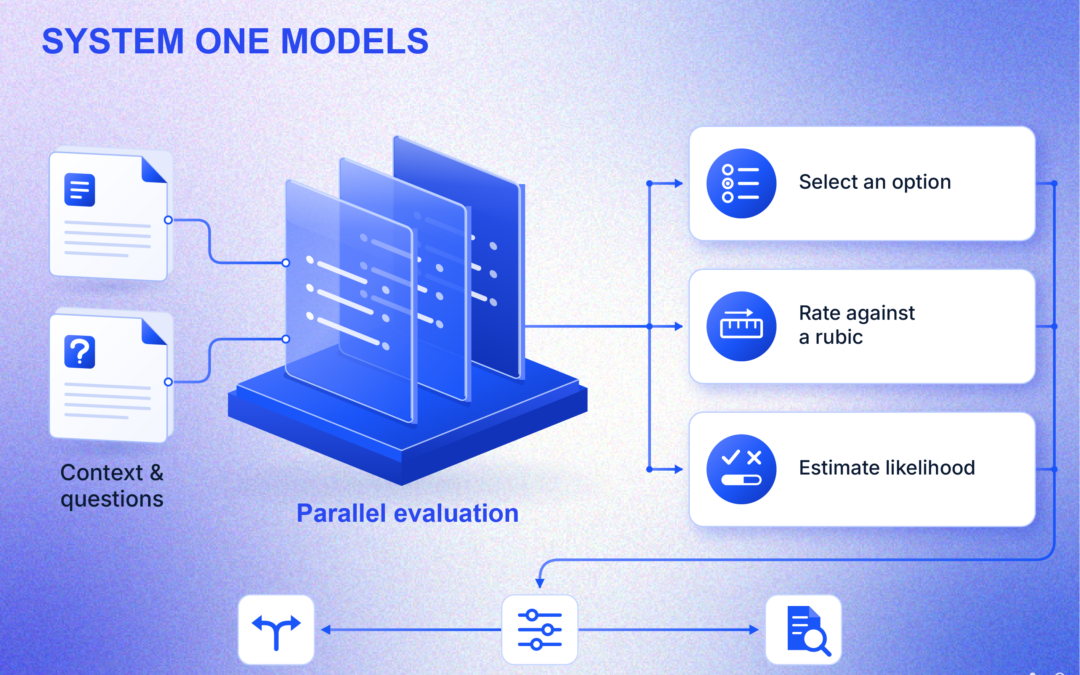
System One Models: A Technical and Enterprise Architecture Deep Dive
A System One model is a proposed class of AI model optimized for fast, bounded judgments that software can consume directly.
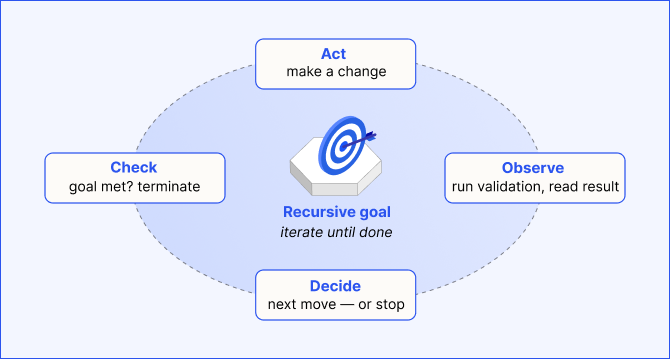
Loop engineering for AI agents: Building reliable autonomous systems
Loop engineering is the practice of designing, operating, and improving the feedback systems that let an AI agent plan, act, observe the results, and revise its approach until a goal is reached without a human driving every turn.
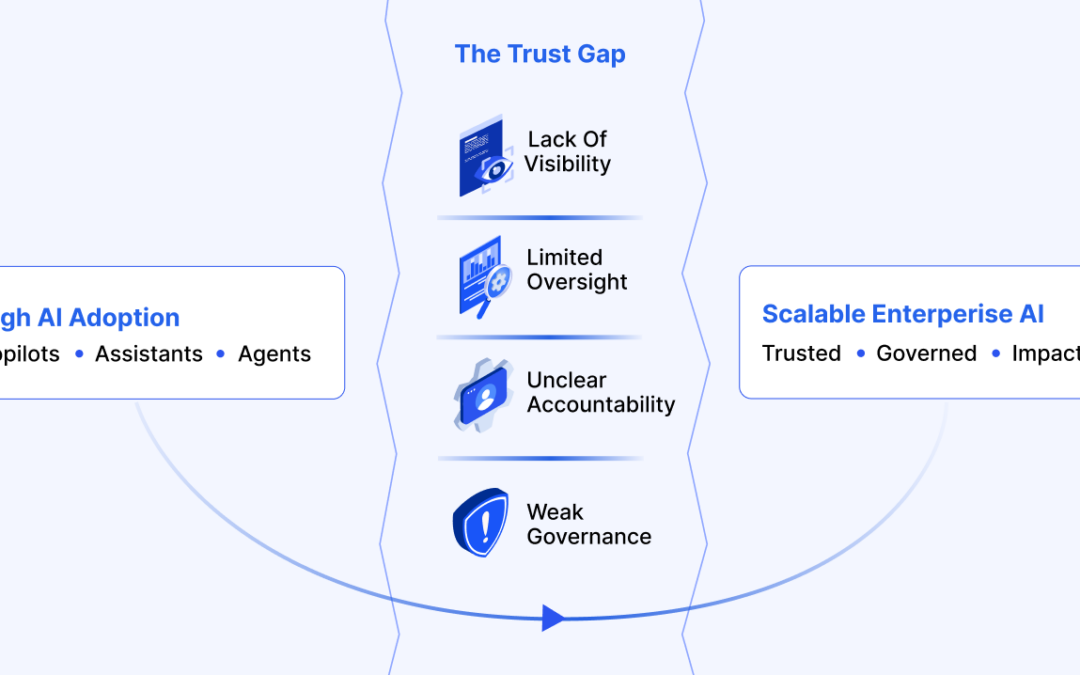
The AI trust gap: Why governance architecture determines enterprise value
The trust gap surrounding enterprise AI is fundamentally an architectural challenge, and its solution is increasingly well understood.
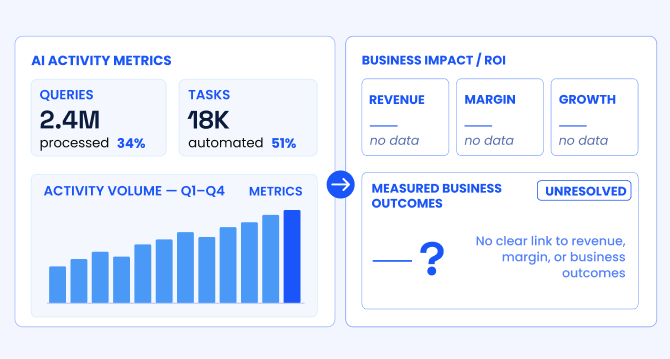
The AI ROI illusion: Why enterprises struggle to measure AI impact
Organizations with stronger measurement discipline are better positioned to link AI deployments to measurable business outcomes, prioritize high-impact use cases across the enterprise, allocate capital more effectively, and continuously refine models using real-world performance feedback.
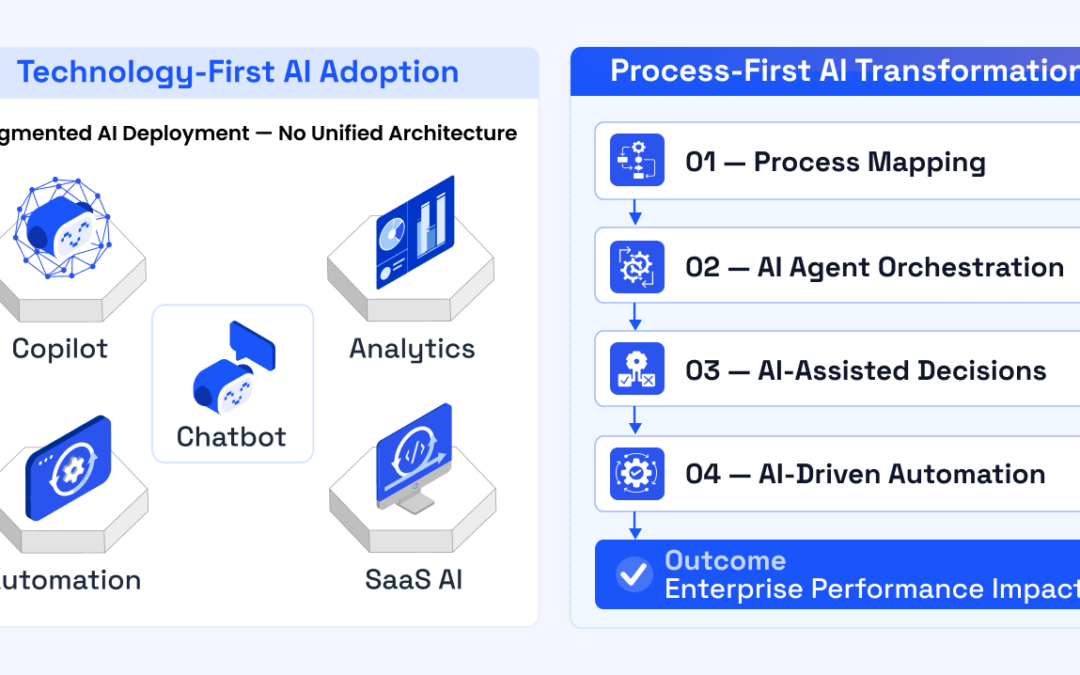
The agentic enterprise: Why AI success requires an operating model redesign
Organizations that redesign their operating models around agentic AI are beginning to outperform those that apply AI only incrementally.
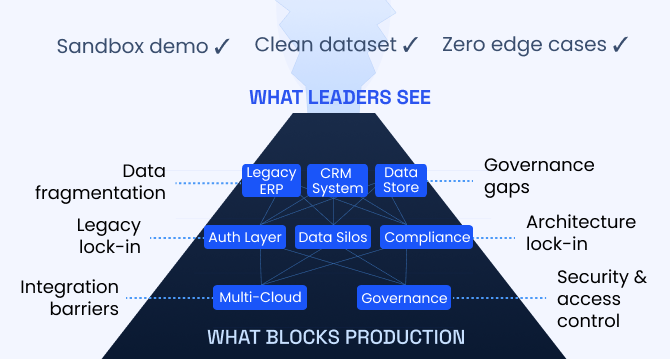
Enterprise AI pilot-to-production gap: Root causes & how to address them
The underlying cause is structural. In many enterprises, AI pilots are developed on infrastructure that was not designed to support production deployment.
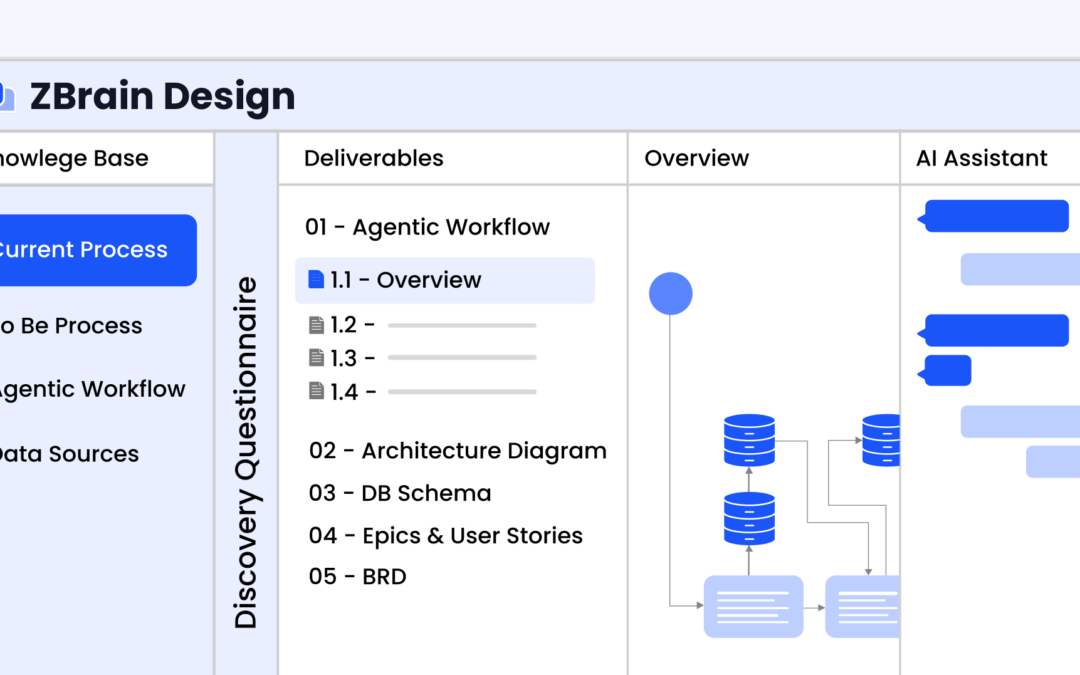
Solution architecture best practices: A guide for enterprise teams
The architecture design process culminates in a set of documented artifacts that communicate the solution to development, operations, and business teams.
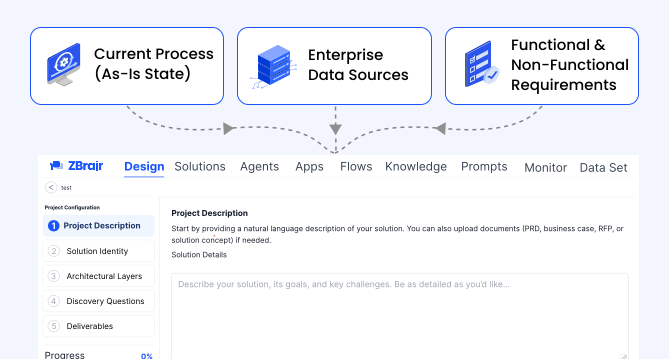
Common solution architecture design challenges and solutions
Solution architecture must evolve from fragmented documentation practices to a structured, collaborative, and continuously validated design capability.
Why structured architecture design is the foundation of scalable enterprise systems
Structured architecture design guides enterprises from requirements to build-ready blueprints. Learn key principles, scalability gains, and TechBrain’s approach.